Freehold vs Leasehold in UAE – What Expats Must Know


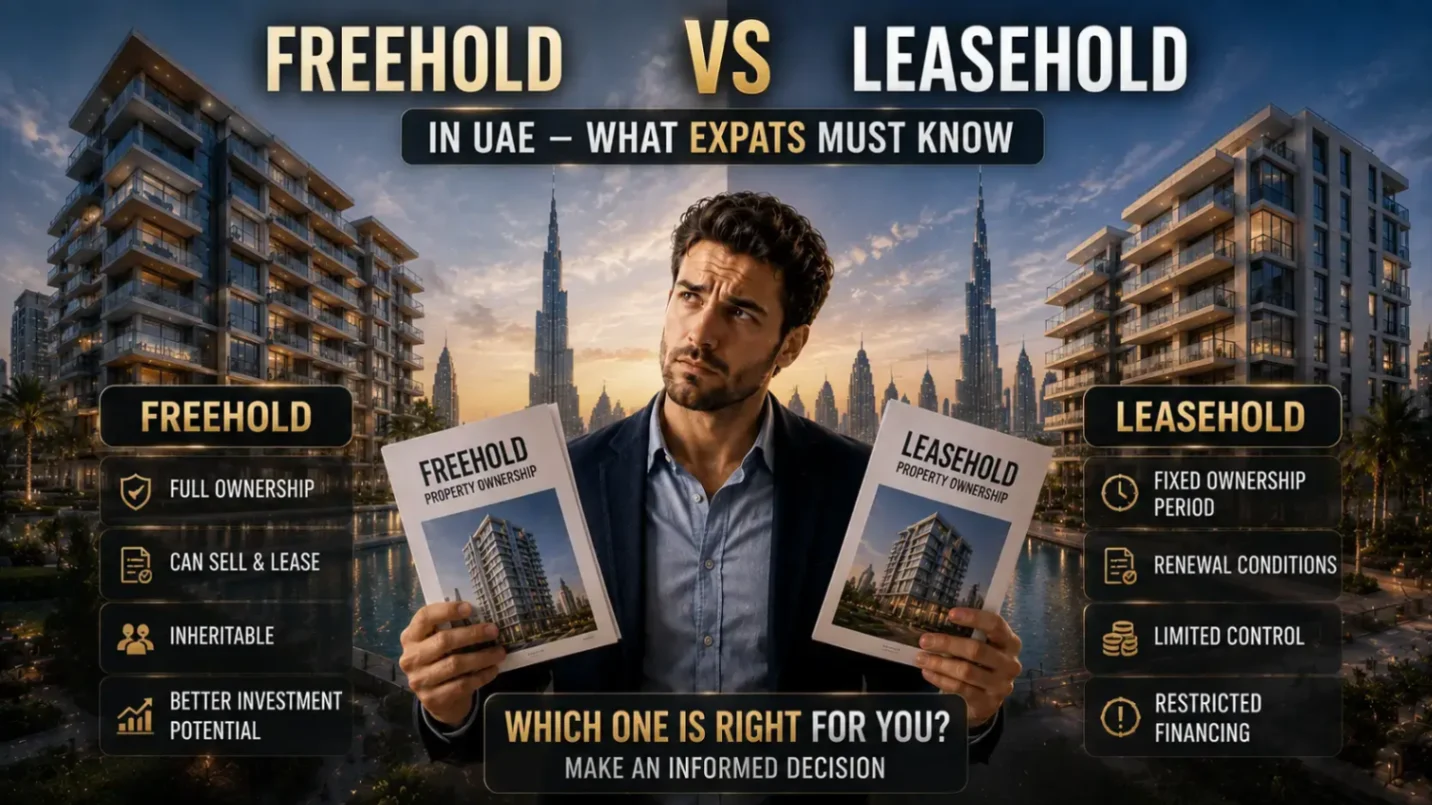
Buying property in the UAE is simple on the surface. But one decision changes everything—freehold or leasehold. Many expats don’t fully understand this before buying, and that leads to long-term problems.
This guide breaks it down in a clear way. We explain how both ownership types work, how they affect your control, your returns, and your exit options. More importantly, we show what most property sites don’t explain clearly.
Understanding Freehold Ownership
Freehold property gives you full ownership of the unit and the land linked to it. Once you buy, the property is fully yours.
You can sell it, rent it, or pass it to your family without restrictions. This is why most expats prefer freehold properties in areas like Dubai.
From an investor’s point of view, freehold gives long-term control and stability.
Understanding Leasehold Ownership
Leasehold gives you the right to use a property for a fixed period, usually between 30 and 99 years. You do not own the land. After the lease ends, ownership returns to the original owner.
You can still live in or rent the property during the lease period. But your rights are limited compared to freehold.
The Difference That Actually Matters
Most blogs stop at ownership. That is surface-level. The real difference shows over time.
Freehold properties are not tied to time. Their value depends on market demand, location, and quality.
Leasehold properties lose appeal as the lease period reduces. Buyers become cautious, and resale becomes harder.
This is where many investors get stuck.
Advantages and Disadvantages
Type | Advantages | Disadvantages |
Freehold |
|
|
Leasehold |
|
|
Legal Framework You Must Know
Property ownership in the UAE is regulated. Foreign buyers can purchase property in approved zones.
Freehold ownership is allowed in designated areas set by authorities. These areas are open to expats for full ownership.
Leasehold agreements are governed by contract terms. The duration, rights, and renewal conditions depend on the agreement signed with the developer or landowner.
The Dubai Land Department handles property registration and ensures legal ownership is recorded. If you don’t understand the legal side, you are relying on assumptions—and that is risky.
Popular Areas for Freehold Properties
Freehold areas attract both investors and end-users.
Popular locations include:
These areas offer strong demand, better resale potential, and steady rental income.
Where Leasehold Still Exists
Leasehold is more common in certain parts of Abu Dhabi and older developments. These properties can still attract buyers, but demand is more limited.
This is why location matters even more with leasehold.
Checkout apartments for sale in Abu Dhabi from our website to explore more on leasehold and freehold properties.
The Hidden Factor Competitors Miss
Here is what most websites avoid saying. Your ownership type decides who will buy from you later.
Freehold attracts a wide audience. Investors and end-users both consider it. Leasehold attracts fewer buyers. Many avoid it because of time limits.
This reduces demand. Lower demand leads to:
slower sales
more price pressure
weaker negotiation power
This is not obvious at the start. But it becomes real when you try to exit.
What Expats Get Wrong
Most expats focus only on affordability.
They think: “This is within my budget, so it works.”
They ignore:
Will I be able to sell this easily?
How will this perform long term?
This is short-term thinking. A cheaper property is not always a better decision.
Cost Difference: What You Actually Pay
Price is where most buyers make fast decisions.
Leasehold properties usually cost less. This is why they attract first-time buyers or investors with limited budgets. At first glance, it looks like a smart way to enter the market.
But lower price comes with trade-offs. As the lease period reduces, the value may not grow at the same pace as freehold properties. This affects both resale and long-term returns.
Freehold properties cost more upfront. But they tend to hold value better because there is no time limit on ownership. Buyers are more confident when there are no restrictions on duration.
Another point most buyers miss is financing. Banks are usually more comfortable with freehold properties. This can make it easier to get a mortgage and better terms compared to some leasehold properties.
So the real question is not just what you pay today. It is how that cost performs over time.
Real Example: How This Decision Plays Out
Consider two buyers with similar budgets.
One buys a cheaper leasehold unit. The other stretches slightly and buys a freehold property in a strong area. After a few years, both decide to sell.
The freehold property attracts more buyers. It sells faster and holds its value better. The leasehold property takes longer to sell. Buyers negotiate harder because of the remaining lease period.
Both buyers entered the market. But only one had flexibility at exit. This is where the difference becomes real.
Which One Should You Choose?
If your goal is long-term investment, stable value, and easier resale, freehold is the stronger choice.
If your goal is short-term use or lower entry cost, leasehold can work—but only with a clear plan.
If you are choosing based only on price, you are ignoring risk.
Final Thoughts
Freehold and leasehold are not just legal terms. They shape your entire investment outcome. Freehold gives you control, stability, and stronger resale demand. Leasehold gives you lower entry cost but comes with limits that affect long-term value.
At PropertySeller, we focus on clarity and trust. Your data stays secure. You get real and verified details with no hidden gaps. Every listing is checked to ensure your search stays clean and reliable.
This helps you make decisions based on facts, not assumptions.
FAQ’s
1. Can expats buy freehold property in the UAE?
Yes, expats can buy freehold property in approved areas with full ownership rights.
2. Is leasehold property safe to buy in the UAE?
Yes, but only if you understand the lease terms, duration, and resale limitations.
3. Which is better for long-term investment?
Freehold is usually better due to stronger resale value and long-term stability.
4. Do leasehold properties lose value over time?
They can become less attractive as the lease period reduces, which affects demand.
5. Can leasehold property be renewed?
In some cases, yes. But renewal terms depend on the original agreement.
6. Are freehold properties more expensive?
Yes, they usually cost more upfront but offer better long-term value.