Renting vs Buying Apartment in UAE: Which Saves More Money?


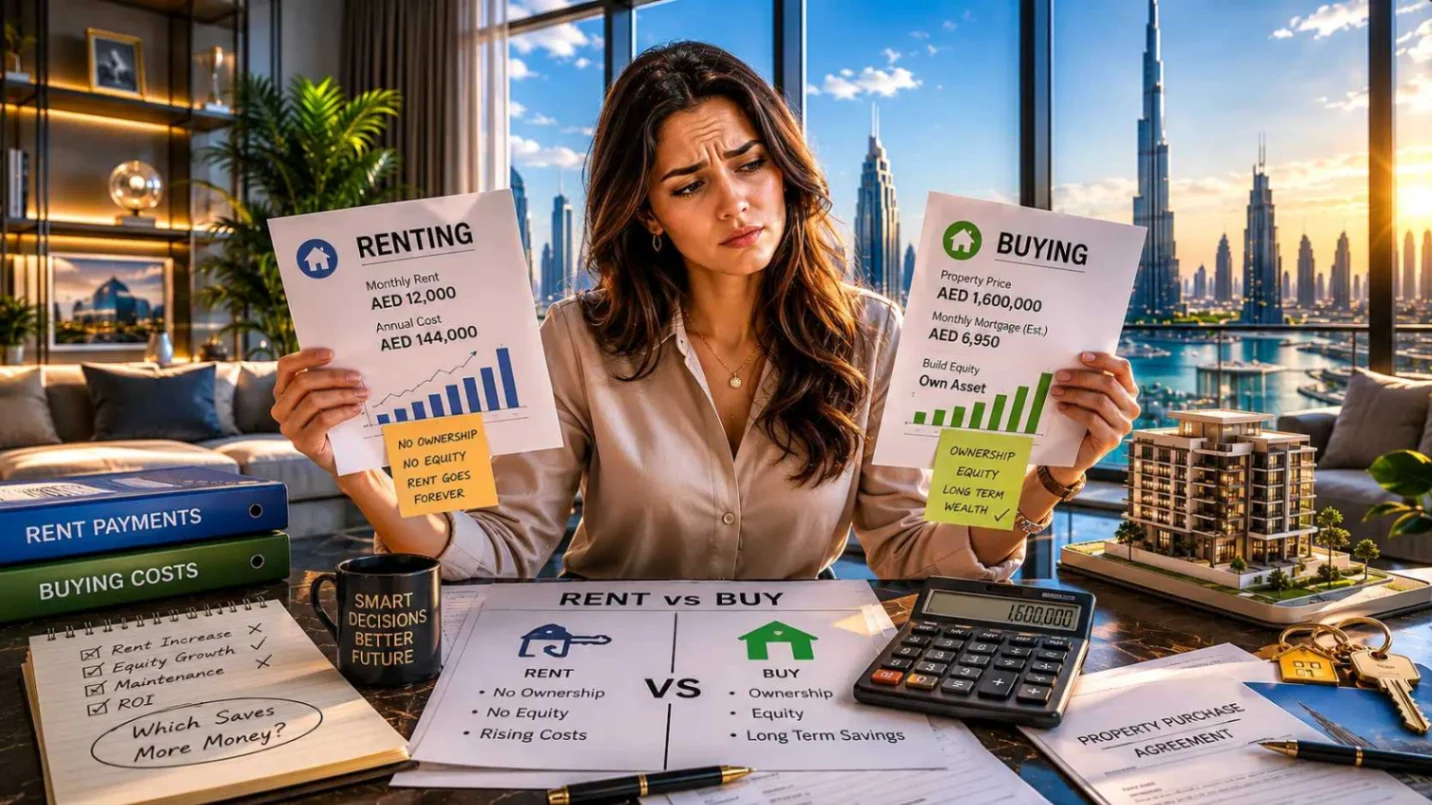
If you’ve been living in the UAE for a while, this question doesn’t just pop up once—it keeps coming back. You see rents going up every year. You hear people saying “just buy, it’s cheaper.” Then someone else tells you buying is risky. And you’re stuck in between, not really sure what makes sense.
This blog is here to clear that confusion. Not by throwing random pros and cons at you, but by actually breaking down what you’re paying, what you’re gaining, and where people usually get it wrong.
Renting vs Buying in UAE: What Are You Actually Paying For?
Let’s simplify this first, because most people overcomplicate it.
When you rent, you’re paying for convenience. You get a place to live, you don’t worry about long-term commitment, and you can move whenever your situation changes. But that’s where it ends. There’s no return on that money. Every payment resets to zero.
Buying, on the other hand, feels heavier in the beginning. More paperwork, more money upfront, more responsibility. But the difference is simple—part of what you pay every month is not an expense. It’s ownership. That one shift is what makes this decision important.
The Upfront Cost That Scares Everyone
This is usually the point where people stop even considering buying. And honestly, it’s understandable.
When you rent, you might pay a deposit and some fees. It’s manageable.
But when you buy in the UAE, you’re looking at:
Around 20% down payment
4% Dubai Land Department fee
Agency fees and other charges
It’s a big amount. No point sugar coating it. But here’s where people make a mistake—they treat this as a loss, not a shift. That money isn’t disappearing. It’s moving into an asset.
Monthly Payments: Where Things Start Getting Interesting
Now comes the part most people don’t expect. In many areas across the UAE today, the monthly mortgage you pay is not very different from rent. Sometimes it’s slightly higher. Sometimes it’s almost the same.
So if you step back and look at it: You’re either:
Paying rent that increases over time
Or paying a mortgage that slowly builds ownership
This is where the decision starts becoming less about affordability and more about direction.
How Banks Actually Decide What You Can Afford
Before you get too far into the idea of buying, there’s one rule you need to understand. Banks in the UAE don’t just give loans based on what you want. They look at what you can handle.
The key factor is your Debt Burden Ratio.
In simple terms, your total monthly loan payments cannot cross 50% of your salary. So if you earn AED 12,000, your total EMI commitments should stay below AED 6,000. And this includes everything—car loans, credit cards, personal loans.
This is why two people with the same salary can end up qualifying for completely different properties.
When Buying Starts Making Sense (And When It Doesn’t)
This is the part most blogs avoid being clear about. Buying does not save you money immediately. In fact, in the first few years, renting is usually cheaper. But over time, things shift.
If you stay:
Less than 3 years → renting almost always makes more sense
Around 3–5 years → you’re in a grey zone
Beyond 5 years → buying starts working in your favour
Why – Because the upfront costs get spread out, and you’re no longer starting from zero every year.
The Part Nobody Explains Properly
Here’s something most blogs either ignore or oversimplify.
When you buy, your money is locked into the property. When you rent, that same money stays with you. So technically, you could invest it somewhere else and grow it.
But let’s be honest for a second.
Most people don’t do that. They don’t invest consistently. They don’t track returns. The money just… goes. So what sounds like a “smart financial strategy” on paper doesn’t actually happen in real life.
That’s why for many people, buying works—not because it’s perfect, but because it forces discipline.
Where People Usually Go Wrong
They try to turn this into a yes-or-no decision. It’s not. It depends on how stable your life is right now.
If your job is uncertain, or you’re not sure how long you’ll stay in the UAE, buying can become a burden. But if you’re settled, planning to stay, and tired of unpredictable rent increases, continuing to rent might quietly cost you more over time.
Starting Apartment Prices Across UAE
Before deciding whether to rent or buy, it helps to understand the entry-level pricing across different emirates. Here’s a simple overview of where the market currently starts:
Emirate | Starting price |
From AED 450,000 | |
From AED 400,000 | |
From AED 350,000 | |
From AED 200,000 | |
From AED 300,000 | |
From AED 280,000 | |
From AED 250,000 |
Dubai and Abu Dhabi come with stronger demand and higher pricing, while emirates like Ajman or Sharjah offer much lower entry points—especially for first-time buyers.
Average Apartment Prices in Popular Dubai Areas
Now let’s narrow it down further, because within Dubai itself, prices vary significantly depending on location. Here’s a realistic snapshot:
Area | Average Price Range |
AED 1.1M - 1.4M | |
AED 900K - 1.1M | |
AED 1.1M - 1.3M | |
AED 600K - 700K | |
AED 550K - 650K |
This is where your decision becomes practical. You’re not choosing between “rent vs buy” in general—you’re choosing based on what you can realistically enter.
The Costs People Forget to Include
This is where planning usually breaks. People calculate property price and EMI—but forget everything else. You’ll also need to account for:
Government fees
Registration charges
Mortgage processing costs
Property valuation
Ignoring these doesn’t make them disappear. It just creates stress later.
So… What Should You Actually Do?
If you’re looking for a clean answer, here it is:
Renting is easier in the short term
Buying becomes smarter in the long term
But only if your situation supports it.
If you rush into buying without stability, it backfires. If you keep renting without thinking long-term, you stay stuck.
Conclusion
In reality, the rent vs buy decision is rarely black and white. Market conditions, interest rates, personal stability, income growth, visa plans, and long-term goals all play a role. What looks cheaper today can become expensive over time, and what feels like a heavy commitment now can turn into stability and equity later.
At PropertySeller, we’ve seen both sides—people who bought too early, and people who waited too long. Both end up with the same feeling: “I should have thought this through better.” That’s why our approach is simple. We don’t push you to buy. We don’t tell you to keep renting. We look at your situation, your numbers, and your plans—and help you make a decision that actually makes sense for you.
FAQ’s
Is it cheaper to rent or buy in the United Arab Emirates?
It depends on your timeline. Renting is cheaper short-term, while buying can save more over time if you hold the property long enough.
How long should I stay in Dubai to make buying worth it?
Typically 4–6 years, but the exact break-even depends on price, rent, and financing—not a fixed rule.
Are mortgage payments lower than rent in Dubai?
In some areas, yes. Mortgage payments can be similar to rent, especially with current market conditions.
What upfront costs do buyers need to plan for?
Down payment, registration fees, agency fees, and mortgage-related costs—usually around 25–30% of property value.
Is renting safer than buying?
Renting offers flexibility and lower risk if your future plans are uncertain. Buying carries commitment but builds long-term value.