Learn, Discover, Invest
Explore helpful reads, market perspectives, and property insights to help buyers stay informed.
Explore helpful reads, market perspectives, and property insights to help buyers stay informed.



Dubai's real estate market continues to attract homebuyers, investors, and expatriates from around the world. With thousands of apartments, villas, townhouses, and commercial properties available, finding the right property has become much easier thanks to real estate apps. Whether you're searching for your first home, comparing investment opportunities, looking for rental properties, or managing your existing portfolio, the right app can save time and help you make informed decisions. However, not every property app offers the same experience. Some focus on rental listings, while others provide detailed investment insights, mortgage tools, or verified property data. Choosing the right platform depends on your goals and the level of transparency you expect during your property search. In this guide, we compare the best real estate apps in Dubai for 2026, highlighting their strengths, ideal users, and features so you can decide which one best fits your property journey. Why Use a Real Estate App in Dubai? The traditional property search process has evolved significantly. Instead of relying solely on property agents or newspaper listings, buyers and investors now use mobile applications to compare properties, receive instant alerts, estimate mortgage payments, and explore neighborhoods before making decisions. A good real estate app helps users: Browse thousands of available properties Compare prices across different communities View property images and details Calculate mortgage payments Estimate rental income Save favourite properties Receive alerts for new listings Connect with property consultants Research investment opportunities For investors especially, having access to reliable property information can make the difference between a successful investment and an expensive mistake. What Makes a Good Real Estate App? With numerous property platforms available in the UAE, it's important to know what separates an average app from one that genuinely helps buyers make informed decisions. Here are the features worth looking for: Verified Property Listings Outdated or duplicate listings waste valuable time. A trustworthy app should display genuine and regularly updated properties. Transparent Property Information Clear pricing, property specifications, payment plans, developer details, and community information help buyers avoid surprises later. Advanced Search Filters Searching by location, price, bedrooms, property type, developer, completion status, and amenities makes the process much easier. Mortgage Planning Tools Mortgage calculators and eligibility checkers allow buyers to estimate monthly payments before committing to a purchase. Rental Investment Analysis Investors benefit from rental income estimators that help calculate potential returns before buying. User-Friendly Experience Fast loading, simple navigation, saved searches, and instant notifications improve the overall experience. Strong Data Privacy Users often share personal details while enquiring about properties. A secure platform should protect user information throughout the buying process. Top 5 Real Estate Apps in Dubai (2026) 1. PropertySeller – Best for Verified Property Buying & Smart Investment Decisions PropertySeller is designed specifically for serious property buyers and investors who value transparency, verified information, and smarter decision-making. Unlike traditional marketplaces that often contain duplicate or outdated listings, PropertySeller focuses on providing a cleaner property search experience through a rigorous multi-level verification process. Every listing goes through multiple verification checks, helping users avoid duplicate listings and inaccurate property information. This allows buyers to compare genuine opportunities without spending unnecessary time filtering repeated advertisements. Another key advantage is PropertySeller's commitment to transparency. Buyers receive clear and accurate property information without hidden surprises, making it easier to evaluate properties based on facts rather than marketing claims. Privacy is another area where PropertySeller stands out. Personal information remains protected throughout the buying journey, giving users confidence when making enquiries or sharing their details. Beyond property listings, PropertySeller offers several practical tools that help buyers and investors plan their finances before making a purchase: Mortgage Calculator Mortgage Eligibility Checker Rental Income Calculator These tools help users estimate monthly mortgage payments, understand financing eligibility, and evaluate potential rental returns before investing. Best For: Property buyers Real estate investors First-time buyers Users looking for verified listings Buyers who value transparency and financial planning 2. Property Finder Property Finder remains one of Dubai's most recognised real estate platforms. It offers an extensive selection of residential and commercial properties across Dubai and the wider UAE. Users can search properties using filters such as location, price range, bedrooms, amenities, and property type. The platform also includes community guides, property alerts, and agent contact options. Its large inventory makes it suitable for buyers and renters looking to compare multiple options across different areas. Key Features Extensive property inventory Buy and rent listings Interactive map search Saved searches Instant property alerts Community guides Best For: Buyers wanting a large selection Renters Families relocating to Dubai 3. Bayut Bayut has become another popular property platform in the UAE thanks to its detailed community information and property search capabilities. One of Bayut's strengths is helping users understand neighbourhoods before making a purchase. Buyers can explore schools, healthcare facilities, transportation links, shopping centres, and lifestyle amenities within different communities. The app also offers useful search filters and market information, making it suitable for both end-users and investors researching different areas. Key Features Area guides Property search filters Community insights Market trends Buy and rent listings Lifestyle information Best For: Families Relocating professionals Buyers researching communities 4. Dubizzle Dubizzle is widely known as a classifieds marketplace where users can browse everything from vehicles to electronics and real estate. Within property, users can explore apartments, villas, townhouses, and commercial spaces listed by agencies and, in some cases, directly by owners. This variety offers buyers and renters a broad selection of properties across different price ranges. Because listings come from multiple sources, users should carefully verify property details and documentation before proceeding with any transaction. Key Features Large property database Direct owner listings Buy and rent options Budget-friendly properties Wide location coverage Best For: Budget-conscious buyers Renters Users seeking owner-listed properties 5. Betterhomes Betterhomes has established itself as one of Dubai's well-known real estate brokerages, particularly in the premium residential segment. Its app and digital platform allow users to browse apartments, villas, townhouses, and luxury homes while connecting directly with experienced property consultants. The platform places a strong emphasis on personalized guidance throughout the buying process, making it particularly useful for buyers looking for professional assistance rather than simply browsing listings. Key Features Premium residential properties Experienced property consultants Luxury homes Property search filters Buyer support Best For: Luxury buyers High-value investors Buyers seeking personalised advice Comparison of Dubai's Best Real Estate Apps App Buying Renting Verified Listings Investment Tools PropertySeller ✔ Focus on buying & selling Multi-level verification Rental Income Calculator Property Finder ✔ ✔ Extensive marketplace Limited Bayut ✔ ✔ Large Inventory Market Insights Dubizzle ✔ ✔ Varies by listing source No Betterhomes ✔ Limited Agency-managed listings Limited Which Real Estate App Is Best for Different Users? Not every buyer has the same goals. Choosing the right app depends on what you're trying to achieve. First-Time Buyers First-time buyers often need financial planning tools alongside reliable listings. PropertySeller's mortgage calculator and eligibility checker make it easier to understand affordability before beginning the buying process. Property Investors Investors need more than attractive listings. Rental income estimates, verified property information, and transparent pricing help evaluate long-term returns more effectively. Families Families relocating to Dubai usually benefit from apps that provide neighbourhood guides, nearby schools, hospitals, parks, and lifestyle information. Luxury Buyers Buyers searching for premium villas, penthouses, and waterfront homes often prefer platforms supported by experienced luxury property consultants. Renters Rental-focused users generally benefit from apps with extensive inventories and flexible search filters that allow quick comparisons across different communities. Features Every Property Buyer Should Look For Before downloading any property app, consider whether it offers these essential features. Accurate Property Information Incomplete or outdated information can lead to poor decisions. Reliable property details help buyers compare options with confidence. Mortgage Planning Understanding your borrowing capacity before viewing properties saves time and narrows your search. Rental Return Estimation Investors should always estimate potential rental income before purchasing. Easy Property Comparison The ability to compare multiple properties side by side simplifies decision-making. Saved Searches and Alerts Instant notifications ensure buyers never miss newly listed properties matching their preferences. Responsive Customer Support Questions often arise during property transactions, making responsive support an important feature. Tips for Using Property Apps Safely Although technology has simplified property searches, buyers should still exercise caution. Verify important property documents before making commitments. Compare multiple listings before deciding. Understand all purchase costs, including government fees and service charges. Research the surrounding community and future developments. Calculate mortgage affordability before booking a property. Avoid rushing into investments based solely on promotional offers. Use trusted platforms that provide transparent information and verified listings. Why Verified Listings Matter More Than Large Listing Numbers Many buyers assume that more listings automatically mean better choices. In reality, the quality of listings often matters more than quantity. Duplicate advertisements, outdated prices, and unavailable properties can waste valuable time and create confusion during the buying process. Buyers may unknowingly compare the same property listed multiple times by different agencies or enquire about homes that are no longer available. Verified listings improve the overall search experience by ensuring users spend their time evaluating genuine opportunities. This leads to more accurate comparisons, greater confidence, and a smoother buying journey. Platforms that prioritise verification and transparency also help reduce misinformation, allowing buyers to focus on properties that genuinely match their requirements. Final Thoughts Dubai's property market offers opportunities for first-time buyers, experienced investors, expatriates, and families alike. Choosing the right real estate app can significantly improve your property search by providing accurate information, useful financial tools, and a more efficient way to compare available options. While every platform has its strengths, buyers should look beyond the number of listings. Verified properties, transparent information, secure handling of personal data, and practical tools such as mortgage calculators and rental income estimators play an important role in making informed investment decisions. PropertySeller stands out by combining verified property listings with privacy-focused practices, transparent information, and smart financial planning tools that support buyers throughout their property journey. Whether you're purchasing your first apartment, expanding your investment portfolio, or simply exploring Dubai's property market, selecting the right platform is the first step toward making a confident and informed decision. Frequently Asked Questions 1. Which app is best for buying property in Dubai? PropertySeller is built for buyers who want access to verified properties, clear pricing, and reliable market information. Our platform helps you compare properties and make informed decisions throughout your buying journey. 2. Do these apps handle Ejari registration? Many property management platforms offer Ejari-related services, including contract preparation and registration. PropertySeller recommends confirming the available features with the provider, as services may vary between platforms. 3. Can I use these real estate apps if I live abroad? Yes. Most modern real estate platforms are cloud-based, allowing international buyers and property owners to browse properties and manage their investments remotely. PropertySeller also helps overseas buyers explore verified properties in Dubai with transparent information throughout the buying process. 4. How accurate are property valuations shown in these apps? Property values are generally estimated using recent market trends, transaction data, and comparable properties. At PropertySeller, we encourage buyers to use online valuations as a helpful guide while also carrying out proper due diligence before making a purchase. 5. Do these apps feature off-plan projects? Yes. Many Dubai real estate platforms showcase off-plan developments from leading developers. PropertySeller also helps buyers explore verified off-plan projects with clear property information, allowing them to compare opportunities that suit their investment goals. 6. Are all property listings on real estate apps verified? Not every platform follows the same verification process. At PropertySeller, we focus on verified property listings to help reduce duplicate and inaccurate listings, making it easier for buyers to explore genuine opportunities.
Jul 13, 2026
Read More
The UAE real estate market is open to local and foreign investors, but ownership is defined by legal structure—not assumptions. A property purchase in the UAE is not just a financial decision. It is a legal classification that determines what you can own, where you can own it, and how much control you actually have after purchase. UAE property laws directly affect where foreigners are permitted to buy property, whether ownership is freehold or time-limited leasehold, legal rights over sale, rental, and inheritance, dispute resolution and regulatory oversight, and risk exposure in off-plan and resale transactions. Many investors misunderstand this structure and assume that buying property automatically grants full, unrestricted ownership rights. In reality, ownership in the UAE is defined by jurisdiction, regulated by emirate-level authorities, and enforced through registered contracts and title systems. This blog breaks down the key UAE property laws every investor should understand in 2026, including ownership rules, freehold zones, escrow protection, registration procedures, and the legal risks that can impact both capital safety and long-term returns. 1. Freehold vs Leasehold: The First Legal Filter This is the most important legal distinction—and the most misunderstood. Freehold Ownership Freehold means: full ownership of property + land (in designated zones) no expiry date on ownership right to sell, lease, or inherit legally registered under land department records Freehold is not available everywhere. It only exists in government-designated zones. If you assume otherwise, your entire investment thesis is wrong. Leasehold Ownership Leasehold means: ownership for a fixed term (often 30–99 years) land remains with original owner or authority renewal is not guaranteed in all cases This is often marketed as “ownership,” but legally it is usage rights, not absolute ownership. Leasehold properties may have lower entry prices, but weaker long-term resale leverage. 2. Foreign Ownership Rules: Where Most Confusion Happens Foreign investors cannot buy anywhere in the UAE. Ownership depends on: emirate development zone property classification What is allowed: Freehold zones → full ownership rights Select leasehold zones → time-based rights What is NOT allowed: random land purchases outside designated areas assuming “all Dubai is freehold” (false) If you don’t check ownership eligibility before signing, the contract itself can become a liability. 3. Property Registration: Where Ownership Actually Becomes Real In the UAE, a signed contract is not ownership. Ownership is only valid after: registration with land department issuance of title deed Registration ensures: legal recognition of ownership protection against duplicate sales enforceability in disputes Without registration, you are holding a contract—not an asset. 4. Escrow Law: Protection That Is Often Misunderstood Off-plan property buyers rely on escrow protection. Here’s how it actually works: buyer payments go into regulated escrow accounts developer cannot freely access funds money is released based on construction milestones What investors incorrectly assume: That escrow guarantees: on-time delivery zero project failure risk It does not. It only protects fund misuse, not project delays or design changes. That distinction is critical. 5. Sales and Purchase Agreement (SPA): The Real Control Document The SPA is where most investors stop reading—and that’s a mistake. It defines: payment schedule penalties and delays handover conditions legal obligations of both parties Once signed, verbal promises become irrelevant. If it is not in the SPA, it does not exist legally. This is where many buyers lose negotiation power without realizing it. 6. Mortgage Laws: Limits You Before You Even Buy Financing in the UAE is structured, not flexible. Banks decide: loan amount based on property value buyer eligibility based on income down payment requirements credit risk assessment Your budget is not your control—it is bank-approved leverage. Many investors plan portfolios assuming full financing freedom. That is not how approvals work. 7. Service Charges: The Silent Long-Term Cost Every property comes with annual charges for: maintenance security facilities shared infrastructure High service charges can: reduce rental yield significantly make “cheap” properties expensive long-term affect resale demand Investors often calculate purchase price but ignore lifetime cost. That is a basic but costly mistake. 8. Legal Role of Brokers: Not All Are Equal Only licensed brokers can legally facilitate transactions. Their real function is: verify listings coordinate legal documentation assist in registration steps Not all brokers protect buyer interest equally. Some prioritize transaction closure over legal clarity. If you rely blindly on brokers, you are outsourcing risk control. 9. Key Legal Risks Investors Ignore This is where most losses actually happen: buying outside approved ownership zones assuming off-plan timelines are fixed ignoring service charge escalation skipping SPA review misunderstanding leasehold vs freehold rights relying on marketing over legal documents The UAE market is regulated—but it is also documentation-heavy. If it’s not written, registered, or approved, it has no legal weight. Conclusion UAE property laws are not barriers to investment. They are a framework that defines what you actually own, how secure your capital is, and how easily you can exit later. Most losses in this market don’t come from bad properties, but from misunderstanding the legal structure behind ownership, zoning rules, and developer obligations. At PropertySeller, the focus is not just on listing properties, but on helping buyers understand what is legally real before they commit, so decisions are based on clarity rather than assumptions or marketing noise. FAQ’s 1. What legal checks should I do before buying property in the UAE? You should confirm ownership type (freehold or leasehold), developer registration, title deed status, and any outstanding dues. PropertySeller highlights these details upfront so you don’t rely on assumptions or incomplete broker information. 2. Can foreigners fully own property in the UAE? Yes, but ownership is limited to designated freehold zones approved by UAE authorities. At PropertySeller, we only highlight properties that fall within legally eligible ownership areas so buyers can invest with clarity and confidence. 3. What is the most common legal mistake property investors make in the UAE? The biggest mistake is treating marketing information as legally binding. Many investors also overlook ownership classification and SPA terms. PropertySeller reduces this risk by emphasizing verified property details and clear legal categorization before any commitment is made. 4. How do I know if a property is legally eligible for foreign ownership? Ownership eligibility depends on the property’s location and classification. At PropertySeller, we ensure listings are verified against official freehold zone regulations so you only see properties you are legally allowed to buy. 5. Is the SPA (Sales and Purchase Agreement) negotiable in UAE property deals? Some clauses can be negotiated, but most terms follow developer or regulatory standards. PropertySeller encourages buyers to carefully review SPA terms before signing, as they override verbal commitments. 6. What is the safest type of property investment in terms of legal security? Fully registered freehold properties with completed title deeds offer the highest legal clarity. PropertySeller prioritizes such properties for buyers seeking long-term stability.
Jun 26, 2026
Read More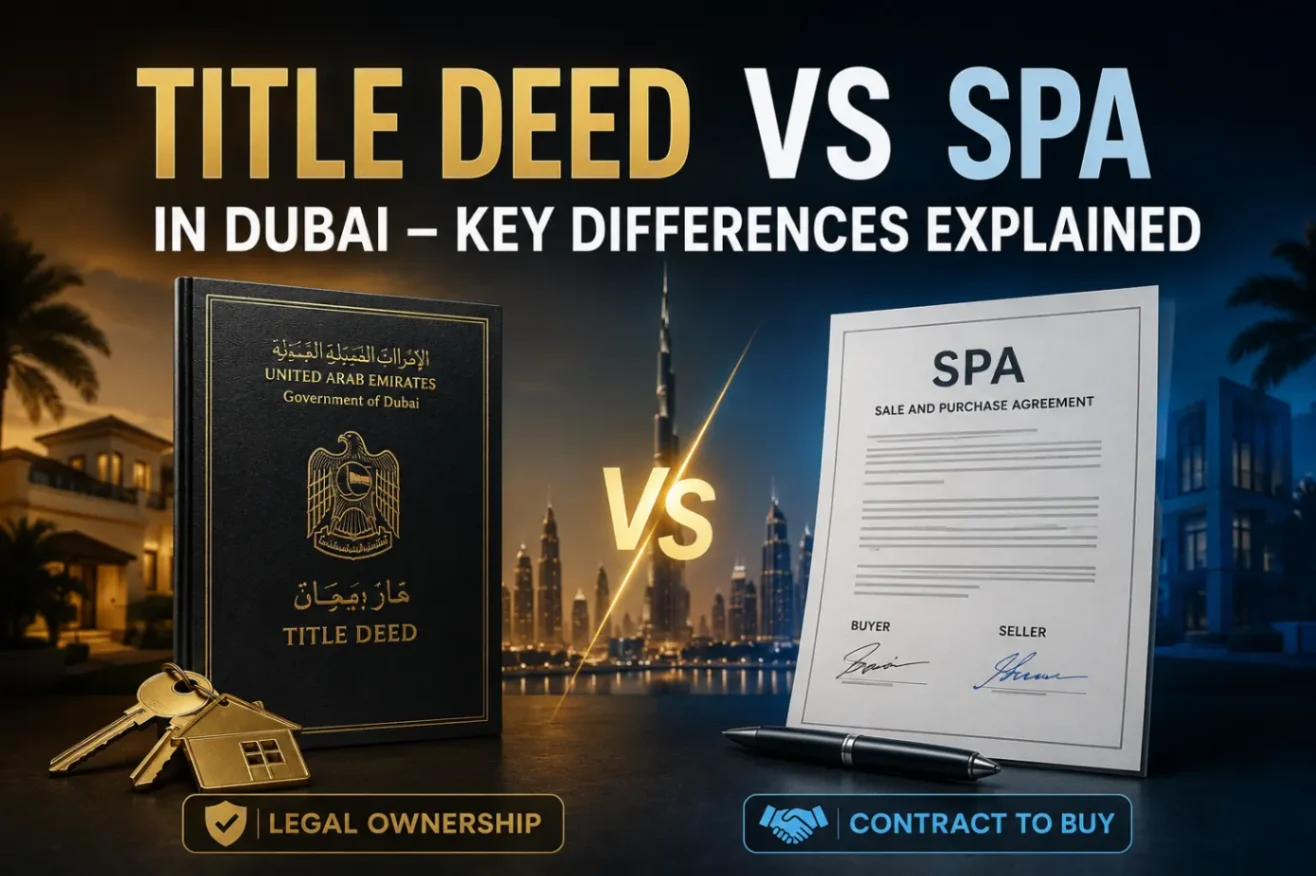
Many property buyers in Dubai assume that signing a contract means they already own the property, but this is not correct and can sometimes lead to financial and legal risk. In Dubai real estate, the Sale and Purchase Agreement (SPA) and the Title Deed represent two different stages of the ownership process, and only the Title Deed confirms legal ownership. The SPA is a binding contract that outlines the terms of the purchase, while the Title Deed is the official government-issued document that proves ownership has been fully transferred. Understanding this difference is important because it determines whether you truly own the property or only hold a contractual right to purchase it. This guide explains the key difference between SPA and Title Deed, how each stage works in the property transaction process, and what buyers must understand to avoid costly mistakes and misinterpretations during ownership transfer. What is a Sale and Purchase Agreement (SPA)? A Sale and Purchase Agreement (SPA) is a legally binding contract between the buyer and the seller or developer that sets out the terms of the property transaction. It includes details such as the purchase price, payment schedule, delivery timeline for off-plan properties, penalties for delays or breaches, and the responsibilities of both parties. In simple terms, the SPA is a commitment document, not proof of ownership. Once it is signed, it becomes legally enforceable, even if circumstances or expectations change later. At this stage of the process, the buyer does not yet own the property but is considered a contractual buyer under agreed terms. What is a Title Deed in Dubai? A Title Deed in Dubai is the official legal document that proves ownership of a property and is issued by the land authority, the Dubai Land Department. It confirms that the property is registered in the buyer’s name and that ownership is officially recognized by the government. Unlike the Sale and Purchase Agreement (SPA), the Title Deed is not a contract or negotiation document—it is a formal record of ownership. In simple terms, without a Title Deed, there is no legal recognition of ownership, regardless of any agreement signed earlier. No Title Deed = No legal ownership recognition. SPA vs Title Deed: The Real Difference Most explanations stop at definitions. That’s where buyers stay confused. Here’s the actual distinction: Factor SPA Title Deed Legal Nature Contract Government ownership record When It Applies At purchase stage After registration Ownership Status No ownership yet Full legal ownership Enforceability Between parties Recognized by state Risk Level Higher Lower In simple terms, SPA = “I agree to buy” & Title Deed = “I legally own” When Does Ownership Actually Transfer? Ownership does not transfer when the Sale and Purchase Agreement (SPA) is signed, when the initial payment is made, or when a booking confirmation is issued. These steps only indicate progress in the transaction, not legal ownership. Ownership is transferred only when the property is officially registered with the land authority and the Title Deed is issued in the buyer’s name. Until this registration is completed, the developer or seller remains the legal owner of the property, regardless of any prior agreements or payments made. Why the SPA Is Critical in Off-Plan Property Deals For off-plan properties, the Sale and Purchase Agreement (SPA) becomes especially important because it sets out the construction obligations of the developer, the expected delivery timelines, and the payment schedule linked to project milestones. However, this is also where many buyers underestimate the risk. If there are delays, changes, or modifications to the project, the buyer’s rights are still governed strictly by the SPA terms, not by any ownership rights. While escrow regulations provide a layer of financial protection by securing buyer payments, they do not remove the contractual limitations or guarantee fixed delivery outcomes. Common Mistakes Buyers Make With SPA and Title Deed This is where money and disputes usually happen: assuming SPA = ownership not reading penalty clauses ignoring registration timelines misunderstanding handover conditions trusting verbal assurances over written terms At the core, the issue is simple — buyers treat marketing as ownership proof. It is not. Final Word: How Ownership Actually Works in Dubai Real Estate The SPA and Title Deed are not competing documents; they represent two different stages of the same legal process. The SPA is a binding agreement that defines the terms of the transaction, while the Title Deed is the official proof that ownership has been legally transferred through the relevant land authority. Confusing the two is one of the most common and costly mistakes in Dubai property transactions, often leading to unrealistic expectations about ownership rights and timelines. At PropertySeller, the focus is on helping buyers understand these legal distinctions before they commit to a purchase. Listings and guidance are structured to highlight ownership status, documentation requirements, and transaction clarity so investors are not relying on assumptions or incomplete information. Understanding the difference between SPA and Title Deed is not optional—it is the foundation of making safe, informed property decisions in the UAE. FAQ’s 1. Does signing an SPA mean I own the property in Dubai? No. At PropertySeller, we make this clear to buyers—the SPA only confirms a legal agreement to purchase a property under specific terms. Ownership is not transferred at this stage. 2. Who issues the Title Deed in Dubai? The Title Deed is issued by the Dubai Land Department after the property is fully registered and the transfer process is completed. 3. Can an SPA be cancelled after signing? An SPA is a legally binding document. Cancellation is only possible under the conditions stated in the agreement or as permitted under UAE property law. 4. Is a Title Deed required to resell a property? Yes. At PropertySeller, we emphasize that a property can only be legally resold once the Title Deed is issued and ownership is officially registered. 5. Can I sell an off-plan property after signing the SPA? In some cases, yes, but only subject to developer approval and specific conditions outlined in the SPA. 6. Which is more important—SPA or Title Deed? Both serve different purposes. The SPA governs the transaction, while the Title Deed confirms legal ownership after registration is completed.
Jun 26, 2026
Read More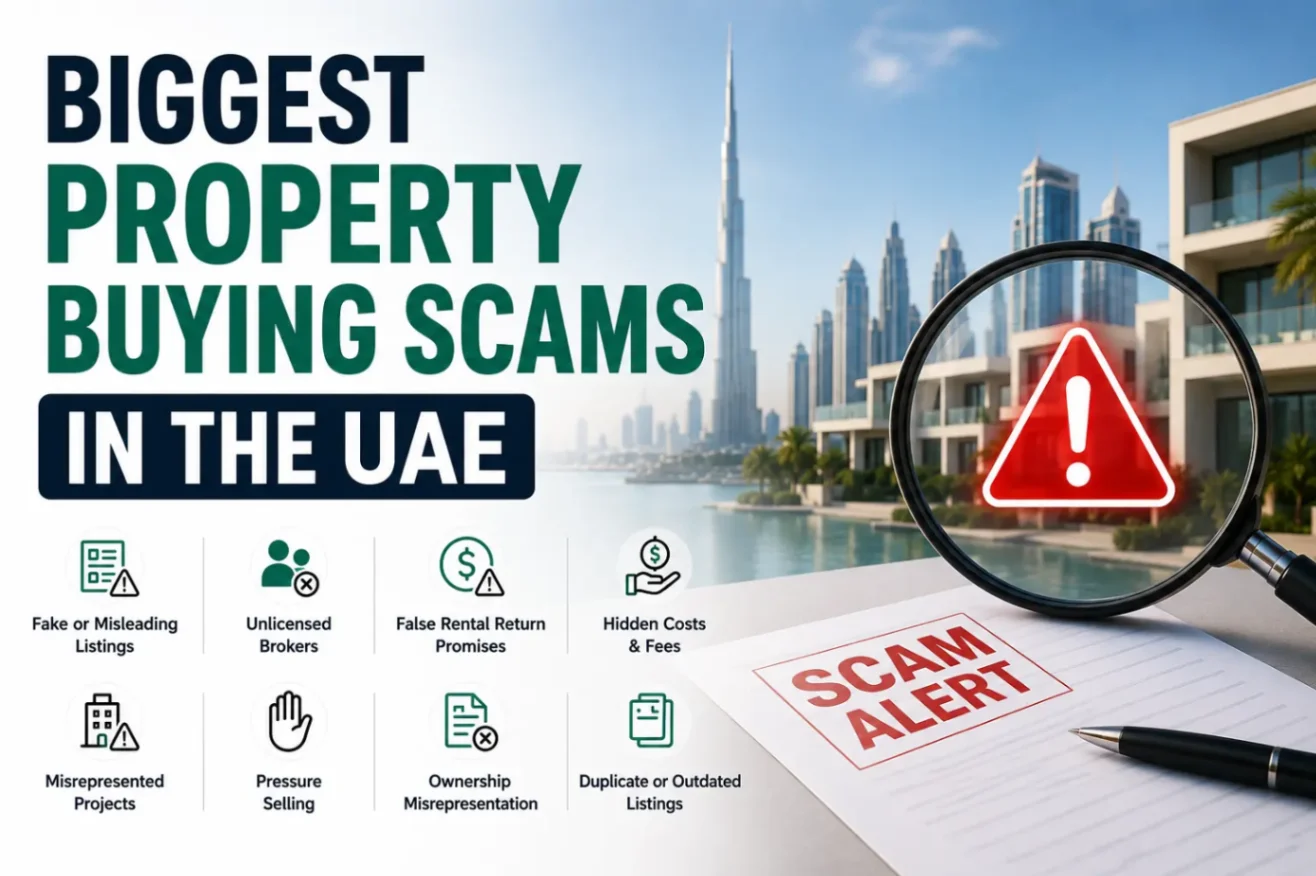
The UAE property market is one of the most regulated and transparent in the region, attracting investors from around the world. However, a regulated market does not automatically eliminate risk. Buyers can still face financial losses and legal complications if proper checks are overlooked. Most real estate scams in the UAE are not obvious cases of fraud. They often arise from misleading listings, unlicensed agents, unverified payment requests, incomplete documentation, or contractual terms that buyers do not fully understand. In many situations, the problem is not the property itself but the process surrounding the transaction. For this reason, experienced investors look beyond attractive prices and marketing promises. They verify the property's legal status, confirm approvals and registrations, review documentation carefully, and ensure payments follow the proper channels. This blog explains some of the most common real estate scams in the UAE, the warning signs buyers should watch for, and the practical steps that can help protect an investment. Fake or Misleading Property Listings Fake or misleading property listings are among the most common risks in the UAE real estate market. These listings may advertise properties that do not exist, show units that are no longer available, exaggerate sizes and features, or use images from other developments to attract interest. In many cases, unusually low prices are used to generate enquiries, only for buyers to be redirected to different properties later. Common warning signs include prices that are significantly below market rates, incomplete project information, and an unwillingness to provide registration details or property documentation. At PropertySeller, listings go through verification checks to help reduce these risks. The platform prioritizes accurate property information, removes duplicate entries, and focuses on verified listings so buyers can make decisions with greater confidence and transparency. Unauthorized Agents or Unlicensed Brokers In the UAE, property transactions should only be handled by licensed real estate brokers and registered agencies. Working with unlicensed intermediaries can expose buyers to significant risks, including invalid agreements, loss of deposits, and limited legal protection if disputes arise. This issue often occurs in high-demand markets, particularly in the off-plan segment, where some individuals attempt to operate informally without the necessary approvals or registrations. Buyers may be attracted by exclusive deals or promises of faster transactions without realizing the risks involved. Before proceeding with any property purchase, it is important to verify the broker's credentials and registration through the relevant real estate regulatory authorities. Taking this simple step can help ensure that the transaction is conducted through authorized channels and reduce the risk of avoidable financial and legal complications. Off-Plan Payment Misrepresentation Off-plan properties in the UAE are regulated by clear legal frameworks, but buyers can still face risks when payment terms are misrepresented. This can happen when payment plans are changed unofficially, construction milestones are presented inaccurately, or verbal promises of "guaranteed returns" and fixed completion timelines are used to influence decisions. The key reality for buyers is that returns and delivery schedules are only enforceable if they are clearly stated in the Sale and Purchase Agreement (SPA) and other official documents. Verbal assurances and marketing promises do not carry legal weight on their own. Before committing to an off-plan investment, buyers should carefully review all payment schedules, milestone conditions, and contractual terms and ensure that every promise is documented in writing and supported by the appropriate agreements. False "Guaranteed Rental Returns" Promises Promises of fixed rental returns are another common issue that buyers should approach with caution. Some sellers advertise guaranteed rental yields of 8% to 12% or promise a fixed income for several years to make an investment appear more attractive. In reality, rental performance in the UAE depends on several factors, including market demand, location, property type and condition, and changes in tenant demand and market cycles. Rental yields can fluctuate over time and are influenced by broader market conditions. Buyers should understand that no regulatory authority guarantees rental income from a property investment. Any claims of assured returns should be carefully reviewed and supported by clear contractual terms. Relying solely on marketing promises without proper verification can lead to unrealistic expectations and investment decisions based on assumptions rather than market fundamentals. Fake Title Deeds and Property Ownership Misrepresentation in the UAE Although uncommon, ownership misrepresentation can have serious consequences for buyers. In some cases, buyers may be shown outdated title deeds, properties that are involved in disputes, or units where ownership transfers have not been fully completed. A property is only legally owned when it is officially registered with the relevant land authority, such as the Dubai Land Department in Dubai. Before completing any payment, buyers should verify the property's ownership status and ensure that all documents accurately reflect the current legal position of the asset. Pressure-Based Selling Tactics Some buyers face high-pressure sales tactics, such as claims that a property is the "last available unit," that prices will increase immediately, or that multiple buyers are ready to proceed with the purchase. These tactics can create unnecessary urgency and encourage buyers to skip important verification steps. While market conditions can change, legitimate property transactions in the UAE should allow buyers enough time to review documentation, verify information, and make informed decisions without feeling pressured into committing quickly. Hidden Property Costs and Undisclosed Fees in UAE Real Estate Another common issue in property transactions is incomplete pricing disclosure. Buyers may receive an initial quotation that does not fully account for service charges, transfer fees, registration costs, or ongoing maintenance expenses. As a result, the actual cost of ownership can be significantly higher than expected. Understanding all associated costs in advance is essential for accurate budgeting, return calculations, and long-term investment planning. Duplicate or Re-Sold Units Without Disclosure In some cases, the same property may be listed by multiple agents, shown as available despite being under negotiation, or marketed without updated availability information. This can create confusion for buyers and may lead to booking conflicts or wasted time during the search process. Verifying a property's current status and working with reliable platforms can help reduce the risk of acting on inaccurate availability information. Property Buying Checklist to Avoid Real Estate Scams in the UAE Before making any payment: Verify the broker's licence and registration Confirm the property's ownership status Review the Sale and Purchase Agreement carefully Verify project approvals and payment structure Understand all fees and ownership costs Avoid relying on verbal promises Ensure all commitments are documented in writing How PropertySeller Helps Reduce These Risks At PropertySeller, the focus goes beyond displaying property listings. The platform is designed to reduce decision risk by prioritizing verified property information, clearly structured listing data, and up-to-date availability whenever possible. Duplicate and unconfirmed listings are minimized, and greater emphasis is placed on ownership clarity and legal status. The goal is to provide buyers with transparent information so they can evaluate opportunities with greater confidence and make decisions based on verified details rather than assumptions. Final Takeaway In the UAE property market, the biggest risk is not always outright fraud. More often, problems arise from misinformation, incomplete verification, or misunderstandings about legal processes and ownership. Many buyers do not lose money because of illegal activity. They face difficulties because they rely on marketing claims instead of documentation, overlook important verification steps, or misunderstand the legal structure behind a transaction. A careful approach that prioritizes verification, documentation, and transparency can eliminate many of these risks before they become costly problems. At PropertySeller, the focus is on making the buying process clearer and more reliable by prioritizing verified listings, reducing duplicate and unconfirmed entries, and highlighting ownership status and key property details. The goal is to help buyers make informed decisions based on accurate information and move forward with greater confidence and trust. FAQ’s 1. Are property scams common in the UAE? The UAE property market is highly regulated, but buyers can still face risks from misleading listings, unlicensed intermediaries, incomplete documentation, and misinformation. At PropertySeller, we focus on verified property information and greater transparency to help buyers reduce these risks. 2. How can I verify whether a property listing is genuine? Buyers should verify the property's ownership status, confirm project details, review supporting documents, and work with licensed brokers or trusted platforms. PropertySeller prioritizes verified listings and minimizes duplicate and unconfirmed entries to help buyers make informed decisions. 3. Is it safe to invest in off-plan property in the UAE? Yes, off-plan investments can be safe when projects are properly registered and payments follow regulated procedures. At PropertySeller, we encourage buyers to review all project details, payment schedules, and contractual terms carefully before committing. 4. Who regulates property transactions in Dubai? Property registration and many real estate activities in Dubai are overseen by the Dubai Land Department. Buyers should always ensure transactions are conducted through approved and properly documented channels. 5. How can I check if a real estate broker is licensed? Buyers should verify a broker's registration and credentials through the relevant real estate authorities before proceeding with any transaction. Working with licensed professionals helps reduce the risk of invalid agreements and financial disputes. 6. What should I do before making a property payment? Before making any payment, buyers should confirm ownership status, review all agreements and payment terms, understand the full cost of ownership, and ensure all commitments are documented in writing.
Jun 26, 2026
Read More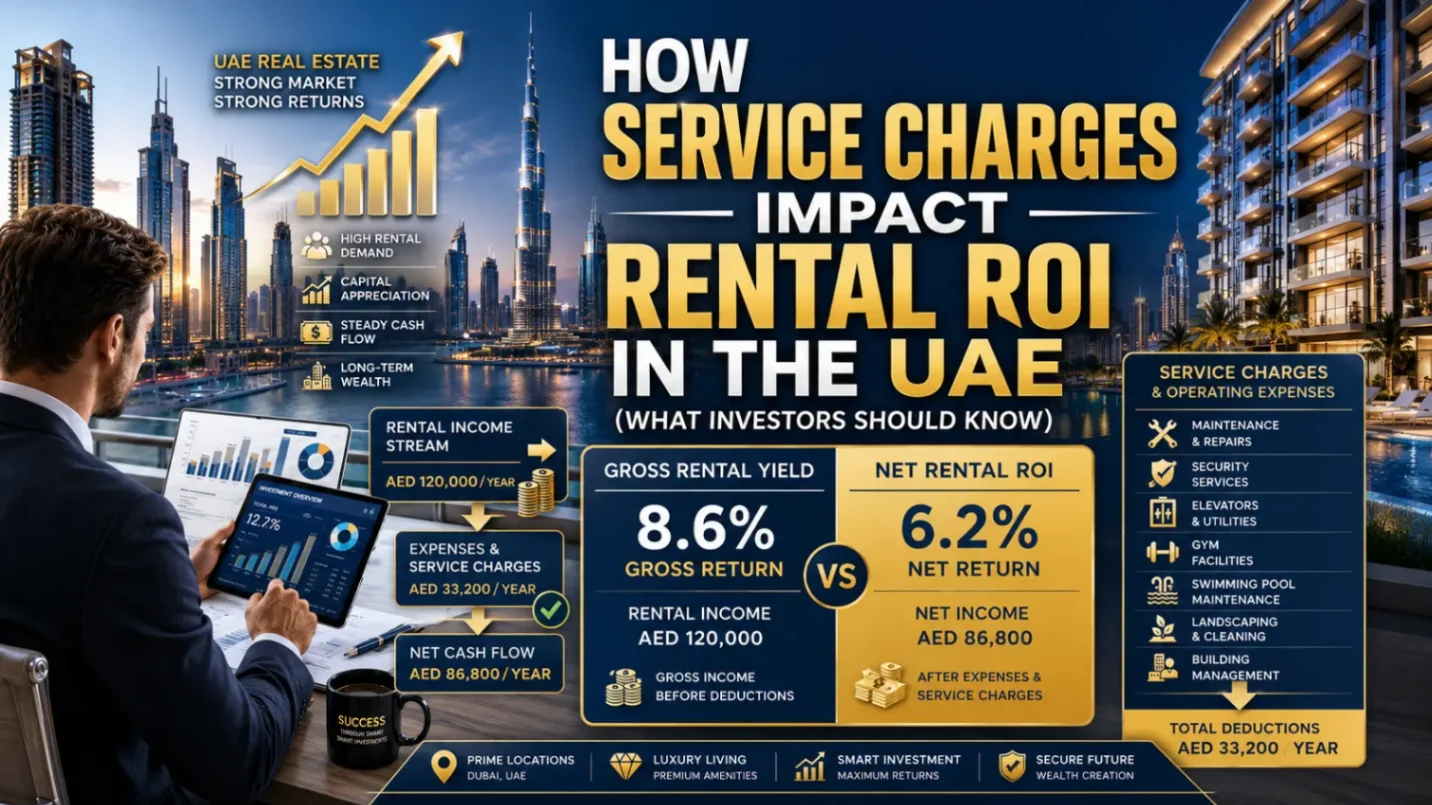
Rental yield is often one of the first figures investors look at when comparing properties in the UAE. A property advertising a 7% or 8% rental yield can seem like an excellent investment. However, many investors make the mistake of focusing only on gross rental income while overlooking one of the biggest ongoing ownership costs: service charges. Service charges can have a significant impact on your actual return on investment (ROI). Two apartments generating the same rental income may produce very different profits simply because one building has substantially higher annual maintenance costs. In this guide, we explain what service charges are, how they are calculated, how they affect your net rental yield and overall ROI, and the key factors investors should consider before buying an apartment in Dubai. What Are Service Charges? Service charges are annual fees paid by apartment owners to cover the maintenance and management of shared areas within a residential building or community. These charges typically contribute towards: Building maintenance Security services Cleaning of common areas Landscaping Swimming pools Gyms Elevator maintenance Building management Shared utilities The exact amount varies depending on the building, location, property size, and the amenities available. While service charges help maintain the quality of a development, they also represent an ongoing cost that directly affects investment returns. Gross Rental Yield vs Net Rental ROI Many property listings advertise gross rental yield. Gross yield is calculated using annual rental income before deducting ownership expenses. However, investors earn net returns, not gross returns. Net Rental ROI considers ongoing costs such as: Service charges Maintenance expenses Property management fees Insurance Vacancy periods Repair costs A property with a slightly lower rental income but lower annual expenses may generate a stronger overall return than one with a higher advertised yield. This is why experienced investors rarely rely on gross rental yield alone. How Service Charges Reduce Rental Returns Every dirham spent on annual service charges reduces your net rental income. For example, imagine two apartments generating similar annual rent. Apartment A has relatively low service charges, while Apartment B is located in a luxury building with premium amenities and significantly higher annual maintenance fees. Although both properties may produce similar rental income, Apartment A could deliver better cash flow because ownership costs are lower. This demonstrates why investors should evaluate both income and expenses before comparing opportunities. Do Higher Service Charges Always Mean a Poor Investment? Not necessarily. Higher service charges often support premium facilities that can increase tenant demand. Luxury developments may offer: Concierge services Fitness centres Swimming pools Children's play areas Landscaped gardens Enhanced security Resident lounges These features can make properties more attractive to tenants and may justify higher rents. The key question isn't whether service charges are high or low. It's whether the additional costs are supported by stronger rental demand, higher occupancy, or improved long-term value. Compare Buildings, Not Just Communities Many investors compare rental yields at the community level, but this approach can overlook important differences between individual buildings. Even within the same neighbourhood, ownership costs can vary significantly from one development to another. Service charges are influenced by factors such as the age of the building, the range of amenities provided, maintenance standards, construction quality, and the effectiveness of the building's management. Properties with extensive facilities or higher operating costs often carry higher annual service charges, which can reduce net rental returns. For this reason, evaluating building-specific ownership costs alongside rental income provides a more accurate picture of an investment's long-term performance than comparing communities alone. How Service Charges Affect Long-Term Cash Flow Rental income generates regular cash flow, but ongoing ownership expenses determine how much of that income is ultimately retained. Service charges are one of the largest recurring costs for apartment owners and should always be factored into investment calculations. Properties with lower annual service charges can contribute to stronger monthly cash flow, improved annual profitability, more predictable investment performance, and higher long-term net returns. Conversely, higher service charges can reduce profitability, particularly during periods of slower rental growth or increased operating costs. By understanding these expenses before purchasing, investors can create more realistic financial projections and compare investment opportunities based on net returns rather than headline rental yields alone. How Service Charges Affect Long-Term Cash Flow Rental income generates regular cash flow, but ongoing ownership expenses determine how much of that income is ultimately retained. Service charges are one of the largest recurring costs for apartment owners and should always be factored into investment calculations. Properties with lower annual service charges can contribute to stronger monthly cash flow, improved annual profitability, more predictable investment performance, and higher long-term net returns. Conversely, higher service charges can reduce profitability, particularly during periods of slower rental growth or increased operating costs. By understanding these expenses before purchasing, investors can create more realistic financial projections and compare investment opportunities based on net returns rather than headline rental yields alone. Balancing Service Charges with Investment Value Service charges are an important part of any investment analysis, but they should not be assessed in isolation. A property with higher annual fees may still deliver stronger overall returns if its location and quality support consistent demand. For example, buildings with strong rental demand, lower vacancy rates, higher tenant retention, premium locations, quality amenities, and solid resale potential can often justify higher service charges through better long-term performance. Likewise, selecting a property solely because it has the lowest service charges may not be the most effective strategy if it compromises rental appeal or future capital growth. The strongest investment decisions come from balancing ongoing ownership costs with a property's long-term income and appreciation potential. Conclusion Service charges are a key part of the total cost of owning an investment property in the UAE and can have a direct impact on your net rental returns. While they reduce annual income, they also help maintain the quality, safety, and long-term appeal of residential buildings and communities. Rather than focusing solely on advertised rental yields, investors should assess the complete financial picture. Comparing service charges alongside rental demand, occupancy levels, maintenance costs, and long-term growth potential provides a more accurate view of a property's investment performance. At PropertySeller, we help investors look beyond headline figures to evaluate the real profitability of a property. By considering both ongoing ownership costs and long-term market fundamentals, buyers can make more informed investment decisions with greater confidence. Frequently Asked Questions 1. How do service charges affect rental ROI in the UAE? Service charges reduce an investor's net rental income, which means they directly influence rental ROI. PropertySeller recommends calculating expected returns after accounting for annual ownership costs rather than relying solely on advertised rental yields. 2. Are higher service charges always bad for property investors? Not necessarily. Higher service charges often support premium amenities that can improve tenant demand and justify higher rental rates. PropertySeller advises investors to assess whether the added costs are matched by stronger rental performance and long-term value. 3. Should I compare service charges before buying an apartment? Yes. Service charges can vary significantly between buildings, even within the same community. PropertySeller helps buyers compare ownership costs alongside rental income and investment potential to make more informed decisions. 4. What costs should I include when calculating rental ROI? In addition to rental income, investors should consider service charges, maintenance, insurance, vacancy periods, property management fees, and financing costs. PropertySeller encourages buyers to focus on net returns rather than gross rental yield. 5. How can I estimate the potential return on an investment property? PropertySeller offers a Rental Income Calculator to estimate rental returns, a Mortgage Calculator to assess financing costs, and an Eligibility Checker to help buyers understand their purchasing power before investing. These tools provide a more complete view of an investment property's financial performance.
Jun 20, 2026
Read More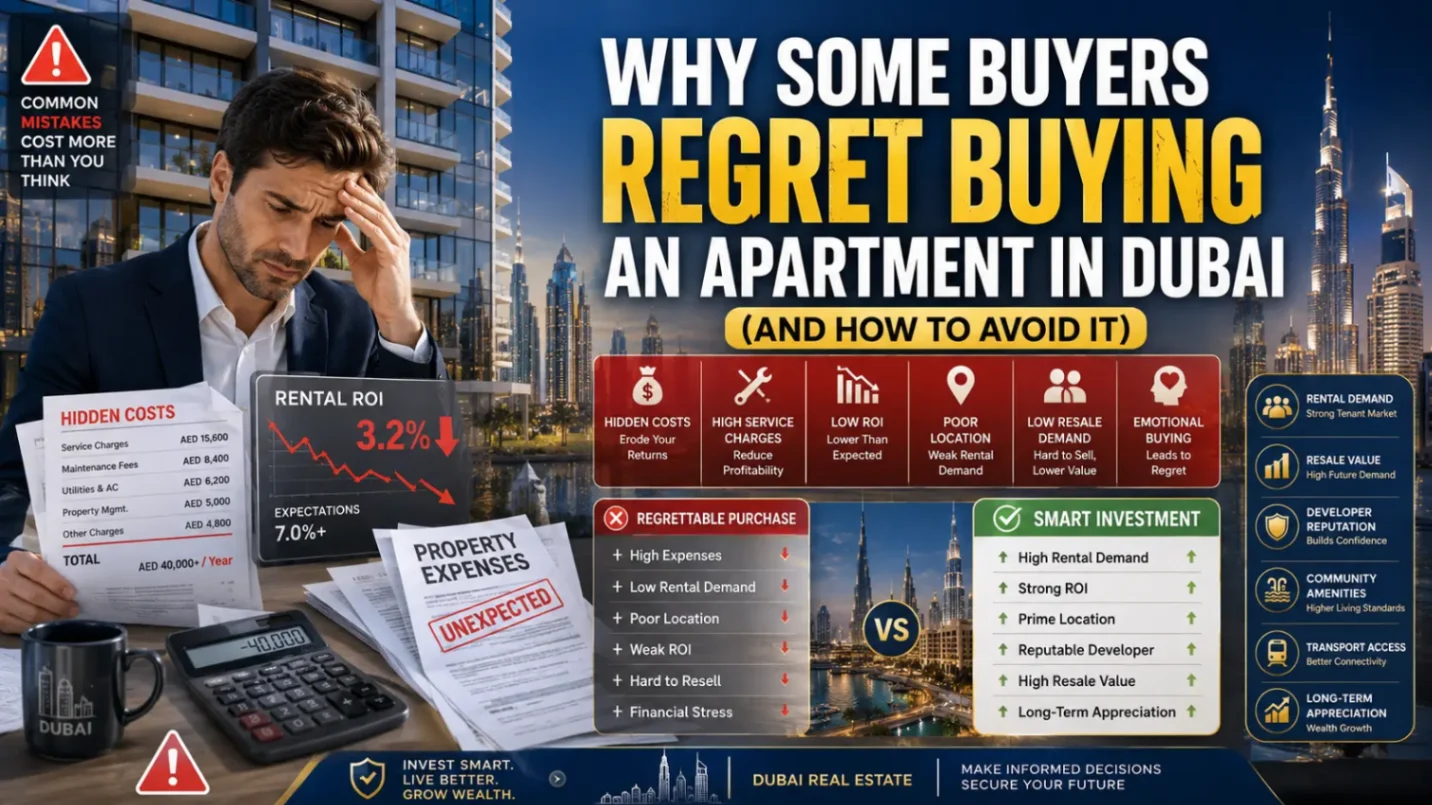
Buying an apartment in Dubai is an exciting milestone. Whether you're purchasing your first home, relocating to the UAE, or investing for rental income, the city offers opportunities that are difficult to ignore. Attractive payment plans, tax advantages, modern communities, and the potential for capital appreciation continue to draw buyers from around the world. Yet not every purchase turns out as expected. The reality is that most buyers who regret buying an apartment in Dubai don't regret becoming property owners—they regret how they bought. Choosing the wrong community, underestimating ownership costs, or making decisions based on emotion instead of research can lead to disappointment long after the excitement of purchase fades. In this guide, we explore the most common reasons buyers regret purchasing an apartment in Dubai, explain how these mistakes can affect both lifestyle and investment outcomes, and share practical tips to help you make a more informed property purchase from the outset. Buying Based on Price Instead of Value Everyone wants a good deal, but the cheapest apartment isn't always the smartest investment. Some buyers focus entirely on securing the lowest purchase price without considering whether the property will perform well over time. A lower-priced apartment in an area with weak rental demand or limited future growth may cost less today but deliver poorer returns in the future. Instead of asking, "How cheap is this apartment?" buyers should ask: Is the location growing? Will tenants want to live here? Is there strong resale demand? Does the building have a good reputation? PropertySeller encourages buyers to evaluate overall value rather than simply comparing asking prices. Underestimating the True Cost of Ownership One of the biggest surprises for first-time buyers is discovering that mortgage payments are only part of the monthly cost. Apartment ownership may also include: Service charges Utility bills Home insurance Maintenance and repairs Furnishing costs Parking or community fees Ignoring these ongoing expenses can place unnecessary pressure on a buyer's monthly budget. Before purchasing, it's important to calculate the complete cost of ownership rather than focusing only on loan repayments. Choosing the Wrong Location In real estate, location continues to be one of the strongest drivers of long-term success. A well-designed apartment in the wrong area may struggle to attract tenants or appreciate in value. Buyers sometimes fall in love with the apartment itself while overlooking factors such as: Connectivity Schools Nearby employment hubs Public transport Retail and lifestyle amenities Planned infrastructure Expecting Property Prices to Rise Forever Dubai has experienced exceptional growth over the past few years, leading some buyers to assume prices will continue increasing indefinitely. Property markets don't work that way. Some communities outperform others, while areas with significant new supply may experience slower appreciation. Buyers who purchase based purely on short-term price expectations are often disappointed when market conditions change. Long-term investment decisions should be based on demand fundamentals rather than speculation. Ignoring the Developer's Track Record This is particularly important for off-plan buyers. Many purchasers are attracted by attractive launch prices and flexible payment plans without researching the developer behind the project. Questions every buyer should ask include: Has the developer completed similar projects? Were previous developments delivered on time? Does the developer have a strong reputation for quality? A strong developer doesn't eliminate risk, but it can significantly reduce uncertainty. Overlooking Service Charges Two apartments with identical purchase prices can have very different ownership costs. That's because service charges vary between buildings depending on amenities and maintenance requirements. Luxury developments with pools, gyms, concierge services, landscaped gardens, and premium facilities generally have higher annual service charges than more modest residential buildings. Many buyers don't realise how much these charges affect long-term affordability until after completion. Buying Without Thinking About Resale Some buyers purchase solely based on their current needs. However, circumstances can change. A property that's easy to buy isn't always easy to sell. Before purchasing, buyers should consider: Future buyer demand Rental appeal Community popularity Market liquidity Thinking ahead can make future resale much smoother. Letting Emotion Drive the Decision Beautiful show apartments, impressive views, and limited-time launch offers can create urgency. While emotional appeal is part of buying a home, relying on emotion alone often leads to regret. Successful buyers balance excitement with objective analysis by evaluating: Budget Ownership costs Investment potential Community growth Long-term suitability Taking time to compare options usually leads to better decisions. Not Matching the Property to Their Lifestyle An apartment that works for one buyer may not work for another. Some buyers prioritise luxury finishes but later realise they needed more space. Others purchase far from work to save money and later regret the daily commute. Before buying, it's worth asking: Will this property suit my needs in five years? Is the location convenient? Does the community match my lifestyle? Buying for the future—not just today—can prevent unnecessary moves later. Focusing on Gross Rental Yield Instead of Net Returns Investors often compare advertised rental yields without accounting for ongoing expenses. To understand a property's true performance, buyers should also consider: Service charges Maintenance costs Vacancy periods Insurance Property management fees A property with a slightly lower gross yield may deliver stronger net returns if ongoing costs are lower. Final Takeaway Buying an apartment in Dubai can be one of the most rewarding financial decisions you make—but only if you choose the right property. Most regrets don't come from owning real estate. They come from overlooking important details such as ownership costs, developer reputation, community demand, or long-term suitability. PropertySeller believes successful property buying starts with informed decision-making. By evaluating the full financial picture and looking beyond marketing promises, buyers can choose apartments that support both their lifestyle and long-term investment goals. Frequently Asked Questions 1. Why do some buyers regret buying an apartment in Dubai? Many buyers regret overlooking factors such as ownership costs, service charges, location, or future resale potential. PropertySeller recommends evaluating the complete investment rather than focusing solely on the purchase price. 2. Is buying an apartment in Dubai still worth it? Yes, for many buyers. PropertySeller believes apartment ownership can offer long-term value, provided the property matches your financial goals, lifestyle, and investment strategy. 3. What is the biggest mistake first-time apartment buyers make? A common mistake is underestimating the total cost of ownership. PropertySeller encourages buyers to consider mortgage payments, service charges, maintenance, and other ongoing expenses before purchasing. 4. Should I buy an off-plan or ready apartment? The right choice depends on your objectives. PropertySeller helps buyers compare off-plan and ready properties by evaluating payment plans, delivery timelines, rental potential, and long-term investment prospects. 5. What tools can help me decide if I can afford an apartment in Dubai? PropertySeller offers a Mortgage Calculator, Eligibility Checker, and Rental Income Calculator to help buyers understand affordability, financing options, and potential investment returns before making a purchase. 6. How can I reduce the risk of buyer's remorse after purchasing an apartment? Thorough research is essential. PropertySeller helps buyers assess developer reputation, ownership costs, community demand, and investment fundamentals so they can purchase with greater confidence.
Jun 20, 2026
Read More
When people compare renting versus buying in Dubai, they usually focus on the mortgage payment. The mortgage is often the largest monthly expense associated with property ownership. But it is far from the only cost. Many first-time buyers are surprised to discover that owning an apartment involves several ongoing expenses that don't appear in property advertisements or mortgage calculators. Service charges, maintenance costs, insurance, utility bills, and furnishing expenses can all impact the true cost of ownership. That doesn't mean buying is a bad financial decision. In many cases, owning an apartment in Dubai can still be more cost-effective than renting over the long term. However, buyers should understand the complete financial picture before making a commitment. In this guide, we break down the key ongoing costs associated with apartment ownership in Dubai, explain how these expenses can affect your monthly budget, and highlight the factors buyers should consider when comparing the true cost of owning versus renting a property. Why Understanding Ownership Costs Matters Dubai's property market continues to attract both investors and end-users thanks to flexible financing options, strong infrastructure, and a wide range of residential communities. However, affordability is not determined by the property's purchase price alone. Two buyers purchasing apartments at the same price may face very different monthly expenses depending on: Building service charges Financing structure Community facilities Maintenance requirements Utility consumption Insurance costs Understanding these expenses helps buyers determine whether a property truly fits their budget. The Largest Cost: Monthly Mortgage Payments For most owners, the mortgage payment represents the biggest recurring expense. The exact amount depends on: Property value Down payment Mortgage tenure Interest rate Loan amount For example, a buyer purchasing a AED 1 million apartment with a standard down payment may face a significantly different monthly payment than someone purchasing a AED 2 million property with the same financing structure. Interest rates also play a major role in affordability. Even relatively small changes in borrowing costs can affect monthly payments over the life of the loan. This is why PropertySeller recommends calculating ownership costs using realistic mortgage scenarios rather than relying solely on advertised rates. Service Charges: The Cost Many Buyers Underestimate One of the most overlooked ownership expenses in Dubai is service charges. Apartment owners contribute toward the maintenance and operation of shared building facilities, including: Security Cleaning Landscaping Building management Swimming pools Gyms Common areas Elevator maintenance Service charges vary significantly between buildings. Luxury developments with extensive amenities often have higher charges than simpler residential communities. In some cases, service charges can represent a substantial annual expense, making them one of the most important factors buyers should evaluate before purchasing. Utilities and Everyday Running Costs Owning an apartment also means paying for utilities. These typically include: Electricity Water Cooling charges (where applicable) Internet services Television services The total monthly cost depends on: Apartment size Occupancy levels Building efficiency Personal usage habits Newer buildings with energy-efficient systems may help reduce ongoing utility expenses compared to older developments. Home Insurance While often overlooked during the buying process, insurance can provide valuable protection. Depending on the ownership structure and lender requirements, buyers may consider: Property Insurance Protects the physical structure and interior improvements. Contents Insurance Protects personal belongings within the property. While insurance costs are generally modest compared to mortgage payments, they remain an important component of responsible ownership. Maintenance and Repair Costs Unlike tenants, property owners are responsible for many repair and maintenance expenses. Common costs may include: Air conditioning servicing Appliance replacement Plumbing repairs Electrical repairs Interior upgrades General wear and tear Newer apartments often require less maintenance initially, but buyers should still budget for unexpected repairs over time. Furnishing and Setup Costs Many buyers focus exclusively on the purchase transaction and forget about move-in expenses. Depending on the property, additional costs may include: Furniture Appliances Curtains and blinds Home technology Interior decoration These expenses are especially relevant for buyers purchasing newly completed or unfurnished apartments. While not always recurring monthly costs, they can significantly impact the overall affordability of ownership. Parking, Community, and Lifestyle Costs Some residential communities may involve additional expenses beyond basic ownership. Examples can include: Additional parking allocations Community memberships Lifestyle facilities Private storage units While these costs are not universal, they can affect the true monthly budget associated with certain developments. What About Investors? For investors, ownership costs directly influence profitability. Many buyers focus heavily on expected rental income while underestimating ongoing expenses. To accurately evaluate returns, investors should account for: Service charges Vacancy periods Maintenance expenses Insurance Property management costs Mortgage payments A property generating strong rental income may produce a very different net return once all ownership costs are considered. Is Buying Still Better Than Renting? The answer depends on several factors: Length of ownership Market conditions Financing costs Rental rates Property appreciation Personal financial goals In many Dubai communities, mortgage payments can be comparable to monthly rent. The difference is that ownership gradually builds equity while renting does not create ownership of the asset. However, buyers should evaluate the full cost of ownership rather than comparing rent solely against mortgage payments. The most accurate comparison includes every recurring expense associated with owning the property. Calculate Your Real Cost of Ownership Before You Buy Understanding ownership costs on paper is one thing. Calculating them for a specific property is another. Before committing to a purchase, buyers should estimate not only their mortgage payments but also potential rental returns, affordability, and long-term ownership costs. PropertySeller provides several tools designed to help buyers make more informed decisions: Mortgage Calculator – Estimate monthly mortgage payments based on property price, down payment, and financing terms. Eligibility Checker – Understand how much you may be able to borrow before beginning your property search. Rental Income Calculator – Estimate potential rental returns and evaluate investment performance. Using these tools together can provide a clearer picture of whether a property aligns with your financial goals before making a purchase decision. Conclusion Owning an apartment in Dubai involves more than just a mortgage payment. Service charges, utilities, maintenance, insurance, and other ongoing expenses all contribute to the true cost of ownership. While many buyers focus on purchase prices and monthly loan repayments, the most successful property decisions are based on a complete understanding of long-term costs. PropertySeller encourages buyers to evaluate the full ownership picture before purchasing. A property that fits your lifestyle, investment goals, and monthly budget is often a stronger choice than simply pursuing the lowest purchase price. Frequently Asked Questions 1. How much does it really cost to own an apartment in Dubai each month? The total monthly cost depends on factors such as mortgage payments, service charges, utilities, maintenance, and insurance. PropertySeller recommends evaluating all recurring expenses rather than focusing solely on mortgage repayments. 2. What are service charges in Dubai apartments? Service charges are fees paid by apartment owners to maintain shared facilities and common areas. PropertySeller advises buyers to review service charge levels carefully, as they can vary significantly between buildings and communities. 3. Are service charges included in mortgage payments? No. Service charges are separate from mortgage repayments and should be considered when calculating the true cost of ownership. PropertySeller helps buyers understand how these charges impact long-term affordability. 4. Is buying an apartment in Dubai cheaper than renting? It depends on the location, financing structure, and ownership timeline. PropertySeller encourages buyers to compare total ownership costs against rental expenses rather than focusing only on monthly mortgage payments. 5. What hidden costs should apartment buyers expect in Dubai? Common costs include service charges, maintenance, insurance, utility bills, furnishing expenses, and occasional repairs. PropertySeller believes understanding these expenses upfront helps buyers avoid unexpected financial pressure later. 6. How can I estimate my monthly ownership costs before buying? Buyers should assess mortgage payments, service charges, utilities, insurance, and maintenance expenses. PropertySeller helps buyers evaluate these costs to ensure the property aligns with their financial goals and budget.
Jun 20, 2026
Read More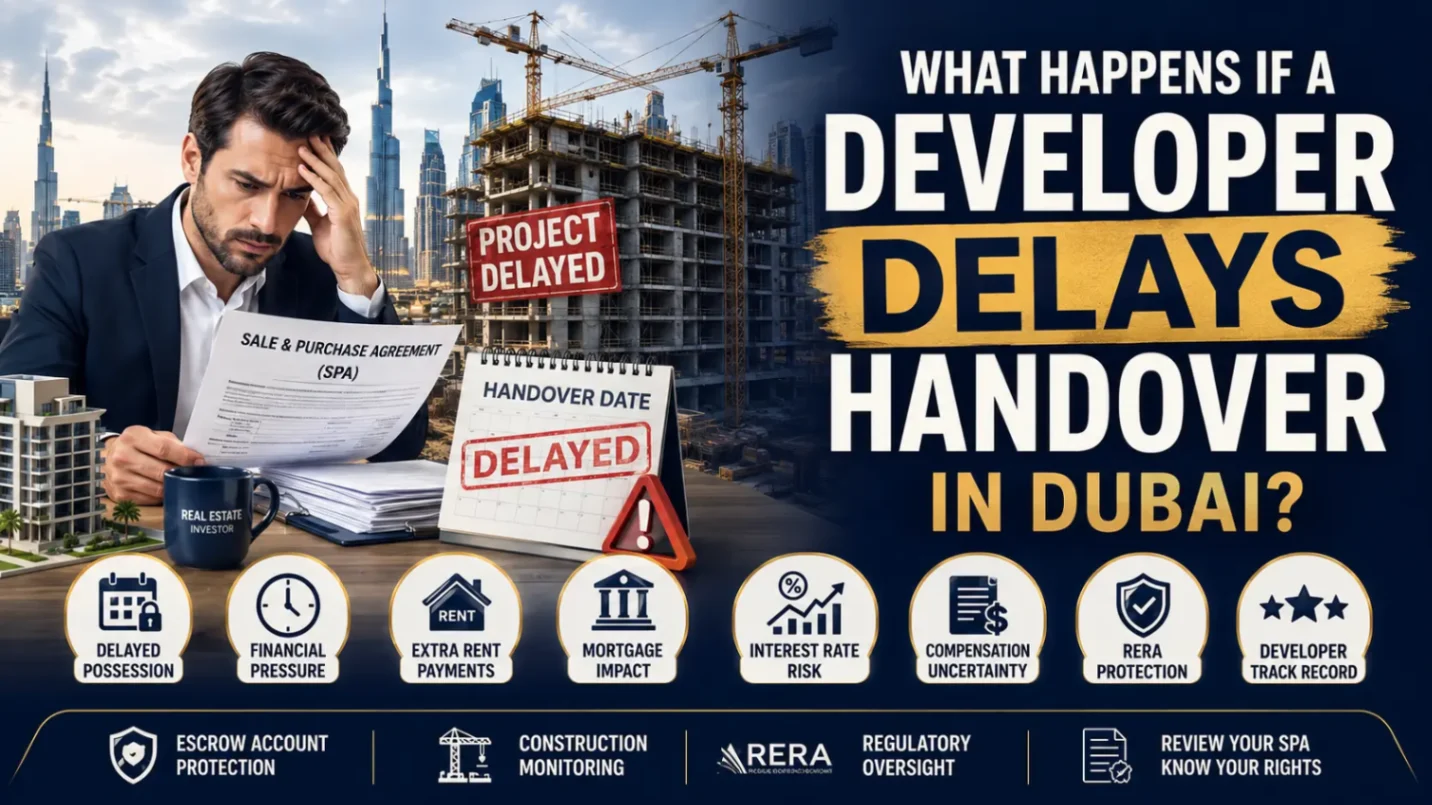
Buying an off-plan property in Dubai often comes with one major trade-off: patience. Developers typically launch projects years before completion, allowing buyers to secure attractive prices and flexible payment plans. In many cases, projects are delivered on time. But sometimes construction takes longer than expected, and handover dates are pushed back. When that happens, buyers usually have one immediate question: What are my rights if a developer delays handover in Dubai? The answer depends on several factors, including the reason for the delay, the terms of the Sale and Purchase Agreement (SPA), the length of the delay, and whether the developer remains compliant with Dubai's regulatory requirements. The good news is that Dubai's real estate sector operates within a regulated framework designed to protect both developers and buyers. Understanding how delays are handled can help you make informed decisions and avoid unnecessary panic. In this guide, we explain the common reasons for handover delays, the legal protections available to buyers, how Sale and Purchase Agreements typically address project extensions, the role of regulatory authorities, and the practical steps buyers can take when a project's completion timeline changes. Are Developer Delays Common in Dubai? Project delays are not unique to Dubai. Large-scale developments anywhere in the world can face challenges such as: Construction delays Labour shortages Supply chain disruptions Infrastructure coordination issues Regulatory approvals Market-related adjustments While most reputable developers work toward their announced timelines, buyers should understand that estimated completion dates are not always guaranteed completion dates. This is particularly important when purchasing off-plan property where construction may still be in its early phases. What Is Considered a Handover Delay? A handover delay occurs when a developer fails to deliver the property by the completion date specified in the Sale and Purchase Agreement. However, many buyers are surprised to discover that the completion date listed in marketing materials may differ from the contractual provisions inside the SPA. Most SPAs include clauses allowing developers a certain extension period before a delay officially becomes a contractual issue. This is why buyers should always review: Original handover date Grace period provisions Force majeure clauses Compensation terms Termination rights The SPA often becomes the most important document when determining a buyer's legal position. What Protections Do Buyers Have in Dubai? Dubai's off-plan market is regulated by authorities including the Government of Dubai's real estate framework and the Real Estate Regulatory Agency (RERA). Several safeguards exist to reduce buyer risk. Escrow Account Requirements Developers must deposit buyer funds into regulated project escrow accounts. These accounts help ensure that funds collected from purchasers are used for project construction rather than unrelated activities. This system significantly improves transparency and helps reduce risks associated with project funding. Construction Monitoring Project progress is monitored throughout various construction stages. Developers generally cannot access escrow funds without meeting construction milestones. This creates additional accountability throughout the development process. Regulatory Oversight Dubai's property sector has evolved significantly over the past decade. Today, buyers benefit from stronger regulatory oversight, clearer project registration requirements, and improved transparency compared with earlier market cycles. Why Do Developers Delay Handover? Not every delay is a sign of financial trouble. In many situations, delays occur because of factors beyond a developer's immediate control. Common reasons include: Construction Challenges Large projects involve multiple contractors, suppliers, consultants, and regulatory approvals. Delays affecting one component can impact the overall timeline. Infrastructure Dependencies Some projects rely on surrounding roads, utility connections, public infrastructure, or community facilities before final completion can occur. Material Supply Issues Global supply chain disruptions can affect construction materials, fixtures, and specialist equipment. Design Changes Occasionally, developers make improvements or modifications during construction that extend timelines. While buyers often prefer faster delivery, some delays occur because developers are enhancing project specifications. Can Buyers Receive Compensation for Delayed Handover? This is one of the most searched questions among off-plan buyers. The answer is sometimes, but not automatically. Compensation depends primarily on the terms contained within the Sale and Purchase Agreement. Certain contracts include provisions covering: Delay compensation Penalty clauses Alternative remedies Cancellation rights after specific periods Other contracts may provide developers with broader protections. Because every project can differ, buyers should avoid assuming compensation applies automatically. The SPA remains the primary reference point. Can a Buyer Cancel the Purchase Due to Delays? Potentially, yes. However, cancellation rights are not triggered by every delay. Several factors influence whether termination may be possible: Length of delay Contract provisions Construction progress Regulatory considerations Circumstances causing the delay In some cases, buyers may negotiate with developers directly. In others, formal dispute resolution may be required. The specific facts of each project matter significantly. What Happens to Mortgage Buyers? Delays can create additional complications for buyers using financing. Potential issues may include: Extended rental commitments Mortgage approval validity periods Changing interest rates Revised financial planning This is one reason why buyers should evaluate project delivery history before committing to an off-plan purchase. A lower launch price may not always offset the cost of substantial delays. How Can Buyers Reduce the Risk of Delayed Handover? No buyer can completely eliminate development risk. However, several steps can reduce exposure. Research the Developer One of the most effective safeguards is choosing a developer with a strong delivery track record. Questions worth asking include: How many projects has the developer completed? Were previous projects delivered on schedule? How does the developer perform during changing market conditions? Past performance does not guarantee future results, but it provides valuable context. Review the SPA Carefully Many buyers focus heavily on pricing and payment plans while paying little attention to contractual obligations. The SPA deserves equal attention. Particular focus should be placed on: Handover commitments Extension clauses Compensation provisions Cancellation rights Monitor Construction Progress Buyers should periodically review project updates and construction milestones. Early awareness of potential delays allows for better financial planning. Avoid Overstretching Financially A common mistake among off-plan buyers is assuming handover will occur exactly on the announced date. Building financial flexibility into your plans can help manage unexpected delays more comfortably. Does a Delayed Handover Mean the Investment Is Bad? Not necessarily. Many successful investments have experienced construction delays. What matters is understanding the impact of the delay on the property's long-term fundamentals. Questions investors should ask include: Is demand for the area still growing? Has rental demand strengthened? Have comparable property values increased? Does the project remain attractive upon completion? In some cases, a delayed project still delivers strong capital appreciation by handover. In others, changing market conditions may alter the investment outlook. This is why investment decisions should be based on broader fundamentals rather than delivery dates alone. Final Takeaway Developer delays can be frustrating, particularly for buyers planning to move into a property or generate rental income immediately after handover. However, a delayed handover does not automatically mean a project has failed or that an investment has become unattractive. Dubai's regulatory framework provides important protections for off-plan buyers, while contractual rights are typically governed by the Sale and Purchase Agreement. Understanding those rights before purchasing is often the best protection available. PropertySeller encourages buyers to evaluate developers carefully, review contractual terms thoroughly, and assess projects based on long-term fundamentals rather than projected completion dates alone. A successful property investment is rarely determined by a single handover date. It is determined by the quality of the asset, the strength of demand, and the long-term value it creates. Frequently Asked Questions 1. What happens if a developer delays handover in Dubai? If a developer delays handover, buyers should first review their Sale and Purchase Agreement (SPA) to understand the applicable terms, grace periods, and available remedies. At PropertySeller, we always encourage buyers to assess developer credibility and project progress before investing, as these factors often influence delivery timelines. 2. Can I get compensation for a delayed handover in Dubai? Compensation depends on the terms outlined in the SPA and the circumstances surrounding the delay. PropertySeller recommends carefully reviewing compensation and delay clauses before purchasing any off-plan property, as contractual rights can vary from one project to another. 3. Can I cancel an off-plan property purchase because of construction delays? In some cases, buyers may have cancellation rights if delays exceed certain contractual thresholds. PropertySeller advises investors to understand these provisions before signing an agreement rather than relying solely on projected handover dates. 4. How can I check whether an off-plan project is progressing on schedule? Buyers can monitor developer updates, construction milestones, and project progress reports. PropertySeller also helps buyers evaluate project status and developer track records to provide a clearer picture of potential delivery risks. 5. Are delayed projects always bad investments? Not necessarily. Some projects experience delays but still deliver strong capital appreciation and rental returns after completion. PropertySeller evaluates each opportunity based on location demand, developer reputation, market conditions, and long-term investment potential rather than handover timelines alone. 6. How can I reduce the risk of buying into a delayed project? One of the most effective ways is to choose developers with a proven delivery history and financially strong projects. PropertySeller helps buyers compare developers, review past performance, and identify projects that offer a better balance of risk and potential return. 7. What should I consider before buying an off-plan property in Dubai? Beyond price and payment plans, buyers should evaluate developer reputation, project location, construction progress, expected demand, and long-term resale potential. PropertySeller helps investors assess these factors to make more informed property decisions.
Jun 20, 2026
Read More
If you're thinking about buying an apartment in the UAE, at some point someone's going to throw a number at you. A yield percentage. A projected return. A "this area gives 7% ROI" claim. And you'll nod along — but quietly wonder: is that actually good? How did they calculate it? What are they leaving out? This is the part most people skip. Not because they don't care, but because nobody explains it clearly. So they buy based on gut feel, a salesperson's pitch, or what a friend said worked for them. Sometimes it works out. Often, they realize later they missed something. ROI — Return on Investment, is not complicated. But it does need to be calculated properly. Because the difference between a 4% ROI and an 8% ROI on the same budget is not just a number. Over five years, it's hundreds of thousands of dirhams. This guide walks you through the exact formula UAE investors use, what most people forget to include, and how to benchmark whether a property is actually worth buying before you sign anything. What Is ROI in UAE Real Estate? Return on Investment (ROI) measures how much profit your property generates relative to what you paid for it. In simple terms, it answers one question: "For every dirham invested, how much am I getting back?" In UAE real estate, ROI captures two income streams: Rental income — the annual rent your tenants pay Capital appreciation — the increase in the property's market value over time A high ROI means your money is working harder. A low ROI means you may be overpaying for an underperforming property. Start With the Total Investment Cost One of the biggest mistakes investors make is calculating ROI using only the property price. The apartment price is only part of the investment. Your total cost may include: Property purchase price Dubai Land Department fees Registration charges Agency commission Mortgage-related fees Furnishing expenses Initial maintenance costs If these costs are excluded, ROI will appear higher than reality. PropertySeller always recommends calculating returns based on total acquisition cost, not just the advertised purchase price. The Basic ROI Formula The most widely used formula for UAE property investors is: ROI (%) = (Annual Rental Income + Capital Appreciation) ÷ Total Investment Cost × 100 Annual Rental Income — The total rent collected over 12 months. Always use net rent after agent fees, vacancy periods, and service charges. Capital Appreciation — The difference between the current market value and your original purchase price. Before you jump into calculations manually, we've built a few tools to make this easier. Use our Rental Income Calculator to project your investment returns — all in one place. Gross Yield vs. Net Yield vs. ROI — Know the Difference Many investors confuse these three metrics. They're not the same thing: Gross Yield = Annual Rent ÷ Purchase Price × 100 (ignores all costs) Net Yield = (Annual Rent − Annual Costs) ÷ Purchase Price × 100 (accounts for running costs) ROI = (Total Returns including appreciation) ÷ Total Investment Cost × 100 (the full picture) Gross ROI Gross ROI only considers rental income. For example: Apartment Price: AED 1,000,000 Annual Rent: AED 80,000 Gross ROI = 8% At first glance, that looks impressive. The problem is that the property also has expenses. Net ROI Net ROI subtracts operating costs such as: Service charges Maintenance expenses Insurance Property management fees Vacancy periods Net ROI gives a far more realistic picture of investment performance. For serious investors, net ROI matters far more than gross ROI. Always use ROI for investment decisions. Gross yield figures can be misleading because they ignore service charges, vacancies, and transaction costs. A property marketed at "8% yield" can easily drop to 5% once real costs are included. Step-by-Step Worked Example Let's say you buy a one-bedroom apartment in Dubai Marina for AED 1,200,000. Cost Item Amount (AED) Purchase Price 1,200,000 DLD Transfer Fee (4%) 48,000 Agent Commission (2%) 24,000 Renovation 15,000 Total Investment Cost 1,287,000 You rent it out at AED 85,000/year and after three years, the property is worth AED 1,380,000. ROI = ((AED 85,000 × 3) + (AED 1,380,000 − AED 1,200,000)) ÷ AED 1,287,000 × 100 ROI = (AED 255,000 + AED 180,000) ÷ AED 1,287,000 × 100 = 33.8% over 3 years That's roughly 11.3% per year, well above the UAE average for residential property. Rental Yield vs ROI Many buyers assume rental yield and ROI are the same thing. They're not. Rental yield focuses mainly on rental income. ROI looks at the broader picture, including costs and overall profitability. Two apartments can have identical rental yields but produce very different investment results because of maintenance expenses, community performance, or vacancy risk. This is why PropertySeller evaluates more than just yield numbers. Check Cash Flow Before You Buy A property can have attractive ROI and still create financial pressure. That's because ROI and cash flow are different. Cash flow measures the money left after paying ownership expenses and mortgage obligations. A simple question every buyer should ask: Will this property generate money every month or require additional money every month? Positive cash flow strengthens an investment. Negative cash flow increases risk. Ignoring cash flow is one of the most common investor mistakes in the UAE market. What Is a Good ROI for UAE Apartments? Benchmarks vary by city and property type: Dubai — Residential Apartments Average ROI: 5% – 9% annually High-performing areas: Jumeirah Village Circle (JVC), Dubai Marina, Business Bay, Dubai Hills Estate Premium areas with strong appreciation: Downtown Dubai, Palm Jumeirah, Dubai Creek Harbour Abu Dhabi — Residential Apartments Average ROI: 5% – 8% annually High-performing areas: Al Reef (8.04%), Masdar City (7.31%), Al Ghadeer (7.14%) Premium areas: Yas Island, Al Reem Island, Saadiyat Island As a rule of thumb: anything above 6% net annual ROI is considered strong for UAE residential apartments. Commercial property typically delivers higher yields of 12–15%, but comes with greater management complexity. Factors That Directly Impact Your ROI 1. Location Location is the single biggest driver of both rental demand and price appreciation. Apartments near metro stations, business hubs, schools, and waterfront developments consistently outperform. In Dubai, communities like JVC and Business Bay offer high rental yields. In Abu Dhabi, Al Reem Island and Yas Island attract strong tenant demand year-round. 2. Occupancy Rate An empty apartment earns nothing. Budget for a vacancy buffer of 4–6 weeks per year when projecting annual rental income. In high-demand areas with strong infrastructure, vacancy rates tend to be lower — which directly protects your ROI. 3. Service Charges and Running Costs Service charges in UAE buildings range from AED 10 to AED 30+ per square foot annually. A 1,000 sq ft apartment can incur AED 10,000–30,000 in service charges alone each year. Always factor this into your net rental income before calculating ROI. 4. Off-Plan vs. Ready Properties Off-plan apartments often come at a lower entry price with flexible payment plans, potentially improving ROI if prices appreciate before handover. However, ready properties generate immediate rental income with no completion risk. Each has a different ROI profile — match the option to your investment timeline. The Costs People Forget to Include This is where most ROI calculations fall apart. People calculate property price and expected rent — and stop there. But you also need to account for: DLD transfer fee (4% of purchase price) Agent commission (2%) Property valuation fee Mortgage processing and arrangement fees Annual service charges Maintenance and repairs Vacancy periods between tenants Leaving these out doesn't make them disappear. It just means your real ROI is lower than you planned for. Common ROI Mistakes Investors Make Before buying an apartment, avoid these common errors: Using gross income instead of net income Ignoring service charges Assuming 100% occupancy Overestimating future appreciation Ignoring transaction costs Focusing only on advertised rental yields Each mistake can significantly distort the true investment picture. Conclusion Calculating ROI before buying an apartment in the UAE isn't optional — it's the foundation of every smart investment decision. Use the formula above, account for every cost, and benchmark your target property against local area averages before committing. The investors who consistently do well in Dubai and Abu Dhabi aren't necessarily the ones with the most money. They're the ones who ran the numbers first. At Propertyseller, we don't just show you listings. We help you understand what each property actually returns so you're making a decision based on data, not assumptions. We also give you the tools to evaluate them — a Mortgage Calculator, Eligibility Checker, and Rental Income projector, so every decision is backed by your actual numbers, not assumptions. Frequently Asked Questions 1. What is a good ROI for an apartment in the UAE? There is no single number that qualifies as a "good" ROI because returns vary based on location, property type, demand, and ownership costs. At PropertySeller, we believe investors should focus on sustainable ROI, not just high ROI. An apartment with stable tenant demand, strong occupancy, and healthy resale potential is often a better investment than one advertising unusually high returns. 2. Is rental yield the same as ROI? No. Rental yield and ROI are related but not identical. Rental yield focuses primarily on rental income compared to the property's purchase price. ROI provides a broader picture by considering ownership costs, expenses, and overall profitability. PropertySeller encourages investors to evaluate ROI rather than relying solely on rental yield when comparing investment opportunities. 3. How do service charges affect apartment ROI? Service charges directly reduce investment returns because they are recurring ownership expenses. Two apartments with similar rental income can generate very different returns if one has substantially higher service charges. PropertySeller always factors ongoing ownership costs into investment analysis rather than focusing solely on rental income. 4. Can off-plan apartments generate good ROI? Yes, but the calculation differs from ready properties. Off-plan investments may offer lower entry prices and future appreciation potential, but they also involve construction timelines, handover uncertainty, and delayed rental income. PropertySeller advises investors to assess both projected returns and project-specific risks before relying on off-plan ROI estimates. 5. Does mortgage financing affect ROI? Yes. Financing can influence both returns and cash flow. While a mortgage may increase leverage and reduce the amount of cash invested upfront, it also introduces interest costs and monthly repayment obligations. PropertySeller recommends analyzing both ROI and cash flow together to understand the full financial impact of financing.
Jun 13, 2026
Read More
Every few months, someone asks the same question: is now a good time to buy in the UAE? In 2024, the answer felt obvious. Prices were climbing fast, transactions were breaking records, and it seemed like you couldn't go wrong. In 2026, the answer is a little more nuanced, and honestly, more interesting. The market hasn't crashed. It hasn't stalled. But it has matured. The days of doubling your money overnight are largely behind us. What's replaced them is something more useful for serious buyers and investors — a market that rewards research, timing, and choosing the right location over blind optimism. This guide breaks down what's actually happening across each major UAE emirate in 2026. Not just Dubai. All of them. Because depending on your budget, your goals, and how long you plan to hold, the best opportunity for you might not be where everyone else is looking. What Is Driving the UAE Property Market? Several long-term factors continue to support demand across the UAE: Population growth Foreign investor interest Business expansion Infrastructure development Investor-friendly regulations Long-term residency programs These drivers have strengthened demand for both ready and off-plan properties across multiple emirates. However, future market performance will depend on how demand balances against new supply entering the market. Will Property Prices Continue Rising in 2026? Price growth may continue in certain communities, but market performance is unlikely to be uniform. Some established locations may experience continued demand due to limited inventory and strong buyer interest. Other areas with substantial new supply could see slower price growth as competition increases. We expect buyers to become more selective, focusing on communities with strong demand fundamentals rather than chasing short-term market momentum. Rental Demand Is Expected to Remain Strong Rental demand continues to be supported by: Population growth New business activity International relocation Lifestyle-driven migration As a result, many communities are expected to maintain healthy occupancy levels. For investors, rental demand remains one of the most important indicators of long-term property performance. Affordability Will Become a Bigger Decision Factor As property values and rents increase, affordability will likely become a more important consideration for buyers. Many residents are increasingly comparing: Monthly rent Mortgage payments Upfront ownership costs This may encourage more long-term residents to explore ownership options where mortgage payments are comparable to rental costs. Off-Plan Projects Will Continue Attracting Buyers Flexible payment plans continue to attract both investors and end-users. Advantages often include: Lower initial entry costs Extended payment schedules Potential capital appreciation before handover However, buyers should evaluate project quality, developer reputation, and delivery timelines before relying on projected returns. Dubai: Steady Growth With Selective Hotspots Dubai remains the most active property market in the UAE, and the forecasts for 2026 reflect that — with one important shift. Growth is moderating, and where you buy matters more than ever. Dubai prices are expected to rise between 5% and 8% in 2026, depending on the community and property type. A mild correction is possible in areas with heavy new supply or high speculative activity, though any decline is expected to be limited. For rental investors, average rent growth in 2026 is expected to remain positive at around 6–8% in key communities, supporting Dubai's reputation as a high-yield rental market. Best areas in Dubai: Downtown Dubai, Palm Jumeirah, Dubai Hills Estate — lower supply, sustained demand, stronger appreciation JVC, Dubai South, Business Bay — high rental yields, strong tenant demand, accessible entry points Dubai Creek Harbour — infrastructure-driven growth with long-term upside The current benchmark interest rate EIBOR sits around 4.5% to 5%, and mortgage rates typically add 1% to 2% on top of that, with expectations that rates may ease modestly during 2026 if global rate cuts continue. For mortgage buyers, this is worth watching closely — even a modest rate reduction improves affordability meaningfully. Abu Dhabi: Quiet Momentum, Strong Foundations Abu Dhabi doesn't make as much noise as Dubai, but the numbers in 2026 are hard to ignore. The market recorded AED 142 billion in total real estate transactions in 2025, with residential sales reaching AED 76 billion. Rental yields remain competitive at 5–8%, while controlled supply growth continues to support long-term value. Most analysts forecast price growth of 3% to 8% for Abu Dhabi residential property, with luxury and waterfront segments — Saadiyat Island, Yas Island — likely at the higher end and mid-market areas seeing more moderate gains. What makes Abu Dhabi particularly attractive right now is stability. It's not chasing speculative highs. The growth is structural — driven by government investment, population growth, and a clear long-term vision. Best areas for buyers in Abu Dhabi: Saadiyat Island & Yas Island — premium yields and lifestyle-driven demand Al Reem Island — consistent rental demand, good liquidity Al Reef & Masdar City — strong ROI for mid-budget investors Sharjah: The Underrated Market Sharjah keeps getting overlooked. That's starting to change. Sharjah's real estate market is expected to see over 10% price growth in 2026, fuelled by strong demand and increasing investor interest. Rental yields remain attractive compared to neighbouring emirates, with gross annual yields typically ranging between 6% and 9%, especially in mid-market apartment blocks. For buy-to-let investors focused on cash flow, Sharjah's relatively low entry costs and consistent tenant demand make the market appealing. The tenant base here is largely end-user driven — people who actually live and work in the emirate rather than short-term speculators. That creates more stable occupancy rates, which is exactly what a rental investor wants. Best areas to invest in Sharjah: Muwaileh Tilal City Aljada Ras Al Khaimah: The Fastest-Moving Market Right Now If one emirate stands out in 2026 for sheer momentum, it's RAK. Ras Al Khaimah heads into 2026 in a rapid appreciation phase, underpinned by strong off-plan sales, sharp price gains for apartments and coastal master plans. Residential capital values rose 15% year on year. The Wynn resort development and ongoing coastal master plans are driving significant interest from both local and international investors. Entry prices remain much lower than Dubai, but the gap is closing — which is exactly where opportunity sits. Emirates at a Glance: 2026 Snapshot Emirate Price Growth Forecast Avg. Rental Yield Best For Dubai 5% – 8% 6% – 9% Yield + appreciation Abu Dhabi 3% – 8% 5% – 8% Stability + long-term value Sharjah 5% – 10%+ 6% – 9% Affordability + cash flow Ras Al Khaimah 10%+ 5% – 7% Capital growth Ajman 3% – 5% 7% – 9% Budget entry point Fujairah 3% – 5% 6% – 8% Low entry, long-term hold Umm Al Quwain 2% – 4% 7% – 9% Lowest entry price in UAE What Could Slow the Market? While the outlook remains positive, buyers should also consider potential challenges: Increased Supply Large volumes of new units entering the market may create competition in certain communities. Mortgage Affordability Changes in borrowing costs can influence purchasing power. Investor Expectations Markets do not move upward indefinitely. Some areas may experience periods of stabilization rather than rapid growth. Understanding both opportunities and risks creates a more balanced investment approach. What This Means If You're Buying in 2026 The market in 2026 rewards a different kind of buyer than 2022 or 2023 did. Back then, almost anything worked. Now, the details matter — which community, which developer, which floor plan, and how the numbers actually stack up. A few things worth keeping in mind: New supply is coming. More units means more choice, which is good for buyers. In some oversupplied pockets, it could soften prices slightly — but this is localised, not market-wide. Off-plan is still active. Payment plans remain flexible and prices at launch are often below secondary market rates. The risk is completion timeline — factor that into your decision. Rental demand is holding. Population growth across the UAE continues to support tenant demand. Vacancy risk is lower in well-connected communities near transport, schools, and employment hubs. Not sure what your budget can actually get you right now? Use our Mortgage Calculator to estimate your monthly payments, the Eligibility Checker to understand your borrowing limit, and the Rental Income Calculator to project what a specific property could return — before you start shortlisting. Final Takeaway The UAE property market in 2026 is expected to remain driven by strong demand, population growth, and ongoing development activity. However, market success will depend on more than simply following headlines or price forecasts. Buyers who focus on affordability, community strength, rental demand, and long-term value are likely to make more resilient property decisions. PropertySeller expects the UAE market to remain active, supported by continued demand, investor interest, and ongoing development. The strongest opportunities are expected to come from areas with sustainable tenant demand, healthy occupancy, strong infrastructure growth, and proven resale liquidity. We help investors and homeowners evaluate opportunities using verified data, transparent insights, and a commitment to smarter property decisions. Frequently Asked Questions 1. Will UAE property prices rise in 2026? PropertySeller expects demand to remain healthy in many communities, but price growth is likely to vary depending on location, supply levels, and buyer demand. 2. Is 2026 a good time to buy property in the UAE? The right time depends on affordability, financial goals, and holding period rather than market predictions alone. PropertySeller encourages buyers to evaluate long-term suitability rather than short-term timing. 3. Which UAE property sectors may perform well in 2026? Apartments, family-oriented communities, and areas with strong rental demand are expected to remain attractive to both investors and end-users. 4. Will rental demand remain strong in 2026? Current market indicators suggest continued rental demand driven by population growth and business expansion, though performance may vary by community. 5. What is the biggest risk for UAE property buyers in 2026? One of the biggest risks is focusing solely on price appreciation while ignoring factors such as affordability, ownership costs, rental demand, and resale liquidity. 6. Can buying property in the UAE help me qualify for a Golden Visa? Yes. Property investment is one of the most popular pathways to obtaining a UAE Golden Visa. Under current rules, investors who own qualifying real estate with a total value of at least AED 2 million may be eligible for a long-term Golden Visa, subject to approval by the relevant authorities. 7. Which areas in Dubai are best for investment in 2026? JVC, Business Bay, and Dubai South offer strong rental yields at accessible price points. For capital appreciation, Downtown Dubai, Dubai Hills Estate, and Palm Jumeirah continue to outperform.
Jun 13, 2026
Read More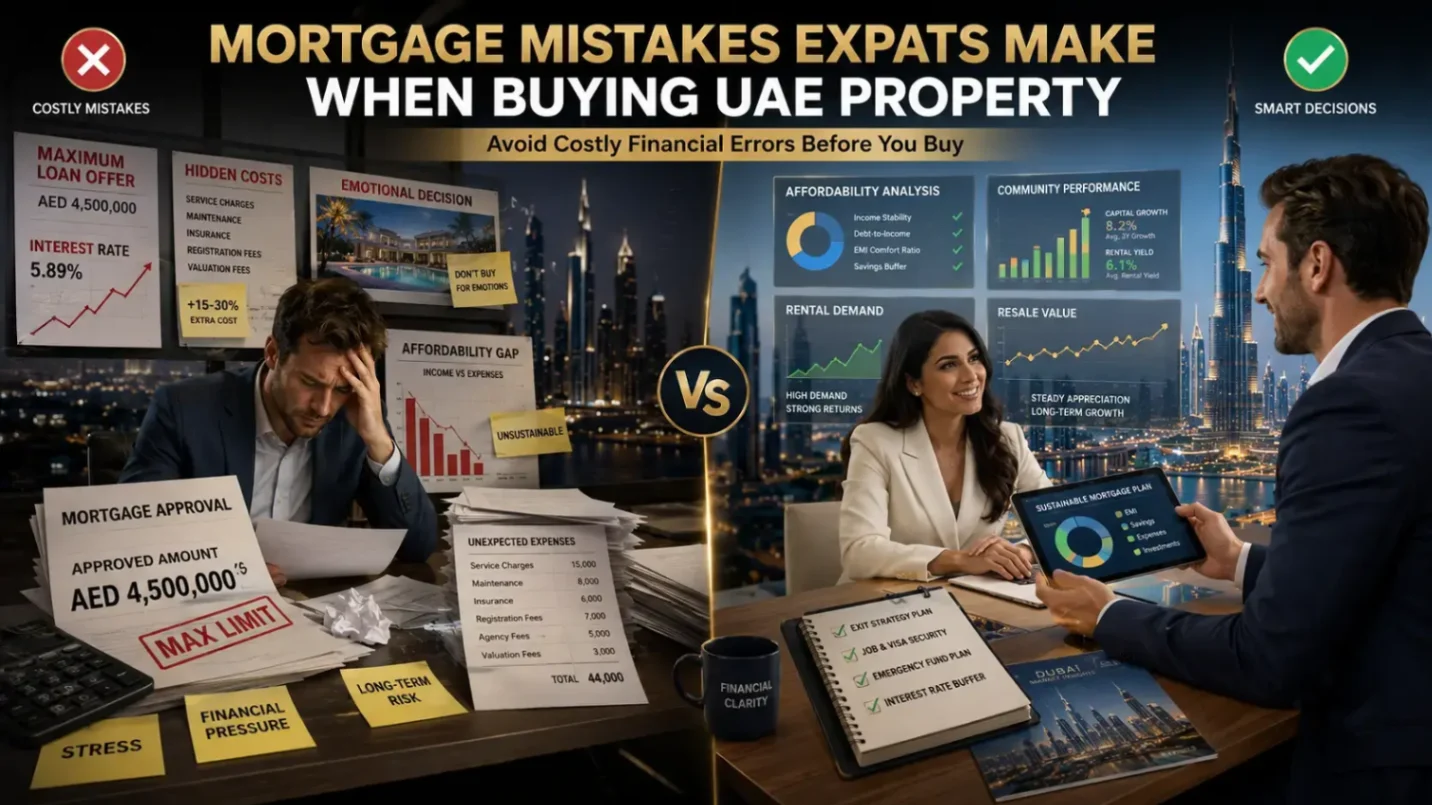
Most expats assume getting a mortgage in the UAE is a simple process: secure approval, select a property, and start paying EMIs. That assumption is exactly why many buyers end up financially stretched, over-leveraged, or locked into poorly timed property decisions. In reality, mortgage approval is only a starting point. The real challenge lies in maintaining long-term affordability, sustaining financial stability through interest rate and cost changes, and preserving flexibility if circumstances or market conditions shift. This guide breaks down the most common mortgage mistakes expats make in the UAE and explains how to avoid them through a more disciplined, data-driven approach to property financing and decision-making. Mistake 1: Confusing Eligibility with Affordability Banks approve mortgages based on income ratios, not real-life financial sustainability. Many expats assume “If I am approved, I can afford it.” That assumption is flawed. Bank approval does not account for rising service charges, lifestyle expenses, emergency savings, or potential job relocation risks. It only measures repayment capacity within predefined income thresholds. PropertySeller treats affordability as a full financial model, not a banking checkbox. Mistake 2: Borrowing at Maximum Limit One of the most common errors is taking the highest loan amount offered by the bank. This often results in financial pressure during interest rate increases, reduced liquidity after purchase, and little to no buffer for emergencies. A more stable approach is keeping EMI within 30–40% of income, rather than stretching to the maximum borrowing limit. Mistake 3: Ignoring Total Ownership Cost Most buyers only calculate EMI when planning affordability. They often ignore additional costs such as service charges, maintenance fees, insurance, mortgage-related fees, and renewal expenses. Over time, these recurring costs can significantly increase the actual monthly housing burden beyond the EMI alone. Mistake 4: Choosing Property Based on Emotion Many expats make purchase decisions based on lifestyle appeal, social influence, or recommendations from friends. This often replaces critical analysis of rental demand, resale liquidity, and long-term community performance. A strong purchase decision should be driven by data, not perception. Mistake 5: Ignoring Exit Strategy Many buyers fail to consider what happens if they leave the UAE within 2–3 years. Without a clear exit plan, selling may take longer than expected, rental income may not fully cover EMI, and market timing risks increase significantly. Every property decision should include an exit strategy from the start. Mistake 6: Buying in Low Liquidity Areas Not all communities in the UAE behave the same in terms of resale and rental demand. Some areas may appear attractive due to lower prices but suffer from weak liquidity, slower resale cycles, and limited buyer demand. Ignoring liquidity risk can lead to difficulty exiting the property when needed. Mistake 7: Not Stress-Testing Interest Rate Changes Many buyers calculate affordability based only on the initial interest rate. However, variable rates can change over time, increasing monthly repayments and affecting long-term affordability. Even small rate increases can have a noticeable impact on monthly financial stability. Mistake 8: Underestimating Job and Residency Risk Unlike long-term citizens, expats face additional uncertainty such as job relocation, visa dependency, and international career movement. These factors make long-term mortgage commitments more complex and require stronger financial buffers and exit flexibility. Mistake 9: Wrong Community Selection Mistake Many expats choose a property based mainly on price per square foot, instead of evaluating long-term demand strength and market performance. A common mistake is prioritizing “cheapest entry price” communities without analysing whether those areas have strong resale demand, consistent tenant interest, or long-term infrastructure development. A better approach is to look at rental yield consistency, tenant demand stability, resale speed, and the future development pipeline of the community. These factors give a clearer picture of whether a location will hold value over time. PropertySeller uses community-level performance data to identify weak liquidity zones and help buyers avoid decisions that look affordable on paper but perform poorly in real market conditions. How PropertySeller Evaluates Mortgage Safety Mortgage approval is not the goal. Sustainable ownership is. A mortgage decision should be evaluated beyond eligibility and focus on long-term financial resilience rather than short-term approval. A sound mortgage strategy should clearly answer: Can you remain financially stable if interest rates increase? Can you sustain 6–12 months of reduced or disrupted income? Can you exit the property without taking a financial loss or being forced into a bad sale? If the answer to any of these is no, then the mortgage structure is too aggressive—even if it has been approved by the bank. Hidden Costs Expats Don’t Factor Into Mortgage Planning Even after calculating EMI, many expats underestimate the real monthly cost of owning a property in the UAE. Mortgage payments are only part of the total financial commitment. Beyond EMI, buyers must also pay annual service charges, which vary depending on the community and cover building maintenance and shared facilities. Property insurance may also be required, adding another recurring expense. In addition, homeowners need to budget for maintenance and repair costs, which are not included in mortgage calculations. Banks may also charge arrangement and renewal fees over time, increasing the long-term cost of borrowing. Some developments may also introduce unexpected special assessments for major repairs or upgrades, which further increase ownership expenses. In many cases, these additional costs can increase the real monthly housing burden by 15–30% above the EMI, making it important to consider total ownership cost rather than just mortgage payments. Final Takeaway Most expat mortgage mistakes are not technical—they are behavioural. Buyers rarely fail because they don’t understand banking rules. They fail because decisions are driven by short-term thinking instead of financial structure and risk awareness. Common patterns include over-borrowing, weak financial planning, ignoring interest rate and liquidity risks, and making emotionally driven purchases instead of data-backed decisions. Property decisions in the UAE require more than approval—they require discipline, scenario testing, and clarity on long-term exposure. PropertySeller helps reduce these decision biases by focusing on verified market data, real affordability assessments, and long-term property performance analysis, rather than relying on mortgage approval figures alone. Frequently Asked Questions 1. What is the biggest mortgage mistake expats make in UAE? The biggest mistake is confusing mortgage approval with true affordability. Banks approve based on income ratios, not lifestyle stability, future job risk, or rising costs. PropertySeller treats approval as only step one—not financial safety. 2. Can expats in UAE take more loan than they can afford? Yes, and many do. Banks may approve high loan amounts based on income, but that often leads to financial strain. PropertySeller advises keeping EMI within 30–40% of monthly income, not the maximum allowed by the bank. 3. Is it risky to take a variable interest rate mortgage in UAE? Yes, if not planned properly. Variable rates can increase over time, raising monthly EMI significantly. PropertySeller recommends stress-testing affordability against possible rate increases before committing. 4. Can I buy property in UAE with existing loans or credit cards? Yes, but it reduces borrowing capacity. High debt-to-income ratio is one of the main reasons mortgage applications get rejected or reduced. PropertySeller recommends clearing or restructuring debt before applying. 5. Do expats need good credit history in UAE to get a mortgage? Yes. UAE banks place strong emphasis on credit behavior when assessing mortgage applications. They evaluate your credit score, existing loans, credit card usage, and overall repayment history. Even relatively small debts or poor repayment patterns can reduce your eligibility or lead to higher interest rates. From a PropertySeller perspective, credit structure is not just a formality—it is a core factor that directly impacts how much you can borrow and whether your application is approved under favorable terms. 6. What happens if I leave UAE while still paying a mortgage? This is one of the most overlooked risks among expat buyers. If you leave the UAE while still repaying a mortgage, your main options are typically selling the property, renting it out, or continuing to service the loan from abroad. However, none of these outcomes are guaranteed to be financially smooth. Market conditions may not support a quick or profitable sale, and rental income may not always fully cover the EMI. From PropertySeller’s standpoint, every buyer should have a clear exit strategy before purchasing, rather than treating it as an afterthought.
Jun 9, 2026
Read More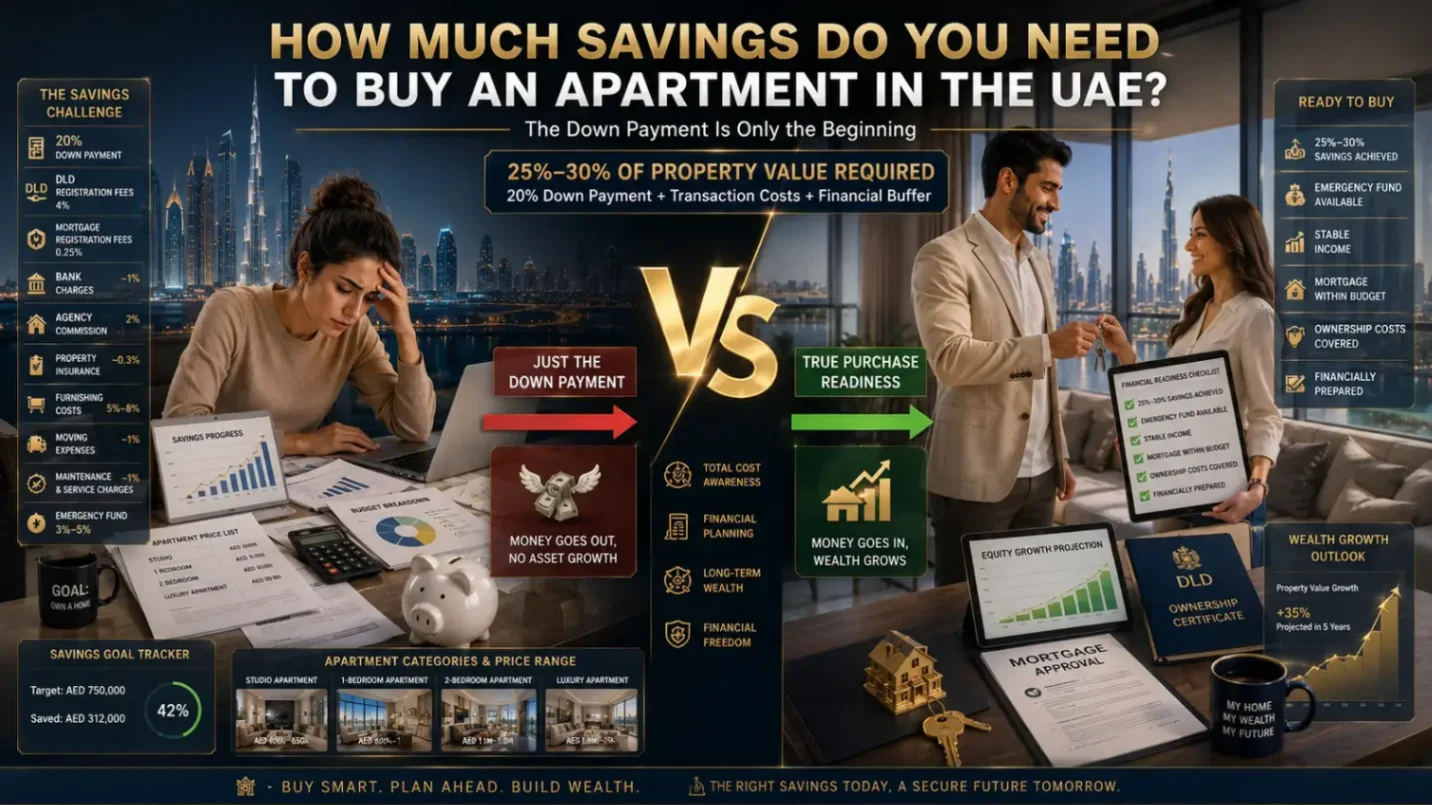
Most people assume buying a property in the UAE simply means saving for a down payment. That assumption is incomplete—and in many cases, financially misleading. In reality, the required savings depend on far more than the property price alone. Buyers must account for upfront transaction costs, bank-related fees, registration charges, and additional expenses that arise during and after the purchase process. These can significantly increase the actual cash required at the time of buying. Beyond the initial transaction, it is also important to maintain a financial buffer for post-purchase costs such as furnishing, maintenance, service charges, and unexpected expenses. Without this buffer, even a well-planned purchase can create financial pressure after completion. This guide breaks down the true amount of savings required to buy an apartment in the UAE, based on real market conditions, helping buyers understand the full financial commitment before making a decision. Minimum Savings Required (Basic Rule) For most expat buyers in the UAE, the upfront financial requirement goes beyond just the down payment. A realistic budget must include both mandatory transaction costs and a safety buffer for post-purchase expenses. Down Payment Typically, buyers need to contribute around 20% of the property value as a down payment when financing through a mortgage. Additional Upfront Costs On top of the down payment, buyers should account for approximately 6%–8% of the property value. This includes registration fees, bank-related charges, and other transaction costs involved in completing the purchase. Recommended Financial Buffer An additional 3%–5% buffer is advisable to cover unexpected expenses such as adjustments, minor repairs, or immediate post-purchase costs. Total Realistic Savings Requirement When combined, the total savings required usually comes to around 30% of the property value for a safe and well-prepared purchase. Savings Breakdown by Property Type Studio Apartment Minimum savings required: AED 180K – 240K This range typically covers the down payment, transaction fees, and basic post-purchase financial buffer under standard mortgage financing conditions. 1-Bedroom Apartment Minimum savings required: AED 270K – 450K At this level, upfront costs increase proportionally, and buyers should account for higher registration fees and additional financial cushioning after purchase. 2-Bedroom Apartment Minimum savings required: AED 450K – 750K Larger properties require higher down payments and transaction costs, making proper liquidity planning essential before committing to purchase. Luxury Apartments Minimum savings required: AED 750K – 1.5M+ Luxury properties involve higher transaction values, larger down payments, and increased service charges. Buyers should also account for stricter lending conditions and higher post-purchase maintenance costs. Duplexes Minimum savings required: AED 540K – 900K Duplexes sit between apartments and villas in terms of cost and typically require higher liquidity due to larger layouts and premium pricing per unit. Villas Minimum savings required: AED 750K – 1.8M+ Villas require the highest financial commitment, with larger down payments, higher maintenance costs, and more significant ongoing expenses. Proper cash flow planning is essential before purchase. These ranges assume standard mortgage financing, average market fees, and a conservative financial buffer to ensure post-purchase stability. Hidden Costs Most Buyers Forget Many buyers focus only on the down payment and underestimate the true cash required to complete a property purchase. In reality, several additional costs apply during and immediately after the transaction. Dubai Land Department (DLD) Fee A mandatory 4% of the property value is payable as a government registration fee when transferring ownership. Mortgage Registration Fee If the property is financed, an additional fee is required to register the mortgage with the relevant authorities. Bank Processing and Valuation Fees Banks typically charge processing fees along with an independent property valuation cost before approving the loan. Real Estate Agency Fees In many transactions, buyers also pay commission fees to the real estate broker involved in the purchase. Property Insurance Home insurance may be required depending on the lender, covering potential risks and damages. Moving and Furnishing Costs After purchase, buyers often incur additional expenses for relocation, furnishing, and setting up the property for occupancy. Salary vs Savings Reality in the UAE Even when a buyer is eligible for a mortgage, the ability to actually save enough for a property is a separate challenge that depends heavily on income, lifestyle, and financial discipline. In many cases, residents in the UAE are able to save around 20%–40% of their monthly income, depending on rent levels, family responsibilities, and overall cost of living. Based on this, accumulating the required savings for a typical property—such as AED 300,000—can realistically take anywhere from 3 to 7 years. This gap between eligibility and actual savings capacity is often underestimated, which leads to delays in purchase readiness even for approved buyers. To help address this, PropertySeller provides tools such as a mortgage calculator, rental income estimator, and eligibility checker, allowing buyers to assess affordability, estimate monthly commitments, and understand their true readiness before entering the market. When You Are Actually Ready to Buy A property purchase in the UAE is financially sustainable only when your savings, income stability, and monthly commitments are aligned with long-term affordability. You are generally in a strong position to buy when you have saved around 25%–30% of the property value, allowing you to comfortably cover the down payment, transaction costs, and initial post-purchase expenses. Your monthly mortgage payment should also remain within 30%–40% of your income, ensuring that housing costs do not create pressure on other essential expenses or lifestyle needs. In addition, you should still have a separate emergency fund in place after purchase, along with the ability to cover ongoing costs such as service charges and maintenance without financial strain. If these conditions are not met, entering the market too early can reduce financial flexibility and increase long-term risk, especially in a market where costs extend beyond just the monthly EMI. Conclusion Buying apartments for sale in Dubai is not just about meeting a down payment requirement. It is about ensuring you have enough upfront capital, sufficient post-purchase liquidity, and stable income to support long-term ownership without financial strain. A purchase decision becomes healthy only when all three factors are aligned. Anything less can turn ownership into a short-term burden instead of a long-term financial advantage. Property decisions in this market are often distorted by incomplete cost assumptions and marketing-driven pricing. The real challenge is not finding a property—it is understanding whether you are actually ready for it. Frequently Asked Questions 1. How much money do I really need to buy an apartment in the UAE? Most buyers think they only need a 20% down payment, but that is incomplete. In reality, you should plan for around 25%–30% of the property value to cover down payment, DLD fees, bank charges, and basic setup costs. PropertySeller always advises budgeting beyond the minimum eligibility to avoid financial pressure after purchase. 2. Is 20% down payment enough to buy property in Dubai? It is enough to qualify for a mortgage in many cases, but not enough for total affordability. You will still need extra funds for: DLD fee (4%) Bank processing and valuation fees Agency fees Moving and furnishing 3. Can I buy property in the UAE with a low salary? Technically yes, if you qualify for a mortgage. But affordability is more important than eligibility. PropertySeller recommends ensuring your EMI does not exceed 30–40% of your monthly income, otherwise long-term financial strain becomes likely. 4. What is the minimum savings for a studio apartment in Dubai? For a typical studio priced between AED 600K–800K, you should expect to save roughly AED 180K to AED 240K minimum. This includes down payment and essential purchase-related fees. PropertySeller emphasizes that cheaper entry price does not mean low total cost. 5. How long does it take to save enough to buy a property in UAE? It depends on income and lifestyle, but for most residents – saving AED 250K–400K can take 3 to 7 years. PropertySeller uses this timeline analysis to help buyers understand whether renting longer or buying earlier makes more sense financially. 6. Is it better to buy off-plan or ready property with limited savings? Off-plan properties often require lower initial payments, making them more accessible. However, ready properties provide immediate rental income potential. PropertySeller evaluates both based on buyer affordability and long-term goals, not just entry price. 7. Can I get 100% financing for property in UAE? No standard mortgage covers 100% of property value. Even UAE nationals usually need some level of down payment. PropertySeller advises buyers to prepare for at least 15%–25% upfront contribution depending on eligibility.
Jun 9, 2026
Read More
Dubai residents face one major financial question sooner or later: should you continue renting or start paying a mortgage? At first glance, renting often appears cheaper because it requires less upfront commitment. Buying, on the other hand, comes with a down payment, registration fees, and long-term obligations. However, comparing rent and EMI based solely on monthly payments can lead to the wrong decision. The reality is that the cost of housing in Dubai extends far beyond a simple rent-versus-mortgage comparison. Factors such as property appreciation, service charges, maintenance expenses, mortgage rates, and equity accumulation can significantly influence the long-term financial outcome of each option. As Dubai's real estate market continues to attract residents, investors, and expatriates, more people are evaluating whether homeownership offers better value than long-term renting. The answer depends on income stability, lifestyle plans, financing eligibility, and how long you expect to remain in the emirate. This guide explores the true cost of renting versus buying in Dubai by examining monthly expenses, upfront costs, hidden ownership charges, equity growth, and long-term wealth creation. Whether you're a first-time buyer, an existing tenant, or an investor assessing your options, understanding the full financial picture is essential before making a decision. By the end of this guide, you'll have a clearer understanding of when renting makes financial sense, when buying becomes the smarter choice, and how to calculate the break-even point based on your personal circumstances and Dubai's current property market conditions. Understanding Rent vs EMI Before comparing the cost of renting and buying in Dubai, it is important to understand what rent and EMI actually represent from a financial perspective. Rent is a recurring payment made to a landlord in exchange for the right to occupy a property. Once the payment period ends, no ownership interest is created, and the money spent does not contribute to building an asset. An EMI (Equated Monthly Installment) is the monthly payment made toward a home loan. Each payment typically consists of two components: principal repayment and interest. While the interest portion is a financing cost, the principal portion increases your ownership stake in the property over time. The key difference is straightforward: Rent is a housing expense. EMI is partly a housing expense and partly an investment in an asset. This distinction is what makes the rent-versus-buy decision more complex than simply comparing monthly payments. A renter may have lower upfront costs and greater flexibility, while a homeowner gradually builds equity and may benefit from long-term property appreciation. Example: A Typical Dubai Apartment Consider a property worth AED 1 million. Renting Annual rent: AED 75,000 Monthly equivalent: AED 6,250 Buying Property value: AED 1,000,000 Down payment (20%): AED 200,000 Mortgage amount: AED 800,000 Mortgage tenure: 25 years Estimated EMI: AED 4,700–5,000 At first glance, the EMI may actually be lower than the monthly rent. But the comparison does not stop there. The Hidden Costs of Buying When comparing rent and EMI, it is important to consider the additional costs that come with property ownership. These expenses can significantly affect the overall cost of buying a home. Dubai Land Department (DLD) Fee The Dubai Land Department charges a fee of 4% of the property value when a property is purchased. This is one of the largest upfront costs buyers need to budget for. Mortgage Registration Charges Buyers financing their purchase through a mortgage must also pay registration fees associated with recording the loan with the relevant authorities. Property Valuation Fee Lenders typically require an independent property valuation before approving a mortgage. This cost is paid by the buyer as part of the financing process. Service Charges Apartment owners are responsible for annual service charges that cover the maintenance and operation of common areas, building facilities, and community infrastructure. Maintenance Expenses Property owners are responsible for repairs, upkeep, and ongoing maintenance costs, which can vary depending on the age and condition of the property. Property Insurance Many homeowners choose or are required to maintain property insurance to protect against potential damage and financial loss. The Hidden Cost of Renting Renting offers flexibility and lower upfront costs, but there are several long-term factors that tenants should consider when comparing renting with homeownership. No Equity Creation One of the biggest financial differences between renting and buying is that rent payments do not create ownership. Regardless of how long a tenant occupies a property, the payments made do not contribute toward building an asset or accumulating equity. Rising Rental Prices Rental costs in Dubai can increase over time depending on market conditions and community demand. As rents rise, tenants may face higher housing expenses without gaining any ownership interest in the property. Limited Control Tenants are subject to lease terms, renewal conditions, and landlord decisions. Changes in rental pricing, lease renewals, or property availability can affect long-term housing stability and flexibility. Long-Term Financial Impact While renting may offer greater mobility and lower upfront commitments, the cumulative cost of rent over many years can be substantial. Evaluating these long-term financial implications is an important part of deciding whether renting or buying is the better option. What Happens After Five Years? A short-term comparison between rent and EMI can be misleading. The real difference often becomes more visible when looking at the financial outcome over several years. Renting for Five Years A tenant paying AED 75,000 per year in rent will spend approximately AED 375,000 over a five-year period. While this provides housing throughout that time, the payments do not create any ownership interest in the property. Ownership stake: AED 0 Buying for Five Years A homeowner makes monthly mortgage payments while gradually reducing the outstanding loan balance. Over time, a portion of each EMI contributes toward property ownership, helping build equity in the asset. In addition to having a place to live, the homeowner accumulates value that may potentially be recovered through resale, subject to market conditions and property performance. Ownership stake: Increases with every mortgage payment The Long-Term Difference This is where the financial distinction between renting and buying becomes more apparent. While both options involve ongoing housing costs, buying allows part of those payments to contribute toward ownership, whereas rent remains a recurring expense with no asset accumulation. Over longer periods, this difference can play a significant role in overall wealth creation and financial planning. Renting vs Buying in Dubai: Advantages and Disadvantages Before deciding between rent and EMI, it is important to understand that neither option is universally better. The right choice depends on your financial situation, future plans, and long-term goals. Advantages of Renting Lower Upfront Costs Renting requires significantly less initial capital compared to buying. Tenants typically need a security deposit, agency fee, and advance rent payments, while buyers must arrange a down payment and property registration costs. Greater Flexibility Renting is ideal for individuals who may relocate for work, education, or lifestyle reasons. Lease agreements offer more flexibility than owning a property. No Maintenance Responsibility Major maintenance and structural repairs are generally the landlord's responsibility, reducing unexpected expenses for tenants. Easier Market Entry Renting allows residents to live in premium communities without the substantial capital commitment required for ownership. Disadvantages of Renting No Wealth Creation Monthly rent payments do not build ownership or equity. Once rent is paid, that money cannot be recovered. Exposure to Rental Increases Dubai's rental market can fluctuate significantly. Tenants may face higher renewal rates over time, increasing long-term housing costs. Limited Control Tenants have restrictions regarding renovations, modifications, and long-term planning for the property. Long-Term Cost Accumulation Over many years, total rent paid can become substantial without creating any asset ownership. Advantages of Buying Equity Building Each mortgage payment contributes toward ownership of the property. Over time, homeowners build an asset that can be sold, refinanced, or passed on. Potential Capital Appreciation Dubai properties in strong locations may increase in value over the long term, creating additional wealth beyond monthly mortgage payments. Protection Against Rising Rents Homeowners with fixed-rate mortgages enjoy greater payment stability compared to tenants exposed to rental market fluctuations. Investment Potential Property owners can generate rental income if they decide to lease the property in the future, creating an additional source of returns. Greater Control Owners can renovate, customize, and improve their property according to their preferences and lifestyle needs. Disadvantages of Buying Higher Upfront Costs Buying requires a down payment, Dubai Land Department fees, mortgage registration fees, valuation charges, and other acquisition costs. Ongoing Ownership Expenses Homeowners are responsible for service charges, maintenance, insurance, and repair costs that renters typically avoid. Reduced Flexibility Selling a property takes time and may involve transaction costs, making ownership less suitable for short-term residents. Market Risk Property values can rise or fall depending on economic conditions, supply, demand, and location-specific factors. FACTOR RENTING BUYING Upfront Cost Lower Higher Monthly Commitment Rent Payment Mortgage EMI Equity Creation No Yes Flexibility High Moderate Maintenance Costs Usually Landlord Owner Long-Term Wealth Building Limited Strong Potential Potential Investment Returns None Possible Rental Yield & Appreciation The most common mistake is comparing only the monthly rent with the monthly EMI. A more accurate approach is evaluating the total cost of occupancy versus the long-term value created through ownership. If you plan to stay in Dubai for a short period, renting may offer greater flexibility and lower upfront commitment. If you intend to stay for several years and your EMI is comparable to local rental prices, buying may provide stronger long-term financial benefits through equity accumulation and potential property appreciation. The decision should always be based on verified market data, total ownership costs, and your future plans—not just the monthly payment amount. To support this, PropertySeller provides tools such as a mortgage calculator and rental income calculator, helping buyers accurately estimate costs, compare scenarios, and make more informed financial decisions. Final Thoughts Comparing EMI and rent is not just about identifying which option has the lower monthly payment. It is a broader financial decision that involves evaluating short-term affordability against long-term value creation. Renting can offer flexibility and lower entry barriers, making it suitable for those with uncertain timelines or short-term residency plans. Buying, on the other hand, can support long-term wealth creation through equity accumulation and potential property appreciation, depending on market conditions. The right decision depends on personal financial stability, expected length of stay, and long-term goals. A clear understanding of total costs—rather than monthly payments alone—is essential to avoid misleading comparisons. PropertySeller helps buyers evaluate both renting and ownership scenarios using real market data, transparent pricing analysis, and practical investment insights, enabling more informed and confident property decisions. Frequently Asked Questions 1. Is it cheaper to rent or buy in Dubai in 2026? There is no universal answer. Renting is better for short-term flexibility and lower upfront costs. Buying becomes financially stronger when your stay exceeds 4–5 years and your EMI is close to or lower than market rent. PropertySeller always recommends evaluating total ownership cost, not just monthly payments. 2. How long should I stay in Dubai before buying property? Typically, if you plan to stay less than 2–3 years, renting is financially safer. For 5 years or more, buying often becomes more cost-efficient due to equity building and avoided rent inflation. PropertySeller uses a break-even analysis model to help buyers decide based on real numbers, not assumptions. 3. Can expats get a mortgage in Dubai? Yes. Expats can access mortgage financing from UAE banks, subject to income, credit history, and employment stability. Loan-to-value ratios vary, but PropertySeller always recommends checking eligibility early before selecting a property. 4. Can I switch from renting to buying easily in Dubai? Yes, but timing and financial readiness matter. Buyers should first evaluate mortgage eligibility, down payment readiness, and total ownership costs. PropertySeller helps users transition by comparing their current rent with potential EMI scenarios. 5. Does paying EMI build equity in Dubai property? Yes. Unlike rent, a portion of every EMI reduces your loan principal, gradually increasing your ownership share. Over time, this builds an asset that can be sold or rented. PropertySeller highlights equity growth as a key long-term advantage of buying.
Jun 9, 2026
Read More
Many buyers look at UAE property not just for returns, but also for residency. The idea sounds simple. Buy a property, get a visa, and gain access to living in the country. But this is where confusion starts. Property investment and residency are linked, but they are not the same thing. This blog explains the difference between property investment and residency benefits in the United Arab Emirates. We break down how each works, what you actually get, and what buyers often misunderstand. The goal is to help you make a clear decision based on facts, not assumptions. What Is Property Investment? Property investment means buying real estate with the goal of making a return. This return can come from: Rental income Property value growth Long-term resale The focus here is financial. You are putting money into an asset and expecting it to grow or generate income over time. A good investment depends on location, developer quality, market timing, and demand. Residency is not the main goal in this case. What Are Residency Benefits? Residency benefits allow you to live in the UAE for a fixed period. These are usually linked to visa programs. Some of these visas are tied to property ownership. Key points: Residency is not automatic with every property purchase There are minimum property value requirements The visa is valid for a set period and must be renewed Residency gives you the right to stay in the country, open bank accounts, and access services. It does not mean citizenship. Property Investment: What You Get When you invest in property, your benefits are tied to money and asset value. Income Potential You can rent out the property and earn regular income. Capital Growth If the market improves, your property value may rise. Asset Ownership You own a physical asset that can be sold later. This path is about returns. If the numbers do not make sense, the investment is weak, no matter what extra benefits are offered. Residency Benefits: What You Get Residency is about access and stability, not profit. Right to Stay You can live in the UAE legally for the visa period. Access to Services You can open a bank account, rent homes, and use local services. Family Sponsorship In many cases, you can sponsor family members under your visa. But there is no direct financial return from residency itself. It is a lifestyle benefit. Minimum Investment for Residency To qualify for a property-linked visa, you must meet a minimum property value. This amount can change based on rules and location. In general: Lower-tier visas require a set minimum property value Long-term visas require higher investment The property must often be completed, not under construction. Some rules also require full payment or a certain level of equity. Do not assume any property qualifies. Always check the latest requirements before buying. Key Difference: Purpose This is where most buyers get it wrong. Property investment = financial return Residency = lifestyle and legal stay If you mix these two without clarity, you may end up with a poor investment just to secure a visa. Can One Property Serve Both Goals? Yes, but only if it meets both conditions. The property must: Be in a strong location for rental demand Meet the minimum value for visa eligibility Be from a reliable developer Have good resale potential If even one of these factors is weak, you are making a compromise. Risks of Buying Only for Residency Many buyers focus only on getting a visa. This is a mistake. Common risks: Overpaying for a property Buying in a weak location Low rental demand Poor resale value A visa does not fix a bad investment. You may end up holding an asset that does not perform. Risks of Ignoring Residency Factors The opposite mistake also happens. Some buyers focus only on returns and ignore visa rules. This can lead to: Property not meeting visa requirements Delays in application Rejection due to eligibility issues If residency matters to you, you must plan for it from the start. Costs Involved Both paths come with costs. For Property Investment Purchase price Registration fees Service charges Maintenance For Residency Visa application fees Renewal costs Medical and admin charges These costs add up. You must factor them into your decision. Long-Term vs Short-Term Thinking Serious buyers think long term. Investment returns take time Property markets move in cycles Residency visas need renewal If you are looking for quick gains or instant benefits, you are likely setting the wrong expectations. What Smart Buyers Do Smart buyers separate their goals first. Decide if your main goal is income or residency Choose a property that fits that goal Only combine both if the numbers and rules align They do not chase offers or promises. They rely on data, location, and clear terms. To get started, explore properties for sale in Dubai that offer strong investment returns and a good lifestyle. Common Misconceptions Let’s clear a few myths: Buying any property does not guarantee residency Residency does not mean citizenship High price does not mean good investment Rental income is not always stable If you believe these, you are likely to make poor decisions. Conclusion Property investment and residency benefits in the UAE are connected, but they serve different purposes. One is about returns. The other is about access and lifestyle. Mixing them without clarity leads to weak decisions. A strong approach starts with a clear goal. If you want returns, focus on numbers and market strength. If you want residency, meet the requirements without overpaying. If you want both, make sure the property supports both without compromise. At PropertySeller, we keep this process clear and grounded. Your data stays secure at every step. We provide real, accurate property details with no hidden gaps. Every listing goes through strict checks and full verification. No duplicates. Only clean, trusted options so you can choose based on facts, not assumptions. FAQ’s 1. Does buying property in the UAE automatically give residency? No. Residency is not automatic. You must meet specific property value and eligibility rules to qualify for a visa. 2. What is the minimum property value required for residency? There is a set minimum value, but it can change based on visa type and rules. Always check current requirements before buying. 3. Do off-plan properties qualify for residency visas? In many cases, no. Most visas require a completed property or a certain level of payment already made. 4. Is residency in the UAE permanent with property ownership? No. Residency visas are valid for a fixed period and must be renewed. 5. What are the risks of buying property only for residency? You may overpay, choose a weak location, or end up with low rental returns. A visa does not make a bad investment better. 6. Can expats get residency by buying property in the UAE? Yes, expats can apply for residency through property ownership if they meet the required property value and visa conditions set by UAE authorities.
Jun 5, 2026
Read More
Technology is changing how people live. In the UAE, many new properties now come with smart features. These homes promise more control, comfort, and efficiency. At the same time, traditional apartments still dominate the market and remain a solid choice for many buyers. This blog explains the difference between smart homes and traditional apartments in the United Arab Emirates. We break down features, costs, returns, and risks. The goal is to help you choose based on real value, not just trends. What Is a Smart Home? A smart home uses technology to control and automate systems inside the property. This includes: Lighting control Smart thermostats Security systems Voice or app-based controls Many smart homes are found in newer developments in Dubai and other growing areas. These homes focus on convenience and modern living. What Is a Traditional Apartment? A traditional apartment does not rely on advanced automation. Systems like lighting, cooling, and security are manual or basic. These properties are common across older and established areas. They offer: Simple setup Lower cost Proven demand Traditional apartments are practical and easy to manage. Cost Comparison Smart homes usually cost more. You are paying for built-in technology, automation systems, and modern design. These features increase the upfront price and can also raise service charges in some buildings. Over time, upgrades or system updates may add extra costs. Traditional apartments are more affordable. The lower entry price makes it easier to enter the market and can improve rental yield if the location is strong. Maintenance and service costs are also usually simpler and more predictable. Do not assume higher cost means better investment. You must compare the total value, including rent potential, ongoing costs, and long-term demand before making a decision. Maintenance and Repairs Smart homes may need specialized maintenance. If systems fail, repairs can be more complex, slower, and more expensive because they often require trained technicians or specific software support. Even small issues in automation systems can affect daily use until fixed. Traditional apartments are easier to maintain. Most repairs are simple, and services are widely available in the market. You are not dependent on advanced systems, so fixes are usually faster and cheaper. If you want fewer technical issues and lower long-term stress, traditional units are easier to handle. Energy Efficiency Smart homes are designed to reduce energy use. Features like automated lighting and climate control can lower utility bills. Traditional apartments may not have these features, which can lead to higher energy use. If long-term savings matter, smart homes have an edge here. Tenant Demand Demand depends on the target tenant. Smart homes usually attract tech-focused tenants and younger renters who value modern features and convenience. These tenants are often willing to pay a bit more for upgraded living. Traditional apartments attract a wider tenant base because they are more affordable and practical for most people. They work well for families, long-term tenants, and budget-focused renters. In many cases, affordability drives demand more than technology. A lower rent often keeps occupancy more stable than premium features alone. Rental Income Potential Smart homes may command slightly higher rent due to added features. But this depends on location and tenant demand. Traditional apartments may offer better ROI because: Lower purchase price Stable demand Do not expect smart features alone to increase rent significantly. Risks To Consider Both options come with risks, but they show up in different ways. Smart homes carry risks like higher upfront cost, systems becoming outdated over time, and more complex repairs when technology fails. These issues can add cost and effort if you are not prepared for them. Traditional apartments come with risks such as lower appeal in premium markets, higher energy use, and fewer modern features compared to new builds. This can affect rent levels in certain areas. You need to decide which type of risk you are more comfortable handling, cost and tech risk or market and demand risk. For more explore apartments for sale in Dubai.. Key Difference: Convenience vs Practical Value Factor New Apartments Old Apartments Cost Higher Lower Technology Advanced Basic Maintenance Complex Simple Energy Use Efficient Standard Tenant Appeal Niche Broad Smart homes focus on convenience and modern living. Traditional apartments focus on affordability and stability. Who Should Choose Smart Homes? Smart homes are not for everyone. They suit buyers who value convenience and are willing to pay for it. Choose a smart home if you: Want modern features and automation Prefer energy efficiency and lower utility use Target premium or tech-focused tenants Are comfortable handling tech systems and updates If you are buying for lifestyle or premium rental, smart homes can make sense. But if you are only chasing returns, you need to check the numbers carefully. Who Should Choose Traditional Apartments? Traditional apartments are a safer and more practical choice for most buyers. Choose a traditional apartment if you: Want lower upfront cost Prefer stable and steady rental income Want fewer maintenance issues Target a wider tenant base If your goal is consistent returns with less effort, traditional apartments are usually the better option. Choosing the Right Option Do not chase trends. Focus on what works for your goal. Choose smart homes if you want modern features and long-term efficiency. Choose traditional apartments if you want lower cost and steady demand If you cannot clearly justify your choice, you are guessing. Final Check Before You Decide Before buying, review the basics. Check total cost, expected rent, and maintenance needs. Look at tenant demand in the area. Do not rely on features alone. A good investment is based on numbers, not hype. Final Thoughts Smart homes offer convenience, automation, and energy efficiency. Traditional apartments offer affordability, simplicity, and stable demand. There is no clear winner. The better option depends on your budget, target tenants, and investment goal. At PropertySeller, we keep things clear and reliable. Your data stays secure at every step. We provide real, accurate property details with no hidden gaps. Every listing goes through strict checks and full verification. No duplicates. Only clean, trusted options so you can choose with clarity and avoid costly mistakes. FAQ’s 1. Are smart homes a better investment than traditional apartments in the UAE? Not always. Smart homes offer modern features, but traditional apartments often give better stability and wider tenant demand. 2. Do smart homes increase rental value? Sometimes, but not always. Rent depends more on location and demand than technology alone. 3. Which type has better tenant demand? Traditional apartments usually attract more tenants due to affordability. Smart homes appeal to a smaller, niche group. 4. Are smart homes worth the higher cost? Only if the location and rental demand support higher pricing. Otherwise, the extra cost may not return value. 5. Can I convert a traditional apartment into a smart home? Yes, in many cases. Basic smart features can be added, but full automation depends on the building setup.
Jun 5, 2026
Read More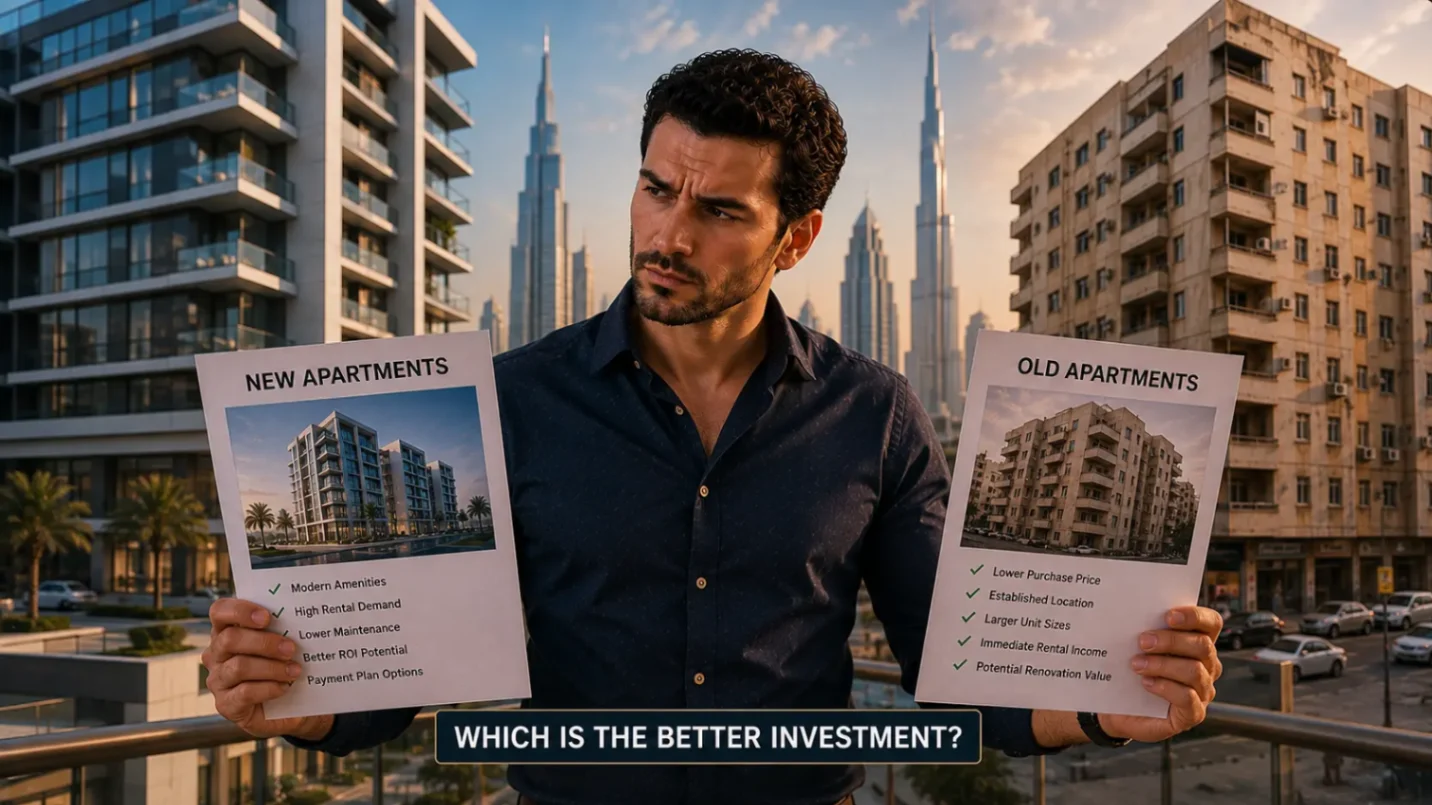
When buying property in the UAE, one common question comes up. Should you invest in a new apartment or go for an older one? Both options have their own benefits and risks. The right choice depends on your goals, budget, and how you plan to use the property. This blog explains the key differences between new and old apartments in the United Arab Emirates. We break down costs, returns, risks, and what buyers often miss. The goal is to help you make a clear decision based on facts, not assumptions. What Is a New Apartment? A new apartment is either recently completed or still under construction. These are often part of new projects with modern designs, updated layouts, and fresh amenities. Buyers are drawn to new units because they offer: Modern interiors Smart layouts New building facilities Flexible payment plans (if off-plan) However, new does not always mean better investment. What Is an Old Apartment? An old apartment is a unit that has been completed for several years. It may have had previous owners or tenants. These properties often offer: Lower purchase price Established location Immediate rental income Larger layouts in some cases Older units may not look modern, but they can still perform well as investments. Price Difference This is where most buyers start. New apartments are usually priced higher. You are paying for modern design, branding, and new construction. Old apartments often cost less per square foot. This lower entry price can improve your ROI if rental demand is strong. If your budget is tight, older units may offer better value. Rental Yield Comparison Rental yield is key for investors. Old apartments often provide higher rental yields because: Purchase price is lower Rent levels in established areas remain strong New apartments may have lower yields at first due to higher purchase cost. But they may attract higher rent in premium locations with strong demand. Hidden Costs You Should Not Ignore Most buyers focus only on the purchase price. That is a mistake. The real cost of a property goes beyond what you pay upfront. For new apartments, you may face service charges, handover fees, and higher prices tied to branding or new launches. For off-plan units, delays can also add indirect costs. For old apartments, renovation and repair costs can add up fast. You may need to upgrade interiors, fix systems, or deal with higher ongoing maintenance. If you ignore these costs, your ROI will not match your expectations. Always calculate the full cost before making a decision. Explore Apartments for sale in Dubai in PropertySeller. Maintenance and Upkeep New apartments require less maintenance in the early years. Everything is new, so repair costs are low. Old apartments may need: Renovation Regular repairs Higher maintenance costs If not managed well, these costs can reduce your returns. Payment Flexibility New apartments, especially off-plan units, often come with flexible payment plans. You can pay in stages over time. Old apartments usually require: Full payment Or mortgage approval There are no staged payment options like off-plan deals. If cash flow is a concern, new apartments may be easier to manage. Location Advantage Old apartments are often located in well-developed areas like Dubai. These areas have established infrastructure, strong rental demand, and better connectivity. New apartments may be in developing areas. These locations can grow over time, but they also carry risk. Location matters more than whether the unit is new or old. Capital Appreciation New apartments may have better price growth if bought early in a developing area. Old apartments may grow slower in value, but they are more stable. If your goal is long-term appreciation, new projects in growth areas may offer better upside. But this comes with higher risk. Explore apartments in Abu Dhabi to find modern homes with flexible payment plans and strong long-term investment potential. Risk Factor Both options carry risk, but in different ways. New Apartments Risks Project delays (for off-plan) Overpricing Uncertain future demand Old Apartments Risks Higher maintenance costs Outdated design Lower appeal to some tenants You must decide which risk you are willing to take. Tenant Demand Tenant preference varies. New apartments attract tenants who want modern living. Old apartments attract tenants looking for lower rent or better locations. Both can perform well if priced correctly. Key Difference: Cost vs Convenience Factor New Apartments Old Apartments Price Higher Lower Maintenance Low (initially) Higher Payment Options Flexible (off-plan) Limited Rental Yield Moderate Often higher Risk Market & delay risk Maintenance & aging risk New apartments offer convenience and modern living. Old apartments offer value and better yield in many cases. How to Choose the Right Option Do not pick based on what “feels better.” Base your choice on your goal. Choose new if you want modern features and flexible payments. Choose old if you want better yield and lower entry cost. Check the numbers. Compare rental income, costs, and location. If you skip this step, you are guessing. Quick Check Before You Commit Before you decide, review the basics. Check the true cost, expected rent, and ongoing expenses. Verify the location, demand and building condition. Do not rely on sales talk. If something is unclear, pause and verify. A rushed decision leads to poor returns. Conclusion New and old apartments in the UAE offer different investment paths. The right choice depends on your goal, budget, and risk tolerance. If you want steady income, older units may perform better. If you want long-term growth and flexibility, new projects may suit you. At PropertySeller, we keep this process clear and reliable. Your data stays secure at every step. We provide real, accurate property details with no hidden gaps. Every listing goes through strict checks and full verification. No duplicates. Only clean, trusted options so you can choose with confidence and avoid costly mistakes. FAQ’s 1. Are new apartments better than old ones in the UAE? Not always. New apartments offer modern features, while old ones often give better value and higher rental yield. 2. Which option gives better rental returns? Old apartments often provide higher ROI due to lower purchase prices and steady rental demand. 3. Are old apartments a risky investment? They can be if not checked properly. Poor condition and high repair costs can reduce returns. 4. Do new apartments have better resale value? They may have higher growth potential, especially in developing areas, but it depends on location and market demand. 5. Which locations are better for old apartments? Established areas like Dubai often have older properties with strong rental demand.
Jun 5, 2026
Read More
Buying an Apartment in Dubai or a property looks simple from the outside. Listings are everywhere, payment plans appear flexible, and the market seems transparent. But once you go through it, you realize something important—what matters is not just the property you choose, but how well you understand the process behind it. There are decisions you only learn to question after you’ve already made them. At PropertySeller, we’ve seen a pattern. Most buyers don’t regret buying property—they regret how they approached it. The decisions that seem small at the beginning tend to have the biggest impact later. This is a collection of things many buyers only understand after going through the process. If you’re planning to buy, these are the areas that deserve more attention than they usually get. Budget Isn’t Just About What You Can Afford The first assumption buyers make is that if they can afford the property price, they are ready to buy. That’s only partially true. What’s often missed is the full cost structure: Down payment Registration and transfer fees Mortgage-related costs Agency fees Service charges and maintenance These costs can significantly change your financial position after purchase. The realization many buyers have later is simple: the purchase price is just the entry point, not the total commitment. Off-Plan Looks Attractive Until Timing Becomes Real Off-plan properties are often marketed with flexible payment plans and lower entry prices. That makes them appealing. What’s not immediately obvious is how the timeline affects you. Construction delays, shifting handover dates, and long payment schedules require patience and financial discipline. Even when projects stay on track, your capital is tied up for a period without immediate return. Many buyers understand the advantage of off-plan at the start, but underestimate the commitment required to wait through the entire cycle. Location Isn’t Just About Popular Areas Before buying, many people focus on well-known locations. The assumption is that popularity equals value. In reality, the performance of a property depends more on: Accessibility Infrastructure around the community Tenant demand within the exact building Future development plans in the surrounding area Two properties in the same district can behave very differently in terms of rental demand and resale value. What matters is not just the name of the area, but how the specific property fits within its surroundings. Developer Reputation Matters More Than Marketing Marketing materials can make any project look appealing. But the real difference lies in execution. A developer’s track record influences: Construction quality Delivery timelines Finishing standards Long-term maintenance of the project Some buyers realize too late that delays or inconsistencies could have been anticipated by reviewing the developer’s history. Trust is not built on presentation—it is built on past delivery. Payment Plans Need to Match Your Cash Flow One of the biggest mistakes buyers make is focusing only on the total price while ignoring how payments are distributed. A property might seem affordable, but if the installment schedule doesn’t align with your income flow, it creates pressure over time. Understanding: When payments are due How frequently installments occur Whether payments are tied to construction milestones helps avoid situations where the structure becomes difficult to sustain. Affordability is not just about total cost—it’s about timing. Service Charges Can Impact Long-Term Returns Many buyers overlook service charges when evaluating a property. These charges vary depending on the building and community and cover maintenance of common areas, facilities, and overall upkeep. Over time, they influence: Net rental income Resale attractiveness Overall cost of ownership Two similar properties can produce very different returns depending on recurring charges. Ignoring this factor leads to incomplete financial planning. Resale Value Should Be Considered From Day One Most buyers think about resale only when they decide to sell. By that time, the options are limited. Resale potential depends on: Layout efficiency Demand in the building Pricing compared to similar units Maintenance and condition over time A property that is easy to rent usually attracts more buyers later as well. Thinking about exit strategy at the entry stage leads to more balanced decisions. Not All Buildings Age the Same Way Two buildings completed in the same year can feel completely different after a few years. Factors like maintenance quality, occupancy levels, and community management influence how a building ages. Some properties maintain their appeal over time, while others start losing value due to neglect or poor upkeep. This is something that becomes visible only after observing how a community evolves. The Buying Process Has More Steps Than Expected On paper, buying property seems like a simple sequence. In reality, it involves coordination between: Buyer Seller or developer Agency Bank (if financing is involved) Registration authorities Each step requires documentation, verification, and timing. Many first-time buyers underestimate how many moving parts are involved until they go through the process themselves. Operational Experience Is Often Ignored (And It Shouldn’t Be) One of the least discussed aspects of property ownership is what happens after the purchase. This includes: Ease of managing tenants Responsiveness of maintenance teams Community rules and approvals Restrictions within the building These factors don’t usually appear in listings, but they affect day-to-day ownership more than people expect. A property can look perfect on paper but feel restrictive in practice if operational aspects are not considered. Conclusion Buying property in Dubai is not difficult—but it becomes complicated when decisions are made without full context. Most of the challenges buyers face are not due to lack of opportunities, but due to missing awareness at the right stages. Understanding the real cost, the importance of timing, developer reliability, and long-term implications helps bring clarity to the process. At PropertySeller, the focus is not just on finding properties, but on helping buyers see the full picture before making a decision. Because in this market, informed choices consistently outperform rushed ones. FAQ’s 1. Is buying property in Dubai a good investment? Yes, but it depends on location, property type, and timing—not every property performs the same. 2. Ready or off-plan—what should I choose? Ready for immediate use or rental income. Off-plan if you want flexible payments and can wait. 3. What extra costs should I expect? Registration fees, agency fees, mortgage costs, and service charges. 4. Biggest mistake buyers make? Focusing only on price and ignoring total costs and long-term implications. 5. How do I check a developer’s reliability? Review their past projects, delivery history, and overall reputation. 6. What are service charges? Ongoing fees for maintenance of the building and common areas.
May 30, 2026
Read More
If you’ve been living in the UAE for a while, this question doesn’t just pop up once—it keeps coming back. You see rents going up every year. You hear people saying “just buy, it’s cheaper.” Then someone else tells you buying is risky. And you’re stuck in between, not really sure what makes sense. This blog is here to clear that confusion. Not by throwing random pros and cons at you, but by actually breaking down what you’re paying, what you’re gaining, and where people usually get it wrong. Renting vs Buying in UAE: What Are You Actually Paying For? Let’s simplify this first, because most people overcomplicate it. When you rent, you’re paying for convenience. You get a place to live, you don’t worry about long-term commitment, and you can move whenever your situation changes. But that’s where it ends. There’s no return on that money. Every payment resets to zero. Buying, on the other hand, feels heavier in the beginning. More paperwork, more money upfront, more responsibility. But the difference is simple—part of what you pay every month is not an expense. It’s ownership. That one shift is what makes this decision important. The Upfront Cost That Scares Everyone This is usually the point where people stop even considering buying. And honestly, it’s understandable. When you rent, you might pay a deposit and some fees. It’s manageable. But when you buy in the UAE, you’re looking at: Around 20% down payment 4% Dubai Land Department fee Agency fees and other charges It’s a big amount. No point sugar coating it. But here’s where people make a mistake—they treat this as a loss, not a shift. That money isn’t disappearing. It’s moving into an asset. Monthly Payments: Where Things Start Getting Interesting Now comes the part most people don’t expect. In many areas across the UAE today, the monthly mortgage you pay is not very different from rent. Sometimes it’s slightly higher. Sometimes it’s almost the same. So if you step back and look at it: You’re either: Paying rent that increases over time Or paying a mortgage that slowly builds ownership This is where the decision starts becoming less about affordability and more about direction. How Banks Actually Decide What You Can Afford Before you get too far into the idea of buying, there’s one rule you need to understand. Banks in the UAE don’t just give loans based on what you want. They look at what you can handle. The key factor is your Debt Burden Ratio. In simple terms, your total monthly loan payments cannot cross 50% of your salary. So if you earn AED 12,000, your total EMI commitments should stay below AED 6,000. And this includes everything—car loans, credit cards, personal loans. This is why two people with the same salary can end up qualifying for completely different properties. When Buying Starts Making Sense (And When It Doesn’t) This is the part most blogs avoid being clear about. Buying does not save you money immediately. In fact, in the first few years, renting is usually cheaper. But over time, things shift. If you stay: Less than 3 years → renting almost always makes more sense Around 3–5 years → you’re in a grey zone Beyond 5 years → buying starts working in your favour Why – Because the upfront costs get spread out, and you’re no longer starting from zero every year. The Part Nobody Explains Properly Here’s something most blogs either ignore or oversimplify. When you buy, your money is locked into the property. When you rent, that same money stays with you. So technically, you could invest it somewhere else and grow it. But let’s be honest for a second. Most people don’t do that. They don’t invest consistently. They don’t track returns. The money just… goes. So what sounds like a “smart financial strategy” on paper doesn’t actually happen in real life. That’s why for many people, buying works—not because it’s perfect, but because it forces discipline. Where People Usually Go Wrong They try to turn this into a yes-or-no decision. It’s not. It depends on how stable your life is right now. If your job is uncertain, or you’re not sure how long you’ll stay in the UAE, buying can become a burden. But if you’re settled, planning to stay, and tired of unpredictable rent increases, continuing to rent might quietly cost you more over time. Starting Apartment Prices Across UAE Before deciding whether to rent or buy, it helps to understand the entry-level pricing across different emirates. Here’s a simple overview of where the market currently starts: Emirate Starting price Dubai From AED 450,000 Abu Dhabi From AED 400,000 Sharjah From AED 350,000 Ajman From AED 200,000 Ras Al Khaimah From AED 300,000 Fujairah From AED 280,000 Umm Al Quwain From AED 250,000 Dubai and Abu Dhabi come with stronger demand and higher pricing, while emirates like Ajman or Sharjah offer much lower entry points—especially for first-time buyers. Average Apartment Prices in Popular Dubai Areas Now let’s narrow it down further, because within Dubai itself, prices vary significantly depending on location. Here’s a realistic snapshot: Area Average Price Range Dubai Marina AED 1.1M - 1.4M Business Bay AED 900K - 1.1M Downtown Dubai AED 1.1M - 1.3M JVC (Jumeirah Village Circle) AED 600K - 700K Dubai South AED 550K - 650K This is where your decision becomes practical. You’re not choosing between “rent vs buy” in general—you’re choosing based on what you can realistically enter. The Costs People Forget to Include This is where planning usually breaks. People calculate property price and EMI—but forget everything else. You’ll also need to account for: Government fees Registration charges Mortgage processing costs Property valuation Ignoring these doesn’t make them disappear. It just creates stress later. So… What Should You Actually Do? If you’re looking for a clean answer, here it is: Renting is easier in the short term Buying becomes smarter in the long term But only if your situation supports it. If you rush into buying without stability, it backfires. If you keep renting without thinking long-term, you stay stuck. Conclusion In reality, the rent vs buy decision is rarely black and white. Market conditions, interest rates, personal stability, income growth, visa plans, and long-term goals all play a role. What looks cheaper today can become expensive over time, and what feels like a heavy commitment now can turn into stability and equity later. At PropertySeller, we’ve seen both sides—people who bought too early, and people who waited too long. Both end up with the same feeling: “I should have thought this through better.” That’s why our approach is simple. We don’t push you to buy. We don’t tell you to keep renting. We look at your situation, your numbers, and your plans—and help you make a decision that actually makes sense for you. FAQ’s Is it cheaper to rent or buy in the United Arab Emirates? It depends on your timeline. Renting is cheaper short-term, while buying can save more over time if you hold the property long enough. How long should I stay in Dubai to make buying worth it? Typically 4–6 years, but the exact break-even depends on price, rent, and financing—not a fixed rule. Are mortgage payments lower than rent in Dubai? In some areas, yes. Mortgage payments can be similar to rent, especially with current market conditions. What upfront costs do buyers need to plan for? Down payment, registration fees, agency fees, and mortgage-related costs—usually around 25–30% of property value. Is renting safer than buying? Renting offers flexibility and lower risk if your future plans are uncertain. Buying carries commitment but builds long-term value.
May 30, 2026
Read More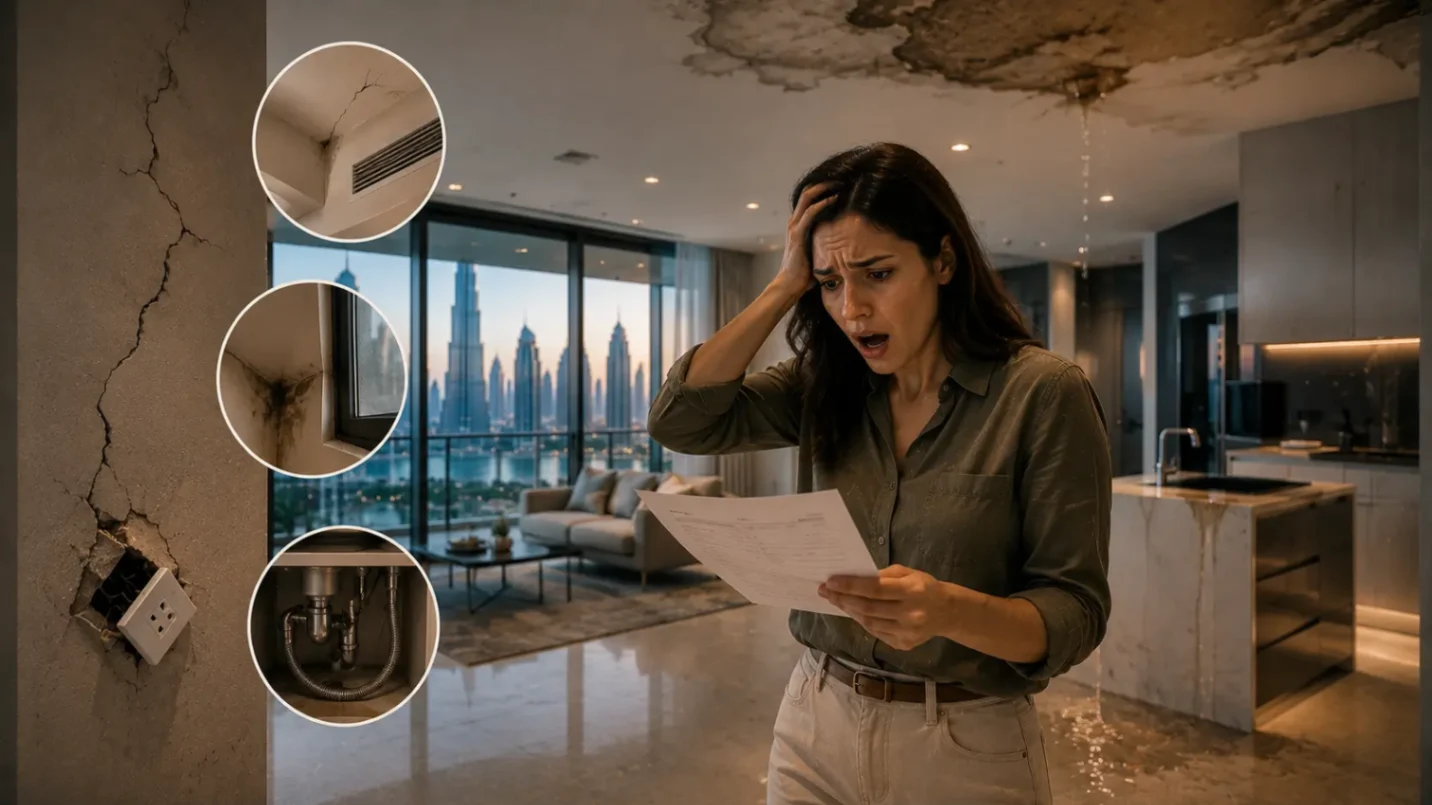
Most apartment issues don’t show up during a viewing. The unit looks clean, the building feels well-maintained, and everything appears in order. That’s exactly the problem. The real risks are structural, financial, and operational—and they only become visible after you’ve already bought. This blog breaks down the hidden problems in UAE apartments that most buyers don’t discover until after purchase. More importantly, it explains how these issues affect your returns, resale value, and long-term ownership experience—because this is where most investment decisions quietly fail. The Problem With How Most Buyers Evaluate Apartments Most buyers focus on visible factors: Price Location Amenities Developer name That’s incomplete. Apartments don’t fail because of what you see. They fail because of what you don’t check: Long-term maintenance behaviour Management quality Cost structure Building aging patterns If you’re only evaluating the visible layer, you’re not investing—you’re reacting to marketing. Service Charges That Don’t Stay Stable Most buyers check current service charges and assume they’ll remain predictable. Almost no one checks how they change. In many buildings: Fees increase year after year Unexpected maintenance costs get added Poor budgeting leads to sudden spikes This directly impacts your rental yield and buyer demand during resale. A property that looks profitable today can become average—or worse—within a few years. Buildings with poor cost control or outdated systems tend to see faster escalation. Poor Building Management (Even in Premium Projects) Here’s a reality most platforms won’t tell you: A well-built property can still perform badly under poor management.. Common issues include: Overpriced vendor contracts Delayed maintenance Lack of cost control Poor tenant handling Two identical buildings can perform completely differently based on management alone. And no—you won’t see this in a brochure. You only feel it when the building starts aging. Construction Quality That Only Shows Later At handover, everything looks new. That’s the trap. Problems usually appear after 1–3 years: Plumbing issues AC inefficiencies Cracks or water leakage Frequent repairs Developers who prioritize speed over durability create long-term cost problems for owners. You don’t detect this during a viewing. You pay for it later. Building Design That Increases Cost Not all buildings are equal in how they are designed to operate. Certain features increase long-term cost: Extensive glass exteriors (frequent cleaning) Large common areas Multiple elevators Complex layouts These are not just design choices—they are cost multipliers. Buyers focus on aesthetics. Investors should focus on operational efficiency. Because ultimately, you pay for how the building functions, not how it looks. Overbuilt Amenities That You Pay For but Don’t Use Pools, gyms, lounges, concierge—sounds great. But here’s the part most buyers ignore: You pay for all of it, whether you use it or not. Buildings overloaded with amenities: Have higher service charges Require more maintenance Need larger operational budgets The result? Lower net returns. Amenities sell the property. Costs stay with you. High Vacancy in Investor-Dominated Buildings Some buildings look active but are actually investor-heavy with low occupancy. This creates: Lower community engagement Higher maintenance cost per occupied unit Reduced rental stability And here’s the impact most people miss: Vacancy affects perception. Perception affects resale. If a building feels empty, demand drops—regardless of how good the unit is. Occupancy Levels and Cost Pressure Low occupancy creates hidden financial pressure. If fewer units are occupied: Costs are distributed across fewer owners Service charges per unit increase Building activity and demand weaken This is common in: Investor-heavy projects Newly completed buildings Over-supplied areas A building can look premium—but if occupancy is low, performance suffers. The “Silent Depreciation” Factor Some buildings don’t crash in value—they slowly become irrelevant. Why? Newer developments enter the market Older buildings lose appeal Facilities become outdated Service charges increase The result is silent depreciation: Rents stagnate Buyers lose interest Value growth slows or stops This doesn’t show up immediately. It builds over time. And by the time you notice it, your exit options are limited. Developer Reputation vs Actual Performance Many buyers rely heavily on developer brands. That’s lazy decision-making. Even strong developers can have: Underperforming projects Management issues post-handover Variations in construction quality You should evaluate: Specific building performance Not just developer reputation Brand gets you confidence. Data gives you accuracy. The Liquidity Trap in “Luxury” Apartments This is the part almost no one talks about. Luxury apartments often: Have higher service charges Require higher entry capital Target a smaller buyer pool This creates a liquidity problem. When you want to sell: Fewer buyers are available Negotiation pressure increases Time on market extends So while luxury buildings look strong, they can become difficult to exit—especially in slower markets. This is not obvious when buying. It becomes obvious when selling. What This Means for Your Investment If you ignore these factors: Your returns get distorted Your costs increase over time Your exit becomes harder This is the difference between: Buying a property vs building an investment Most buyers think they’re doing the second. In reality, they’re doing the first. How to Identify These Problems Before You Buy If you want to avoid these mistakes, shift how you evaluate properties: Check service charge history, not just current cost Understand occupancy levels in the building Evaluate management quality Review actual maintenance condition Compare building performance, not just price If you’re not doing this, you’re missing the variables that actually matter. Final Thoughts Most apartment problems in the UAE are not obvious at the time of purchase. They develop over time through management decisions, cost structures, and market positioning. That’s why surface-level evaluation is not enough. The real risk is not buying the wrong property—it’s buying without understanding how that property behaves after you own it. Long-term performance is shaped by factors most buyers ignore, and those factors only become visible when it’s too late to adjust. At PropertySeller, we focus on what happens beyond the listing. Every property is evaluated based on real performance indicators—service charge behaviour, occupancy trends, and long-term demand—so you’re not relying on assumptions when making a decision. FAQ’s What are common hidden problems in UAE apartments? Hidden issues include rising service charges, poor building management, construction defects, and low occupancy levels that affect long-term value. How do service charges impact property investment in the UAE? High or increasing service charges reduce rental yield and make properties less attractive to future buyers. Are new apartments in Dubai free from defects? No. Many issues like plumbing, AC inefficiency, and structural wear appear after 1–3 years of usage. How can I check if a building is well managed? Review maintenance quality, service charge history, tenant feedback, and overall building condition before buying. Why do some apartments lose value over time in the UAE? Factors like aging buildings, increasing costs, new supply, and declining demand contribute to slow or “silent” depreciation.
May 30, 2026
Read More
Buying property in the UAE is a clear and structured process. The market is open to both residents and non-residents, but the rules must be followed closely. Having the right documents ready helps avoid delays and keeps the deal on track. Without proper paperwork, even a good offer can fall through. This blog explains the key documents needed to buy property in the UAE. We cover what buyers must prepare, what sellers may ask for, and what steps are involved in the process. The goal is to help you move forward with confidence and avoid common mistakes that slow down property purchases. Why Documents Matter in UAE Property Deals The UAE real estate system is regulated. Authorities require proof of identity, financial status, and legal eligibility before any property transfer takes place. Each document serves a purpose. Some confirm who you are. Others confirm how you will pay. Some are needed for registration with government bodies. Missing or incorrect documents can delay or block the transaction. In some cases, deals are cancelled if documents are not complete on time. That is why preparation is not optional. It is a core part of buying property in the UAE. Basic Identification Documents The first step is proving your identity. Buyers must present valid identification documents. Passport Copy A valid passport is required for all buyers. The passport must not be expired. A clear copy of the photo page is usually needed. Visa Copy (if applicable) If you are a resident in the UAE, a valid residence visa is required. Non-residents can still buy property in many areas, but a visa is not mandatory for them. Emirates ID (for residents) UAE residents must provide a copy of their Emirates ID. This confirms legal residency and is often required for registration and banking. These documents confirm your legal identity and eligibility to own property in the country. Proof of Address Buyers are often asked to provide proof of their current address. This may include: Utility bill (electricity, water, or internet) Tenancy contract Bank statement showing address This helps verify where you live and supports compliance checks during the purchase process. Financial Documents Property purchases in the UAE require proof that you can complete the payment. This is a key step, especially if you are applying for a mortgage. Bank Statements Banks or sellers may request recent bank statements. These show your financial stability and available funds. Salary Certificate If you are employed, a salary certificate from your employer may be required. It confirms your income level. Employment Letter An employment letter may be requested to confirm your job status, position, and duration of employment. Mortgage Pre-Approval (if financing) If you plan to take a loan, a mortgage pre-approval letter is required. This is issued by a bank after reviewing your income and credit profile. It shows how much you can borrow. Without financial proof, the seller may not proceed with the deal. No Objection Certificate (NOC) In many cases, a No Objection Certificate is required from the developer. This document confirms that there are no dues on the property and that the seller has permission to transfer ownership. The NOC is issued by the developer of the property, not the buyer. However, the buyer may need to pay a fee for it. Without this certificate, the transfer cannot move forward. Sale Agreement Documents Once both parties agree on the price and terms, a sale agreement is signed. This document outlines: Purchase price Payment plan Transfer date Responsibilities of both buyer and seller The agreement is legally binding. Both parties must sign it before proceeding to the next stage. Reservation Form and Initial Deposit Before the final contract, buyers usually sign a reservation form. This holds the property for a short time. An initial deposit is paid at this stage. The deposit is usually a small percentage of the total price. It shows commitment from the buyer and prevents the seller from accepting other offers during the agreed period. Documents for Property Registration To complete the ownership transfer, documents must be submitted to the land department or relevant authority. Title Deed Transfer The title deed is the official proof of ownership. It must be transferred from the seller to the buyer. Form F (MOU) Form F is a standard contract used in Dubai for property transactions. It includes terms agreed between both parties. Transfer Application Form This form is submitted to the land department to request the official transfer of ownership. Power of Attorney (If Applicable) In some cases, buyers or sellers may appoint a representative to act on their behalf. A Power of Attorney (POA) document allows another person to sign and complete the transaction. The POA must be legally prepared and attested. It must clearly state the powers granted to the representative. Additional Documents for Foreign Buyers Foreign buyers may need extra documents depending on their situation: Proof of funds from overseas accounts Translated documents if not in English or Arabic Attested documents from home country authorities Payment Proofs Payment records are required at different stages of the purchase. These include: Bank transfer receipts Manager’s cheques Payment confirmations The UAE property market relies on clear and traceable payments. Cash payments are not standard for property transfers. Legal and Government Checks Before final transfer, government authorities review the transaction. They check: Validity of documents Ownership status Any debts on the property Compliance with local laws Only after approval will the ownership be transferred. Common Mistakes to Avoid Many buyers face delays due to simple errors. Some common issues include: Expired documents Missing signatures Incorrect spelling of names Incomplete financial proof Delayed NOC from developer Double-check all documents before submission. Small errors can slow down the entire process. Timeline of the Process The document process follows a general timeline: Initial agreement and reservation Submission of documents NOC request from developer Signing of sale agreement Payment of required amounts Registration with authorities Transfer of title deed Each step depends on the completion of documents. Missing paperwork can pause the process at any stage. Role of Banks and Brokers Banks review financial documents before approving loans. Brokers guide buyers through paperwork and help coordinate with sellers and developers. They also ensure that all documents meet legal standards. Working with experienced professionals reduces the risk of mistakes. They help keep the process smooth and clear. Conclusion Buying property in the UAE requires proper documents at every stage. From identity proof to financial records and legal forms, each document plays a role in completing the transaction. Buyers must prepare in advance to avoid delays and meet all requirements set by authorities. At PropertySeller, your privacy comes first. Your personal data stays secure at every step. We focus on clear and honest information, so you see real property details with no hidden gaps. Every listing goes through strict checks and multiple layers of verification. This keeps your search clean, accurate, and free from duplicates, so you can move forward with full trust and confidence. FAQ’s What is the most important document for buying property? A valid passport is the main identity document. It is required for all buyers, whether resident or non-resident. Do I need a UAE residence visa to buy property? No. A residence visa is not required to buy property. However, residents must provide their visa and Emirates ID. What financial documents are required? Banks or sellers may ask for bank statements, salary proof, and an employment letter. These confirm your ability to pay. What is a No Objection Certificate (NOC)? An NOC is issued by the developer. It confirms there are no dues on the property and allows the transfer to proceed. Can I buy property without visiting the UAE? Yes, in many cases. You can complete the process through a Power of Attorney. Proper legal steps must be followed. Can foreigners buy property in the UAE? Yes. Foreigners can buy property in designated freehold areas. They do not need a residence visa to purchase in most cases.
May 30, 2026
Read More
Buying an apartment in the UAE often comes with one big assumption—own property, and you can live in the country. That assumption is wrong. Property ownership and residency are connected, but they are not the same thing. You can own a property in the UAE and still not have the right to live there long-term. This blog explains what actually happens after you buy, when property can lead to residency, and where most buyers misunderstand the process. Does Buying Property in the UAE Give You Residency? Not automatically. Buying property in the UAE does not instantly grant you the right to live in the country. Ownership alone is not enough. Residency depends on meeting specific visa requirements. This is where most buyers get misled. Marketing often simplifies the message, but the legal structure is more controlled. To live in the UAE legally, you still need a valid residency visa. When Property Investment Can Lead to Residency Property can help you qualify for certain types of visas, but only under defined conditions. The most common option is the investor visa, which depends on: Property value Ownership status Payment structure If your property meets the eligibility criteria, you can apply for residency linked to your investment. But here’s the key point: Not all properties qualify. Minimum Property Value for Residency Eligibility For most property-linked residency options: The property value must typically be AED 2 million or more for long-term visas Lower-value properties may qualify for shorter-term investor visas (depending on structure) The property must also be: Fully owned or meet approved financing conditions Located in a freehold area Legally registered If these conditions are not met, owning property does not help with residency. The Golden Visa Option For investors meeting higher thresholds, the UAE Golden Visa is the most stable route. It offers: Long-term residency (5 or 10 years) No need for a local sponsor Ability to sponsor family members But again—eligibility is not just about price. Factors like: Amount paid vs financed Property registration Ownership clarity all influence whether you actually qualify. Can You Live in the UAE Without a Visa If You Own Property? No. Owning property does not replace visa requirements. Without a valid visa: You cannot stay long-term You are limited to standard visit durations You cannot access full resident benefits This is one of the most common misunderstandings among international buyers. Ownership gives you an asset—not residency rights. Freehold Ownership and Why It Matters To even be considered for residency through property, the unit must be in a freehold area. Freehold ownership means: Full ownership rights Eligibility for investor-based visas Legal recognition for residency applications Leasehold properties usually do not qualify because they do not provide full ownership. Buyers who ignore this often realize too late that their property cannot support their residency plans. Off-Plan Property and Residency Timing Many investors buy off-plan expecting to secure residency immediately. That’s not how it works. Residency eligibility typically depends on: Payment completion level Project status Handover progress In most cases you can only apply once the property meets required payment or completion thresholds. This creates a gap: You invest today—but qualify later. If you don’t plan for this, your expectations and timeline won’t match reality. The Real Cost of Living vs Owning Here’s something competitors avoid talking about. Owning property does not automatically make living in the UAE financially practical. You still need to consider: Service charges Utility costs Maintenance expenses Cost of living Some investors buy property thinking it simplifies relocation. In reality, it only solves one part of the equation. Residency is legal. Living is financial. The Residency vs Investment Conflict (The Part Nobody Explains) This is where most buyers get it wrong. When you buy property mainly for residency: You aim for higher value (to meet visa criteria) You prioritize eligibility over returns But higher-value properties: Often deliver lower rental yield Require higher capital Can be harder to resell So you end up making a trade-off: Residency stability vs investment performance Most buyers don’t think about this clearly—and end up with average results on both sides. What Happens If You Sell the Property? Your residency status is linked to your investment. If you sell the property: Your visa eligibility may be affected Renewal may not be possible You may need to reinvest to maintain residency This is why exit strategy matters. You are not just buying property—you are tying it to your legal status in the country. Common Mistakes Buyers Make Most problems come from assumptions: Believing property ownership guarantees residency Ignoring minimum investment requirements Not understanding mortgage-related conditions Buying in non-qualifying areas Focusing only on visa, not investment quality These are not small errors—they directly affect both your residency and your financial outcome. Why Live in Dubai? The appeal of property-linked residency in Dubai goes beyond ownership. It’s about what living here actually gives you. Dubai offers a tax-friendly environment, strong infrastructure, and a level of safety and connectivity that makes everyday life easier. But more importantly, being based in the same market where you invest gives you better control over your property, finances, and decisions. This is why many buyers are not just investing in property—they’re choosing to position themselves in a place that supports both lifestyle and long-term financial stability. Final Thoughts Buying an apartment in the UAE can support your residency plans, but only if the investment is structured correctly. Ownership alone is not enough. Eligibility depends on property value, legal status, and how the purchase is financed. The key is understanding that residency and investment are linked—but not identical. Treating them as the same leads to poor decisions, unrealistic expectations, and financial inefficiency. At PropertySeller, we approach this with clarity. We don’t just show properties that appear to qualify—we evaluate whether they actually align with both residency requirements and long-term investment performance. That way, you’re not just buying to stay in the UAE, but investing in something that makes sense over time. FAQ’s Can you live in Dubai if you buy an apartment? You can live in Dubai only if your property qualifies you for a residency visa. Ownership alone does not grant the right to stay. Does buying property in UAE give residency automatically? No. Property ownership must meet specific value and legal conditions to qualify for a residency visa. What is the minimum property value for UAE residency visa? Typically, a minimum of AED 2 million is required to qualify for long-term residency options like the Golden Visa. Can expats live in UAE after buying property? Yes, but only if they obtain a valid residency visa linked to their investment or another eligible category. Can I stay in Dubai without a visa if I own property? No. Without a valid visa, you are limited to short-term visit stays regardless of property ownership.
May 30, 2026
Read More
Most investors think qualifying for a UAE Golden Visa through property is simple—buy something worth AED 2 million and you’re done. The minimum property value is not just a number. It is tied to valuation, ownership structure, and how much of the property is actually paid for. Two investors can both purchase AED 2 million properties, yet only one qualifies. If you don’t understand how this works, you’re not investing—you’re guessing. This guide breaks down the real requirements behind the minimum property value, what actually qualifies, and the key factors most buyers overlook when planning around visa eligibility. Minimum Property Value for a UAE Golden Visa To qualify for a UAE Golden Visa through real estate investment: Minimum required property value: AED 2 million This can be: A single property worth AED 2M+ Multiple properties combined to reach AED 2M At a surface level, this looks straightforward. But the requirement is not based on what you see—it is based on what is officially recognized. What Is the UAE Golden Visa and Why Investors Target It The UAE Golden Visa is a long-term residency program designed for investors, entrepreneurs, and professionals. For property investors, it offers residency for up to 10 years, linked directly to your real estate investment rather than employment. This gives investors a different level of control. Instead of relying on job-based visas, residency is tied to asset ownership, giving more long-term stability and control. Key benefits include: Long-term residency without a local sponsor Ability to sponsor family members Flexibility to stay outside the UAE without visa cancellation Access to banking, business, and financial systems But here’s the part most people overlook. The visa is a benefit—not the investment itself. If the property decision is weak, the long-term outcome will still be weak. Market Price vs Government-Recognized Value Here’s where most buyers get it wrong. The AED 2 million requirement is not based on listing price, developer marketing price or agent quotation. It is based on official valuation and registered ownership value. That means: Inflated pricing does not help you qualify Discounts or under-valuation can affect eligibility The registered value must clearly meet the threshold Two similar properties can produce different outcomes depending on how the transaction is structured. This is one of the biggest gaps in most blogs—and one of the main reasons applications get rejected. Can You Qualify with a Mortgaged Property? Yes—but with conditions. If your property is financed: The paid amount must meet the required threshold, not just total property value A bank NOC (No Objection Certificate) is required The financed portion does not automatically count toward eligibility This is where investors misunderstand the system. Buying a AED 2M property with minimal upfront payment does not guarantee qualification. What matters is how much ownership value you actually hold. Combining Multiple Properties for Eligibility Investors can combine multiple properties to meet the AED 2 million threshold. However: All properties must be under the same owner The total combined value must meet AED 2M Documentation must clearly support valuation This approach is often used by investors who already own smaller units. But combining properties increases complexity. If documentation is inconsistent, eligibility can still be rejected. Freehold Requirement: What You Can Actually Buy Golden Visa eligibility depends on ownership type. To qualify: The property must be in a freehold area Ownership must be fully registered Leasehold properties generally do not qualify because they do not provide full ownership rights. This is not just a legal detail—it directly affects whether your investment can support residency. Off-Plan Properties: Do They Count? This is one of the most misunderstood areas. Off-plan properties can qualify—but only if certain conditions are met: A significant portion of the property value must be paid The developer must be approved The project must meet eligibility criteria In most cases, qualification happens closer to completion or after significant payment milestones. This creates a gap. You may invest today expecting residency benefits—but only qualify years later. If you don’t plan for this, your expectations and liquidity won’t align. The Overlooked Factor: Liquidity vs Eligibility Here’s something almost no competitor talks about. When investors target the AED 2 million threshold, they often move into a different property segment—one that is less liquid. Higher-value properties: Have a smaller buyer pool Take longer to sell Require stronger market conditions for exit So while you may qualify for a Golden Visa, your capital becomes less flexible. This is a trade-off most investors do not consider. They focus on entry and ignore exit. How Minimum Value Affects Investment Performance Hitting the AED 2 million mark changes the nature of your investment. These properties often: Deliver lower rental yields Require higher capital commitment Have slower resale cycles This creates a strategic question: Are you investing for residency, or for returns? If that is not clearly defined, the result is usually average on both sides. Additional Costs Beyond Property Value Meeting the AED 2 million requirement is not your total investment. You also need to account for: Dubai Land Department transfer fee (~4%) Registration and trustee fees Agency commission (~2%) Mortgage-related costs (if applicable) Golden Visa processing fees These costs do not count toward eligibility, but they directly impact your capital planning. Common Mistakes Investors Make The same errors keep repeating: Assuming listed price equals eligibility Ignoring mortgage-related conditions Buying in non-freehold areas Expecting off-plan properties to qualify immediately Focusing only on visa benefits, not asset quality These are not small mistakes. They affect both approval and long-term returns. Conclusion The AED 2 million requirement is only the starting point. What actually matters is how that value is structured, verified, and aligned with your investment strategy. Meeting the threshold on paper is not enough if the property does not hold up in terms of valuation, ownership clarity, and long-term demand. At PropertySeller, we go beyond surface-level eligibility. We focus on properties that not only meet Golden Visa requirements but also make sense from a long-term investment perspective—so you’re not just qualifying for residency, but making a decision that holds value over time. FAQ’s 1. What is the minimum property value required for a UAE Golden Visa? The minimum property value is AED 2 million, either through a single property or multiple combined properties under one owner. 2. Can I get a Golden Visa with a mortgaged property in the UAE? Yes, but only if the paid portion of the property meets eligibility criteria and a bank NOC is provided. 3. Do off-plan properties qualify for a UAE Golden Visa? They can qualify, but usually only after significant payment completion or near project completion. 4. Can multiple properties be combined for Golden Visa eligibility? Yes, as long as they are under the same ownership and meet the AED 2 million threshold collectively. 5. Can spouses apply jointly using one property? Yes, but only if each spouse’s individual ownership share is valued at AED 2 million or more. 6. Does the listing price count toward Golden Visa eligibility? No, eligibility is based on official registered property value, not listing or advertised prices.
May 29, 2026
Read More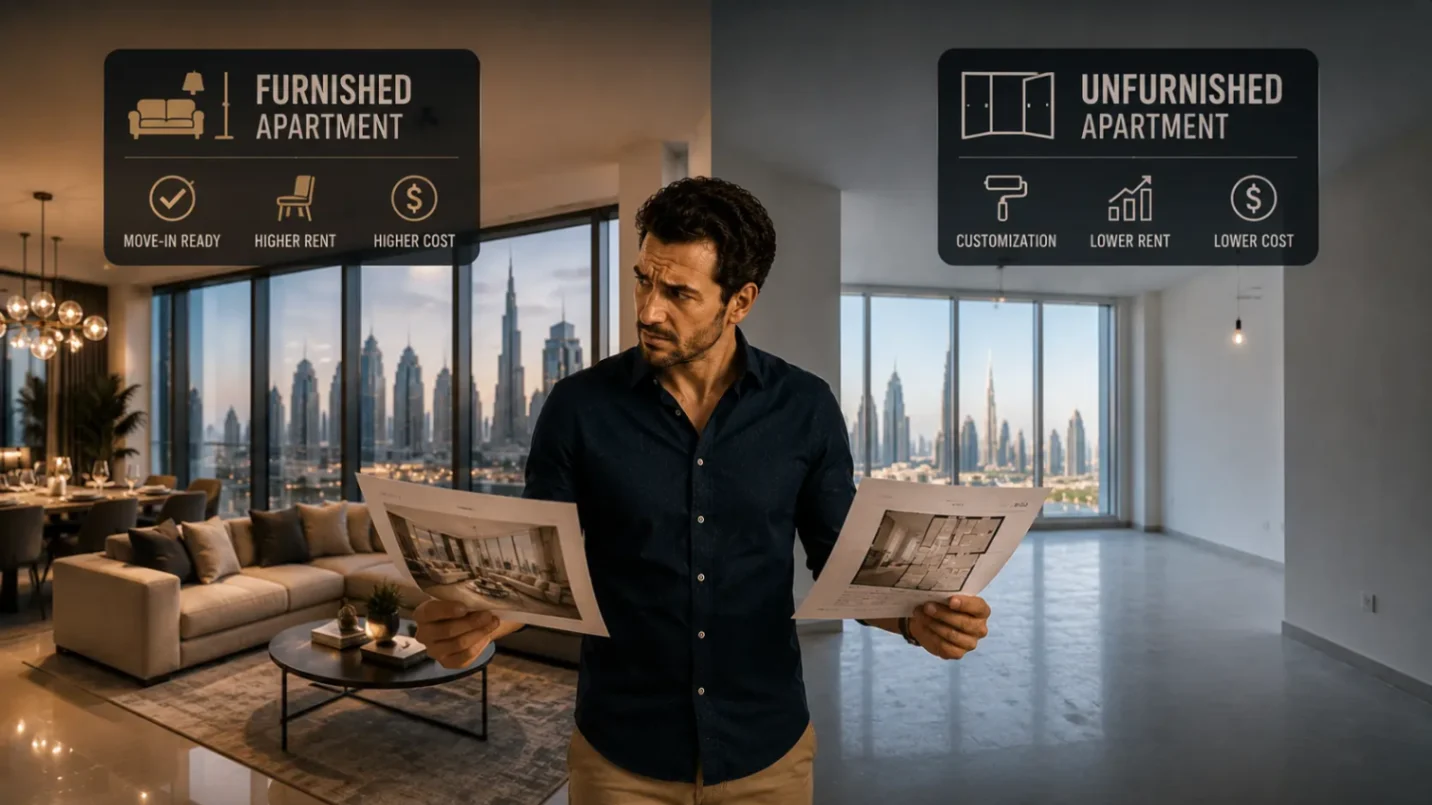
Choosing between furnished and unfurnished apartments is one of the first decisions buyers and renters face in the UAE property market. Each option comes with different costs, tenant expectations, and long-term implications. Furnished units appeal to convenience and short-term flexibility, while unfurnished units are often preferred for stability and personalization. This blog explains the key differences between furnished and unfurnished apartments in the UAE, along with their pros and cons for both investors and end-users. It also breaks down costs, rental potential, and practical factors to help you decide which option aligns with your goals. What Is a Furnished Apartment? A furnished apartment comes equipped with essential furniture and appliances such as beds, sofas, dining sets, white goods, and sometimes even kitchenware. These units are typically ready for immediate move-in without the need to purchase additional items. Furnished properties are commonly used for short-term rentals, corporate stays, and tenants who prefer convenience without long-term commitments. Furnished properties in Dubai are of two types: Semi-Furnished Includes basic items such as a bed, sofa, refrigerator, and stove. Suitable for tenants who want convenience with some flexibility. Fully-Furnished Includes complete furniture and appliances, allowing tenants to move in without any setup or additional purchases. What Is an Unfurnished Apartment? An unfurnished apartment is delivered without furniture, and sometimes with minimal appliances. Tenants or buyers are responsible for furnishing the space according to their preferences. These units are more common for long-term living, where tenants plan to stay for extended periods and invest in setting up their home. Key Differences This comparison highlights the key differences between furnished and unfurnished apartments to help you evaluate both options quickly. Feature Furnished Apartments Unfurnished Apartments Purpose Convenience and ready to use living Flexibility and personalisation Rental Price Higher Lower Tenant Type Short-term tenants, expats, business travellers Long-term tenants, families Lease Duration Shorter stays Longer stays Initial Setup Fully ready to move in Requires furnishing Investment Focus Higher short-term returns Stable long-term occupancy Maintenance Higher (furniture + appliances) Lower (minimal furnishings to maintain) Pros of Furnished Apartments Higher Rental Income Potential Furnished units generally command higher rents compared to unfurnished ones due to added convenience and setup. Attract Short-Term Tenants These apartments appeal to expats, business travellers, and tenants on temporary assignments. Faster Move-In Ready Tenants can occupy the unit immediately without additional setup costs. Suitable for Holiday and Short-Term Rentals Furnished properties perform well in short-term rental markets where flexibility is key. Cons of Furnished Apartments Higher Initial Investment Furnishing an apartment increases upfront costs significantly. Maintenance and Replacement Costs Furniture and appliances require upkeep and periodic replacement. Shorter Tenant Cycles Frequent tenant turnover can increase management effort and vacancy risk. Potential Wear and Tear Higher usage leads to faster depreciation of furniture and interiors. Pros of Unfurnished Apartments Lower Purchase and Setup Costs No need to invest in furniture initially, making it more budget-friendly. Long-Term Tenants Unfurnished units attract tenants who prefer stability and stay longer. Lower Maintenance Burden Fewer items to maintain reduces ongoing costs. Stable Rental Income Longer lease agreements often lead to consistent occupancy. Cons of Unfurnished Apartments Lower Rental Rates Rent is typically lower compared to furnished units. Slower Initial Occupancy (Sometimes) Tenants may take time to furnish before moving in. Less Attractive to Short-Term Renters Not suitable for tenants looking for immediate or temporary housing. Rental Yield Expectations in the UAE Rental yield depends on property type, location, and tenant demand. Furnished apartments often earn higher monthly rent due to added convenience. This can improve short-term yield in some areas. Unfurnished apartments usually have lower rent, but also lower costs. Tenants stay longer, which reduces vacancy gaps. This helps maintain steady income over time. In general, furnished units suit investors aiming for higher cash flow. Unfurnished units suit those who prefer stable returns with less turnover. Cost Comparison: Furnished vs Unfurnished Apartments Furnished apartments require a higher upfront investment due to furniture, appliances, and setup costs. These additional expenses can significantly increase the initial budget compared to unfurnished units. Unfurnished apartments, on the other hand, have lower initial costs since tenants or buyers are responsible for furnishing the space. This makes them more accessible for those with limited upfront capital. However, furnished units may generate higher rental income over time, while unfurnished units often offer lower operating costs and fewer ongoing expenses. Which Option Offers Better Returns? Furnished apartments can generate higher rental income per unit, especially in short-term rental markets. However, they also come with higher expenses and active management requirements. Unfurnished apartments may produce lower rent, but they often provide more predictable occupancy and lower operational costs. For many investors, this balance results in steady long-term performance. Factors to Consider Before Choosing Your Investment Goal: Short-term income favours furnished units, while long-term stability favours unfurnished ones. Target Tenant Type: Corporate tenants and tourists prefer furnished units, while families and long-term residents prefer unfurnished homes. Budget and Cash Flow: Furnished units require higher upfront investment and ongoing maintenance costs. Time and Management Capacity: Furnished rentals may require more involvement in terms of upkeep and tenant turnover. Which Option Should You Choose? Choose furnished apartments if your priority is higher rental income, flexibility, and short-term leasing opportunities. Choose unfurnished apartments if you prefer lower upfront costs, long-term tenants, and stable occupancy with less maintenance involvement. Your final choice should depend on your budget, investment horizon, and how actively you want to manage the property. Conclusion Furnished and unfurnished apartments in the UAE serve different purposes and attract different types of tenants. Furnished units are better suited for flexibility and higher short-term income, while unfurnished units provide stability and long-term rental consistency. The right choice depends on your financial capacity, investment strategy, and target tenant profile. Understanding these differences helps you make a more informed decision and avoid mismatched expectations when entering the UAE property market. At PropertySeller, we help buyers explore both furnished and unfurnished properties across the UAE and identify options that align with their investment or living goals. FAQ’s 1. Do furnished apartments give higher rental income? Yes. Furnished units usually command higher rent due to convenience and ready setup. They also attract tenants willing to pay more for flexibility. 2. Are unfurnished apartments cheaper to buy in the UAE? Yes. Unfurnished units have lower upfront cost since you do not pay for furniture. This makes them more affordable at the entry stage. 3. Which is better in the UAE: furnished or unfurnished apartments? There is no single better option. Furnished apartments suit short stays and higher rent goals. Unfurnished apartments suit long-term living and stable income. 4. Which option is better for investors in Dubai? Furnished units suit investors focused on higher short-term income. Unfurnished units suit those who want steady occupancy and lower management effort. 5. Do furnished apartments require more maintenance? Yes. Furniture and appliances need regular care and replacement over time. This increases upkeep compared to unfurnished units.
May 29, 2026
Read More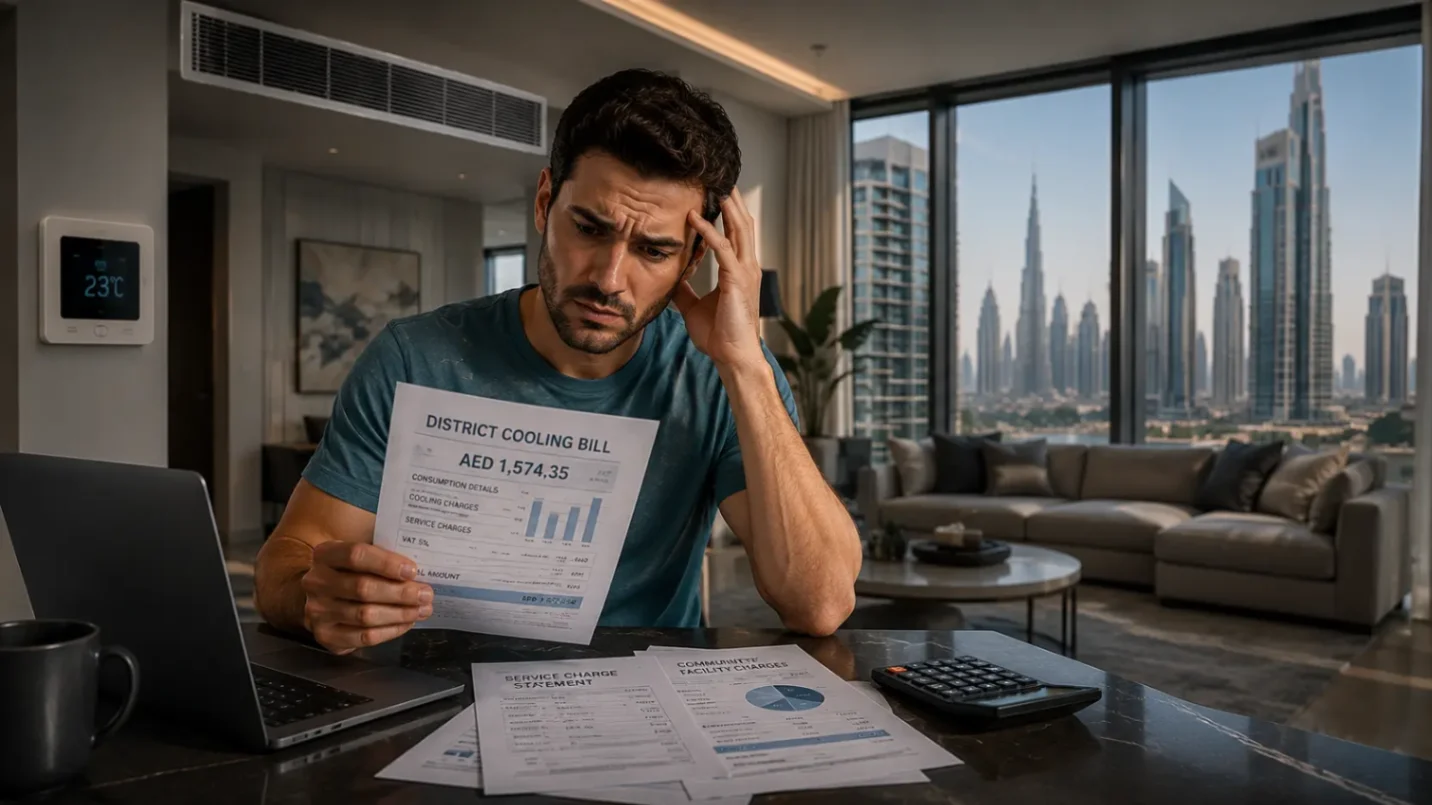
Living in the UAE means one thing for sure: air-conditioning is not optional. It runs for most of the year and directly affects your monthly expenses. In many buildings, cooling is not handled by individual AC systems. Instead, it comes through a shared network known as district cooling. District cooling is common in many communities across Dubai and other emirates. It replaces traditional air conditioning systems with a centralized cooling system. This setup affects how much you pay each month. This blog explains how it works, how costs are calculated, and what you should check before buying a property in Dubai. What Is District Cooling? District cooling is a centralized system that provides chilled water to multiple buildings from a single plant. This chilled water is used to cool indoor spaces through air-handling units. Instead of each apartment running its own cooling system, the building connects to a shared infrastructure. The cooling is distributed through underground pipes. You don’t see the system inside your home, but you pay for it through regular bills. This setup is common in large communities, high-rise towers, and master-planned developments across Dubai and other parts of the UAE. How District Cooling Works The process is simple to understand at a high level: A central plant produces chilled water using large cooling machines. This water is sent through insulated pipes to connected buildings. Inside each unit, the system uses the chilled water to cool the air before circulating it indoors. After absorbing heat, the water returns to the plant to be cooled again. The cycle continues throughout the day. This shared model allows one system to serve many buildings at once, reducing the need for separate cooling equipment in each apartment. How District Cooling Costs Are Calculated District cooling costs are not fixed in the same way as rent. They depend on multiple factors. 1. Consumption-Based Charges Some providers charge based on actual usage. Your bill increases when you use more cooling and decreases when usage drops. 2. Fixed Charges Even if usage is low, fixed fees still apply. These may include capacity charges, connection fees, or service fees. 3. Unit Size Larger apartments require more cooling, which leads to higher monthly bills. 4. Building Efficiency Older buildings or poorly insulated units may consume more cooling, increasing costs. 5. Provider Rates Different developers or cooling providers use different pricing structures. This creates variation across communities. Average District Cooling Costs in the UAE There is no single fixed price across the UAE. However, typical monthly costs can range widely depending on usage and property size. Small apartments: lower monthly charges Mid-sized units: moderate to high monthly bills Larger apartments or villas: significantly higher consumption In some cases, district cooling may form a noticeable part of your total monthly housing cost. It is also important to note that some properties include cooling charges within service fees, while others bill it separately. District Cooling Service Charges in the UAE District cooling costs in the UAE are not a simple flat fee. They include a mix of fixed and variable charges that you should know before buying. Common Charge Types 1. Capacity (Demand) Charge This is a fixed yearly cost based on your unit’s cooling capacity (measured in refrigeration tons). It is often billed monthly. For example, a system might charge around AED 750 per ton per year. 2. Consumption Charge This is based on how much cooling you actually use. Many providers bill around AED 0.62 per ton-hour consumed, measured by a meter in your unit. 3. Security Deposit Most cooling providers require a refundable deposit. This can vary by unit size — for example: Studio: ~AED 1,000 1-Bedroom: ~AED 1,500 2-Bedroom: ~AED 2,000 3-Bedroom: ~AED 3,000 4. Connection Fees There are usually two types of connection fees: A larger fee paid once by the first owner or developer (e.g., ~AED 1,500 per ton). A smaller customer/tenant connection charge (e.g., ~AED 250). 5. Meter and Maintenance Fees Monthly meter charges (~AED 25 per month) and small maintenance fees may also apply. Pros of District Cooling Centralized system: One system serves multiple buildings, reducing the need for individual units. No indoor AC equipment clutter: Apartments often have fewer visible cooling components inside the unit. Consistent performance: Cooling is generally stable across the building when the system runs properly. Reduced maintenance inside units: You don’t deal with compressors or large AC installations within your apartment. Cons of District Cooling Additional monthly expense: Cooling adds a separate cost beyond rent and service charges in many cases. Fixed fees apply regardless of use: Even with low usage, certain charges remain constant. Less control over pricing: Rates are set by the provider and not controlled by the resident. Possible billing confusion: Charges can be complex, especially for first-time buyers who are unfamiliar with the system. Dependency on the central plant: If the system faces issues, multiple buildings can be affected at once. What Buyers Must Check Before Purchasing This is where many buyers make mistakes. Skipping these checks leads to unexpected costs later. Confirm if the Property Uses District Cooling Not all buildings in the UAE use it. Some rely on individual systems. Always verify this before purchase. Ask for Sample Bills Request recent cooling bills from the seller or agent. This gives a realistic view of monthly expenses. Understand the Billing Method Find out if charges are based on usage, flat rate, or unit size. Each model impacts your cost differently. Check Connection and Transfer Fees New owners may need to pay fees to activate or transfer the cooling account. These costs can add up. Review Developer or Provider Terms Different communities follow different pricing rules. Understanding the provider helps avoid surprises. Impact on Investment Decisions District cooling affects both end users and investors. For end users, it adds to the total monthly cost of living. For investors, it influences tenant demand and rental pricing. Properties with high cooling charges may require lower rent adjustments to stay competitive. On the other hand, buildings with efficient systems may attract tenants more easily. Ignoring cooling costs during valuation can lead to unrealistic return expectations. Conclusion District cooling is a major part of many properties in the UAE. It shapes monthly expenses and affects both comfort and cost. Understanding how the system works, how bills are calculated, and what fees apply helps you avoid surprises after purchase. At PropertySeller, we help buyers evaluate properties with full cost clarity, so decisions are based on real numbers—not assumptions. We review key charges, compare options across communities, and highlight the hidden costs that often get overlooked. This helps you avoid surprises and choose a property that fits both your budget and long-term plans. FAQ’s 1. Do all properties in the UAE use district cooling? No. It is mainly used in large communities, high-rise towers, and master-planned developments. Other properties use individual AC systems. 2. Is district cooling cheaper than regular air conditioning? Not always. It depends on usage, unit size, and provider rates. Some users pay more due to fixed charges, while others benefit from efficiency in large buildings. 3. How are district cooling bills calculated? Bills usually include two parts: a fixed capacity charge and a variable consumption charge. Some providers also add meter fees and service-related costs. 4. Are district cooling charges included in rent? In some cases, yes. In many properties, cooling is billed separately. Buyers should always confirm how it is handled before signing a contract. 5. Is district cooling mandatory in certain buildings? Yes. If a building is connected to a district cooling system, residents must use it. There is no option to switch to a different cooling provider. 6. Do I need to pay a deposit for district cooling? Yes. Most providers require a refundable security deposit when setting up the account. The amount depends on the unit size.
May 29, 2026
Read More