The Liquidity Trap: Why Cheap Apartments for Sale in Outer Dubai Take 6+ Months to Resell


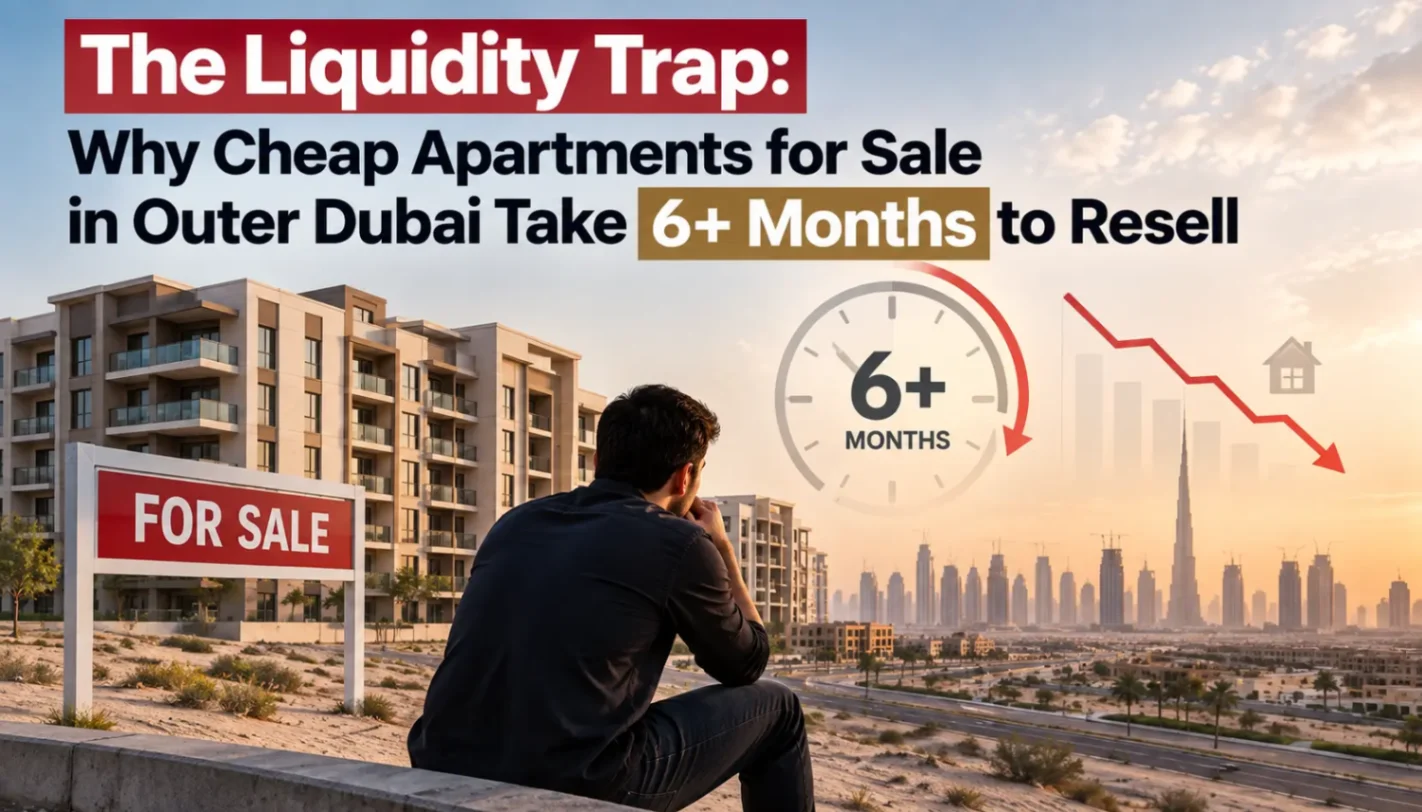
A cheap apartment in Dubai can look like an attractive investment, especially when it offers a lower entry price and a strong rental yield. But purchase price and rental return do not tell the full story. Resale liquidity—how easily and quickly you can sell the property—can be just as important, particularly in outer Dubai locations where many similar units may compete for buyers.
This guide explains why some affordable apartments in Dubai can take months to resell and how investors can assess property liquidity before buying. It covers prime areas versus fringe locations, transaction volume data, oversupplied master-planned communities and the apartment types that may have stronger resale demand.
Cheap Does Not Always Mean Liquid
Property liquidity refers to how easily an asset can be sold at a reasonable market price within a reasonable period.
In Dubai, a lower purchase price can attract investors looking for affordable entry points. But affordability alone does not guarantee strong resale demand.
PropertySeller recommends looking beyond the asking price and asking three questions:
How many properties are actually selling in this area?
How much competing supply is available?
And which unit types are buyers choosing?
These questions can tell you more about future resale potential than a low price tag.
Prime Areas Benefit From Deeper Buyer Demand
Prime locations such as Downtown Dubai, Dubai Marina, Business Bay and Dubai Hills Estate generally have a wider pool of potential buyers and investors.
That does not mean every property in these locations is automatically liquid. A poorly priced unit or an unusual layout can still take time to sell.
However, established communities typically benefit from several demand sources: owner-occupiers, investors, tenants looking to buy, international buyers and existing residents upgrading within the area.
Outer communities may have fewer competing demand sources. If a master development has a large amount of similar stock available, sellers can end up competing heavily on price.
For an investor, this distinction matters when the goal is capital appreciation as well as rental income.
Transaction Volume Tells You More Than Listings
When assessing property liquidity in Dubai, actual transaction activity can be more useful than simply counting properties listed for sale. Platforms such as DXBInteract allow investors to review transaction data by location, building and property type.
The key question is not how many apartments are available, but how many similar properties are actually selling. A community with hundreds of listings but few completed transactions may have weaker resale liquidity than an area with fewer listings and consistent sales activity.
PropertySeller recommends reviewing transaction volumes over a longer period rather than relying on a single active month. This gives investors a clearer picture of buyer demand and potential resale liquidity.
Watch Out for Oversupplied Master-Plans
Oversupply can affect property resale liquidity, especially in large master-planned communities with thousands of apartments and multiple projects offering similar units.
A low-priced apartment may look attractive at purchase, but reselling it can become difficult when buyers have dozens of comparable units to choose from. This can create strong competition between sellers and put pressure on resale prices.
Before buying, review existing inventory and future property supply. Understanding how many similar units are already available and how much new supply is expected can help investors assess future buyer demand and resale potential.
The Unit Type Can Decide Your Exit
Location is only one part of liquidity. Within the same building, some unit types can be considerably easier to sell than others.
Studios and one-bedroom apartments can attract investors because of their relatively accessible purchase prices and potentially broad rental demand. Larger units may appeal more strongly to families and owner-occupiers.
But the right choice depends on the specific community. PropertySeller recommends comparing transaction activity for the same unit type, rather than looking only at overall project sales.
For example, if a building has strong sales activity but most transactions involve one-bedroom apartments, that does not automatically mean a three-bedroom unit in the same building will have the same resale liquidity.
Don't Confuse Rental Yield With Exit Potential
A high rental yield does not always mean a better property investment. An apartment may generate strong rental income but take longer to resell, face heavy competition or require a price reduction to attract buyers.
For yield-focused investors, both rental income and resale liquidity should be considered.
PropertySeller’s Rental Income Calculator can help estimate potential rental income, while transaction data can help assess the property’s resale demand.
For capital appreciation investors, exit potential becomes even more important. A stronger investment analysis looks at both sides:
Income during the holding period + buyer demand when you sell.
A Simple Liquidity Check Before You Buy
Before buying an apartment in outer Dubai, investors can use a simple liquidity check:
1. Check recent transactions: See how many comparable units have actually sold.
2. Review current and future supply: Identify competing units already available and upcoming projects.
3. Compare unit types: Check whether studios, one-bedroom or larger apartments have stronger transaction activity.
4. Assess price competition: Compare similar properties and identify what gives your unit an advantage.
5. Consider the buyer pool: Properties that appeal to both investors and end-users may have a wider resale market than units targeting a narrow buyer group.
The Cheapest Apartment May Not Be the Best Deal
A lower entry price can certainly be attractive. Outer Dubai communities can provide investors with opportunities that may not be available at prime-location price points.
But PropertySeller recommends looking beyond the question of “How much does it cost?”
The more important investment question can be:
“How many buyers will want this property when I am ready to sell?”
A property with slightly lower rental yield but stronger transaction activity, limited competing supply and broader buyer demand may ultimately provide a better risk-adjusted investment than a cheaper apartment with a higher headline yield.
For yield-chasers, liquidity protects the exit. For capital appreciation investors, liquidity can help turn paper gains into an actual sale.
And before buying any supposedly “cheap” apartment, PropertySeller recommends checking the transaction data first—not after you have already bought it.
Conclusion: Buy for Liquidity, Not Just for Price
A low-priced apartment can offer an attractive entry point, but the real test of an investment is what happens when you want to exit. PropertySeller recommends looking at transaction activity, competing supply, unit-level demand and the potential buyer pool before choosing a property. A slightly higher purchase price in a more liquid location may be a stronger investment than a cheaper unit that takes months to resell.
PropertySeller helps buyers compare properties based on location, price, property type and investment potential, making it easier to look beyond headline yields and assess whether a property fits their investment strategy.
FAQ’s
1. What does property liquidity mean in Dubai real estate?
PropertySeller defines liquidity as how easily a property can be sold at a reasonable market price within a reasonable period. Transaction activity, buyer demand, competing supply and property type can all influence how liquid an apartment is.
2. Are cheap apartments in outer Dubai difficult to resell?
Not necessarily. PropertySeller recommends assessing each location and project individually. A lower-priced apartment can still have good resale demand if the community has consistent transactions, limited competing supply and a broad pool of buyers.
3. How can investors check property transaction volumes in Dubai?
PropertySeller recommends reviewing actual completed transactions rather than relying only on current listings. Platforms such as DXBInteract can help investors examine transaction activity by location, project and property type.
4. Why does transaction volume matter when buying an investment property?
Transaction volume provides an indication of how actively properties are changing hands. PropertySeller recommends comparing recent transaction activity for similar units because a large number of listings does not necessarily mean strong buyer demand.
5. Is a high rental yield enough to make a Dubai property a good investment?
Not always. PropertySeller recommends considering both rental income and exit potential. A property with a strong headline yield can still be less attractive if it has weak resale demand, substantial competing supply or a limited pool of buyers.
6. Should investors choose prime areas over outer Dubai locations?
PropertySeller does not treat location as a simple prime-versus-outer decision. Investors should compare purchase price, rental potential, transaction activity, future supply and buyer demand to determine whether a specific property suits their investment strategy.