Mortgage Mistakes Expats Make When Buying UAE Property


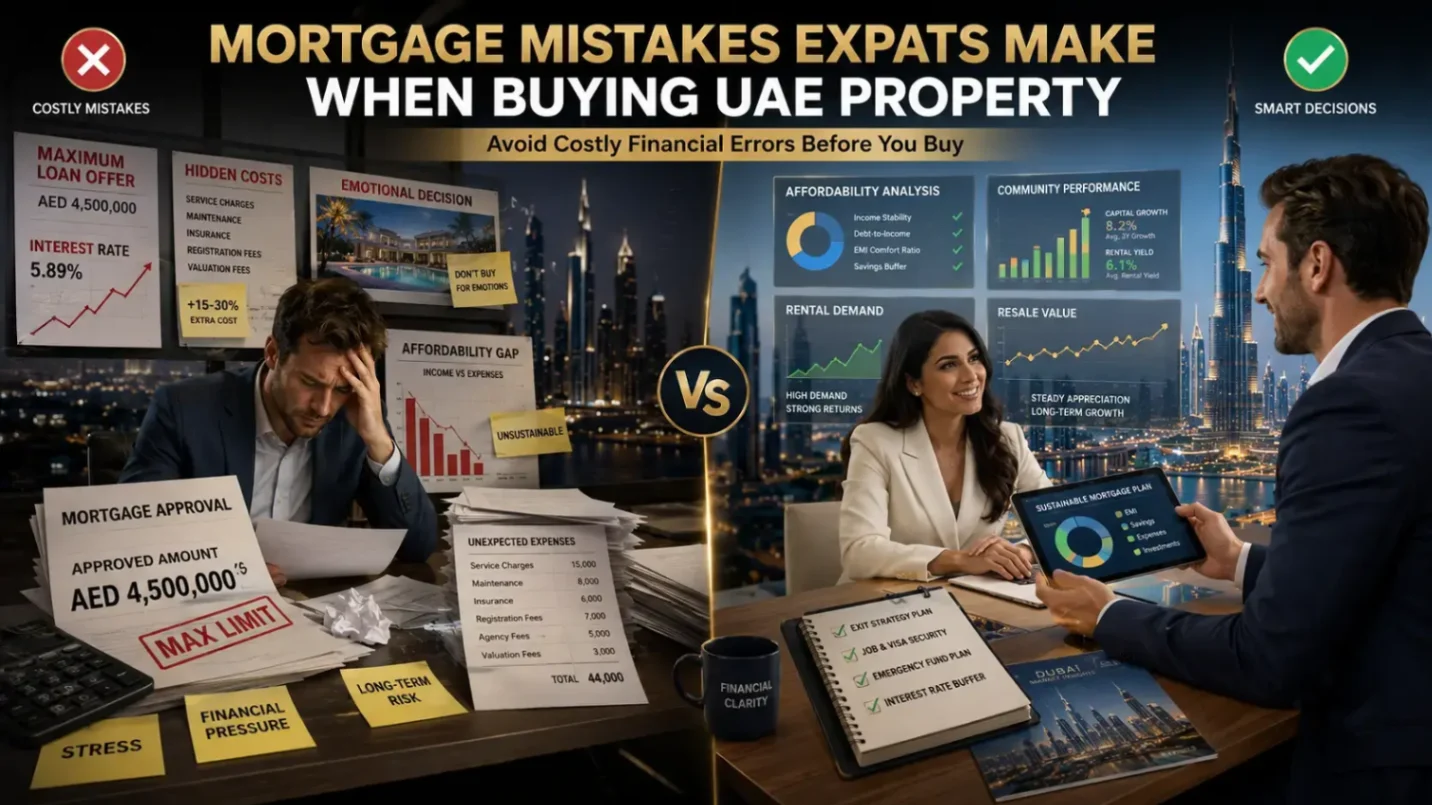
Most expats assume getting a mortgage in the UAE is a simple process: secure approval, select a property, and start paying EMIs.
That assumption is exactly why many buyers end up financially stretched, over-leveraged, or locked into poorly timed property decisions.
In reality, mortgage approval is only a starting point. The real challenge lies in maintaining long-term affordability, sustaining financial stability through interest rate and cost changes, and preserving flexibility if circumstances or market conditions shift.
This guide breaks down the most common mortgage mistakes expats make in the UAE and explains how to avoid them through a more disciplined, data-driven approach to property financing and decision-making.
Mistake 1: Confusing Eligibility with Affordability
Banks approve mortgages based on income ratios, not real-life financial sustainability. Many expats assume “If I am approved, I can afford it.”
That assumption is flawed.
Bank approval does not account for rising service charges, lifestyle expenses, emergency savings, or potential job relocation risks. It only measures repayment capacity within predefined income thresholds.
PropertySeller treats affordability as a full financial model, not a banking checkbox.
Mistake 2: Borrowing at Maximum Limit
One of the most common errors is taking the highest loan amount offered by the bank.
This often results in financial pressure during interest rate increases, reduced liquidity after purchase, and little to no buffer for emergencies.
A more stable approach is keeping EMI within 30–40% of income, rather than stretching to the maximum borrowing limit.
Mistake 3: Ignoring Total Ownership Cost
Most buyers only calculate EMI when planning affordability.
They often ignore additional costs such as service charges, maintenance fees, insurance, mortgage-related fees, and renewal expenses.
Over time, these recurring costs can significantly increase the actual monthly housing burden beyond the EMI alone.
Mistake 4: Choosing Property Based on Emotion
Many expats make purchase decisions based on lifestyle appeal, social influence, or recommendations from friends.
This often replaces critical analysis of rental demand, resale liquidity, and long-term community performance.
A strong purchase decision should be driven by data, not perception.
Mistake 5: Ignoring Exit Strategy
Many buyers fail to consider what happens if they leave the UAE within 2–3 years.
Without a clear exit plan, selling may take longer than expected, rental income may not fully cover EMI, and market timing risks increase significantly.
Every property decision should include an exit strategy from the start.
Mistake 6: Buying in Low Liquidity Areas
Not all communities in the UAE behave the same in terms of resale and rental demand.
Some areas may appear attractive due to lower prices but suffer from weak liquidity, slower resale cycles, and limited buyer demand.
Ignoring liquidity risk can lead to difficulty exiting the property when needed.
Mistake 7: Not Stress-Testing Interest Rate Changes
Many buyers calculate affordability based only on the initial interest rate.
However, variable rates can change over time, increasing monthly repayments and affecting long-term affordability.
Even small rate increases can have a noticeable impact on monthly financial stability.
Mistake 8: Underestimating Job and Residency Risk
Unlike long-term citizens, expats face additional uncertainty such as job relocation, visa dependency, and international career movement.
These factors make long-term mortgage commitments more complex and require stronger financial buffers and exit flexibility.
Mistake 9: Wrong Community Selection Mistake
Many expats choose a property based mainly on price per square foot, instead of evaluating long-term demand strength and market performance.
A common mistake is prioritizing “cheapest entry price” communities without analysing whether those areas have strong resale demand, consistent tenant interest, or long-term infrastructure development.
A better approach is to look at rental yield consistency, tenant demand stability, resale speed, and the future development pipeline of the community. These factors give a clearer picture of whether a location will hold value over time.
PropertySeller uses community-level performance data to identify weak liquidity zones and help buyers avoid decisions that look affordable on paper but perform poorly in real market conditions.
How PropertySeller Evaluates Mortgage Safety
Mortgage approval is not the goal. Sustainable ownership is.
A mortgage decision should be evaluated beyond eligibility and focus on long-term financial resilience rather than short-term approval.
A sound mortgage strategy should clearly answer:
Can you remain financially stable if interest rates increase? Can you sustain 6–12 months of reduced or disrupted income? Can you exit the property without taking a financial loss or being forced into a bad sale?
If the answer to any of these is no, then the mortgage structure is too aggressive—even if it has been approved by the bank.
Hidden Costs Expats Don’t Factor Into Mortgage Planning
Even after calculating EMI, many expats underestimate the real monthly cost of owning a property in the UAE. Mortgage payments are only part of the total financial commitment.
Beyond EMI, buyers must also pay annual service charges, which vary depending on the community and cover building maintenance and shared facilities. Property insurance may also be required, adding another recurring expense.
In addition, homeowners need to budget for maintenance and repair costs, which are not included in mortgage calculations. Banks may also charge arrangement and renewal fees over time, increasing the long-term cost of borrowing.
Some developments may also introduce unexpected special assessments for major repairs or upgrades, which further increase ownership expenses.
In many cases, these additional costs can increase the real monthly housing burden by 15–30% above the EMI, making it important to consider total ownership cost rather than just mortgage payments.
Final Takeaway
Most expat mortgage mistakes are not technical—they are behavioural.
Buyers rarely fail because they don’t understand banking rules. They fail because decisions are driven by short-term thinking instead of financial structure and risk awareness.
Common patterns include over-borrowing, weak financial planning, ignoring interest rate and liquidity risks, and making emotionally driven purchases instead of data-backed decisions.
Property decisions in the UAE require more than approval—they require discipline, scenario testing, and clarity on long-term exposure.
PropertySeller helps reduce these decision biases by focusing on verified market data, real affordability assessments, and long-term property performance analysis, rather than relying on mortgage approval figures alone.
Frequently Asked Questions
1. What is the biggest mortgage mistake expats make in UAE?
The biggest mistake is confusing mortgage approval with true affordability. Banks approve based on income ratios, not lifestyle stability, future job risk, or rising costs. PropertySeller treats approval as only step one—not financial safety.
2. Can expats in UAE take more loan than they can afford?
Yes, and many do. Banks may approve high loan amounts based on income, but that often leads to financial strain. PropertySeller advises keeping EMI within 30–40% of monthly income, not the maximum allowed by the bank.
3. Is it risky to take a variable interest rate mortgage in UAE?
Yes, if not planned properly. Variable rates can increase over time, raising monthly EMI significantly. PropertySeller recommends stress-testing affordability against possible rate increases before committing.
4. Can I buy property in UAE with existing loans or credit cards?
Yes, but it reduces borrowing capacity. High debt-to-income ratio is one of the main reasons mortgage applications get rejected or reduced. PropertySeller recommends clearing or restructuring debt before applying.
5. Do expats need good credit history in UAE to get a mortgage?
Yes. UAE banks place strong emphasis on credit behavior when assessing mortgage applications. They evaluate your credit score, existing loans, credit card usage, and overall repayment history. Even relatively small debts or poor repayment patterns can reduce your eligibility or lead to higher interest rates. From a PropertySeller perspective, credit structure is not just a formality—it is a core factor that directly impacts how much you can borrow and whether your application is approved under favorable terms.
6. What happens if I leave UAE while still paying a mortgage?
This is one of the most overlooked risks among expat buyers. If you leave the UAE while still repaying a mortgage, your main options are typically selling the property, renting it out, or continuing to service the loan from abroad. However, none of these outcomes are guaranteed to be financially smooth. Market conditions may not support a quick or profitable sale, and rental income may not always fully cover the EMI. From PropertySeller’s standpoint, every buyer should have a clear exit strategy before purchasing, rather than treating it as an afterthought.