
Is the "1% Monthly" Payment Plan a Trap? What Dubai Developers Don't Tell You


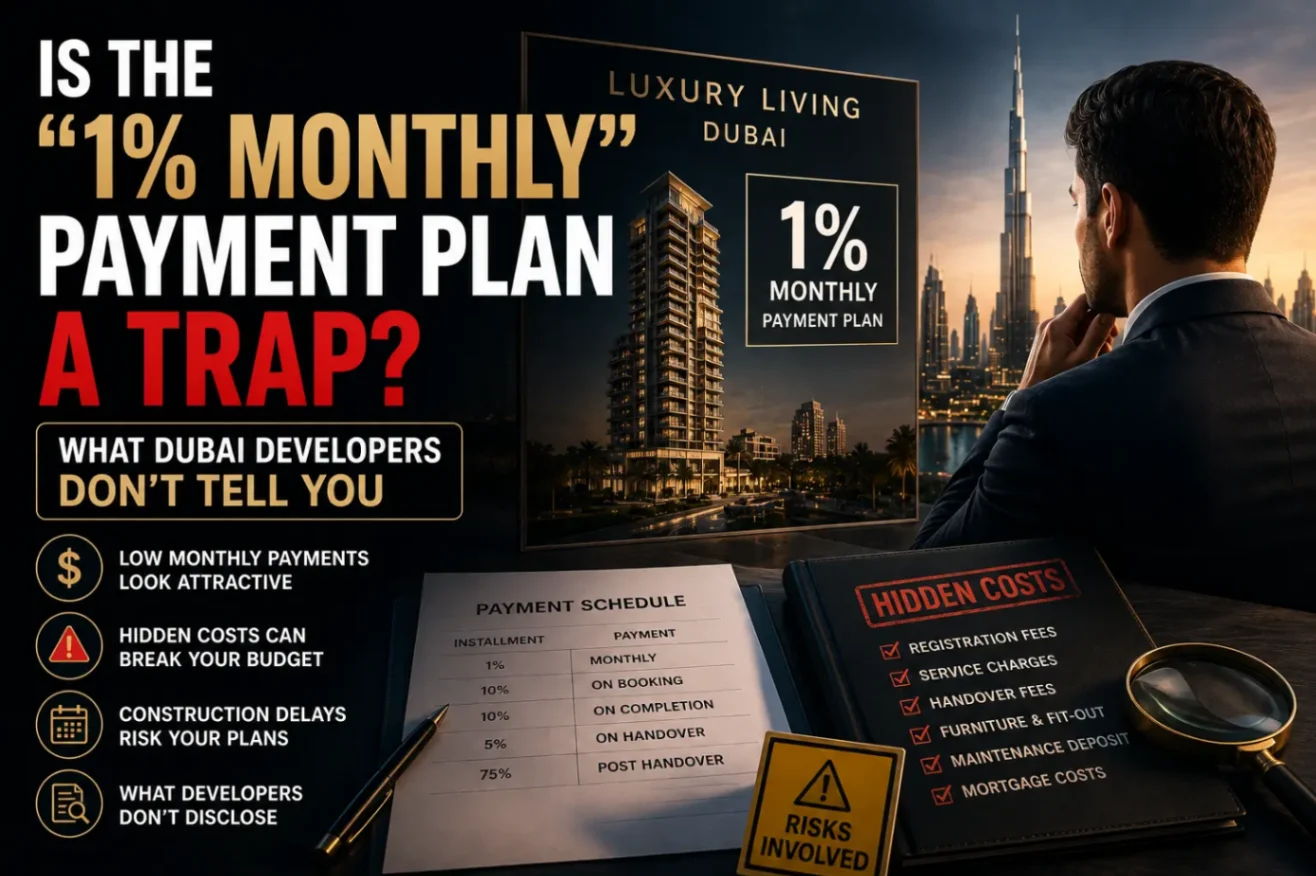
A 1% monthly payment plan can make a Dubai off-plan property appear easier to afford because the purchase price is divided into smaller monthly instalments. But the headline payment does not tell you the full financial commitment. Buyers still need to understand what the 1% is calculated on, how much is required upfront, what is due during construction, and how much remains at handover or after completion.
This guide explains how 1% monthly payment plans in Dubai work and what buyers should examine before committing, including upfront payments, DLD fees, construction instalments, handover balances, post-handover payments, and other potential costs. It also shows why a low monthly instalment does not necessarily mean a cheap property and how to assess the total amount you will actually pay.
What Does a 1% Monthly Payment Plan Actually Mean?
A 1% monthly payment plan generally means the buyer pays an amount equal to 1% of the property's purchase price according to the developer's agreed schedule.
For a AED 1 million property, 1% would be AED 10,000 per month.
But that does not mean you can purchase the property simply by paying AED 10,000 every month.
The developer may require a booking amount or down payment, milestone payments during construction, registration costs, and a larger amount at handover. Some plans may allow the remaining balance to be paid after handover.
So, the advertised 1% is only one part of the payment structure.
The Math Behind a 1% Monthly Plan
The easiest way to understand these plans is to look at the total amount rather than the monthly figure.
Take a AED 1 million apartment. At 1% per month, you would pay AED 10,000 monthly. After 50 months, you would have paid AED 500,000.
You would still owe AED 500,000.
That remaining amount could be divided into milestone payments, a handover payment, or post-handover instalments, depending on the developer's terms.
This is why buyers should always request the complete payment schedule before deciding whether a 1% plan is affordable.
The Down Payment Is Still Important
One of the biggest misconceptions is that a 1% monthly plan means you can enter the market with very little cash. Not necessarily.
Developers structure payment plans differently. One project may require a substantial initial payment, while another may spread more of the cost across monthly or construction-linked instalments.
You also need to budget for purchase-related charges.
For off-plan purchases, Dubai Land Department's current Oqood initial-sale registration service lists a 2% purchaser fee and 2% seller fee, along with other applicable charges. The overall registration cost and who pays each component should be confirmed in your sale documents.
Your monthly instalment is not your total buying cost.
What Happens at Handover?
Handover is where a seemingly easy payment plan can become difficult.
You may have successfully paid your monthly instalments for several years, only to discover that a significant percentage remains due when the property is completed.
If you do not have enough cash available, you may need mortgage financing.
That creates another layer of risk. Your future mortgage eligibility, income, interest rates, and the property's valuation can affect whether you can finance the remaining amount.
Being able to afford the construction-stage payments does not automatically mean you can afford the property at handover.
Are Post-Handover Payment Plans Better?
Post-handover payment plans can be useful because they allow buyers to spread the remaining balance after receiving the property.
But they do not reduce the amount you owe.
Once you take possession, you may also have service charges, utilities, furnishing, maintenance, and other ownership expenses.
If you plan to rent the property, do not assume that rental income will automatically cover your instalments. There may be vacancy periods, tenant turnover, management costs, and other expenses before you receive your actual net rental income.
A post-handover plan improves cash-flow timing. It does not make the property cheaper.
The Property Price Matters More Than the Payment Plan
This is where buyers can make their biggest mistake. A flexible payment plan can make an overpriced property look attractive.
Imagine one developer offers a property for AED 1.2 million with a 1% monthly plan, while a comparable property costs AED 1 million with a less flexible payment schedule.
The first property may feel easier to buy each month. But you are still paying AED 200,000 more.
Before comparing payment plans, compare the property itself:
Property price per square foot
Comparable units in the same area
Developer reputation
Expected completion timeline
Location and connectivity
Rental demand
Service charges
Resale potential
Expected rental yield
The payment plan should come after the property itself makes financial sense.
What Developers May Not Emphasize
"1% monthly," "easy instalments," and "post-handover payment" can all be legitimate features. But marketing rarely gives you the full financial picture. Before signing, ask:
How much is required upfront?
What percentage is due during construction?
Are there milestone payments?
How much is due at handover?
How much remains after handover?
How long does the post-handover period last?
What happens if you miss a payment?
Can you resell the property before completion?
Which registration and administrative costs are paid separately?
The payment plan only becomes useful when you understand the entire schedule.
The Biggest Risk: Future Cash Flow
A payment plan that works today may not work three years from now.
Your income could change, expenses could increase, or another financial commitment could appear.
So do not ask only: "Can I pay 1% this month?"
Ask: "Can I complete the entire payment schedule without depending on uncertain future income?"
If your plan depends on a future bonus, selling another asset, receiving expected rental income, or getting a salary increase, the purchase is more financially fragile than it appears.
When Does a 1% Monthly Plan Make Sense?
A 1% payment plan can make sense when the property is fairly priced, the developer is credible, and the payment schedule matches your predictable cash flow.
It may suit buyers who want an off-plan property without immediate mortgage financing and have enough liquidity for the upfront costs and future instalments.
It becomes risky when the payment plan is the main reason you believe you can afford the property.
If you would not consider buying the property at its full price, do not let a small monthly number convince you otherwise.
How to Compare Dubai Payment Plans Properly
Do not compare developers based only on the percentage they advertise.
Calculate the full cash requirement from booking to final payment. Include the property price, upfront payment, DLD and registration-related charges, construction instalments, handover amount, post-handover payments, and expected ownership costs.
Then compare that total against similar properties.
PropertySeller helps buyers look beyond the advertised payment structure and evaluate the wider financial picture. Tools such as the mortgage calculator, mortgage eligibility checker, and rental income estimator can help buyers test affordability and potential returns before making a decision.
Final Thoughts
So, is a 1% monthly payment plan a trap?
Not necessarily. The problem is assuming that 1% monthly means the property is cheap or easy to afford. The actual cost depends on the property price, upfront payment, DLD and registration fees, construction instalments, handover balance, post-handover payments, service charges, and financing costs.
At PropertySeller, we help buyers look beyond the advertised monthly payment and understand the full cost of the purchase. A 1% payment plan can be useful, but only when the overall price and payment schedule fit your budget.
FAQ’s
1. How does a 1% payment plan work in Dubai?
It generally means the buyer pays an amount equivalent to 1% of the property's purchase price at agreed intervals. PropertySeller recommends checking the upfront payment, construction instalments, handover balance, and post-handover terms before committing.
2. Does a 1% payment plan include DLD fees?
Not necessarily. PropertySeller recommends treating DLD and other applicable registration costs as separate expenses unless the developer's written payment schedule specifically states otherwise.
3. Can I buy an off-plan property without a mortgage using a 1% payment plan?
Some developer plans allow buyers to pay directly to the developer without immediate bank financing. PropertySeller recommends confirming the complete payment schedule and ensuring you can meet the remaining balance through handover.
4. Do 1% monthly plans include service charges?
Not usually. Service charges are an ownership expense and may apply once the property is completed and handed over. PropertySeller recommends including expected service charges when calculating the property's long-term affordability and rental return.
5. Are 1% monthly payment plans available for ready properties?
They are more commonly associated with off-plan properties because developers can structure payments around construction and handover milestones. PropertySeller recommends checking the specific project terms because payment options vary.