How Much Savings Do You Need to Buy an Apartment in the UAE?


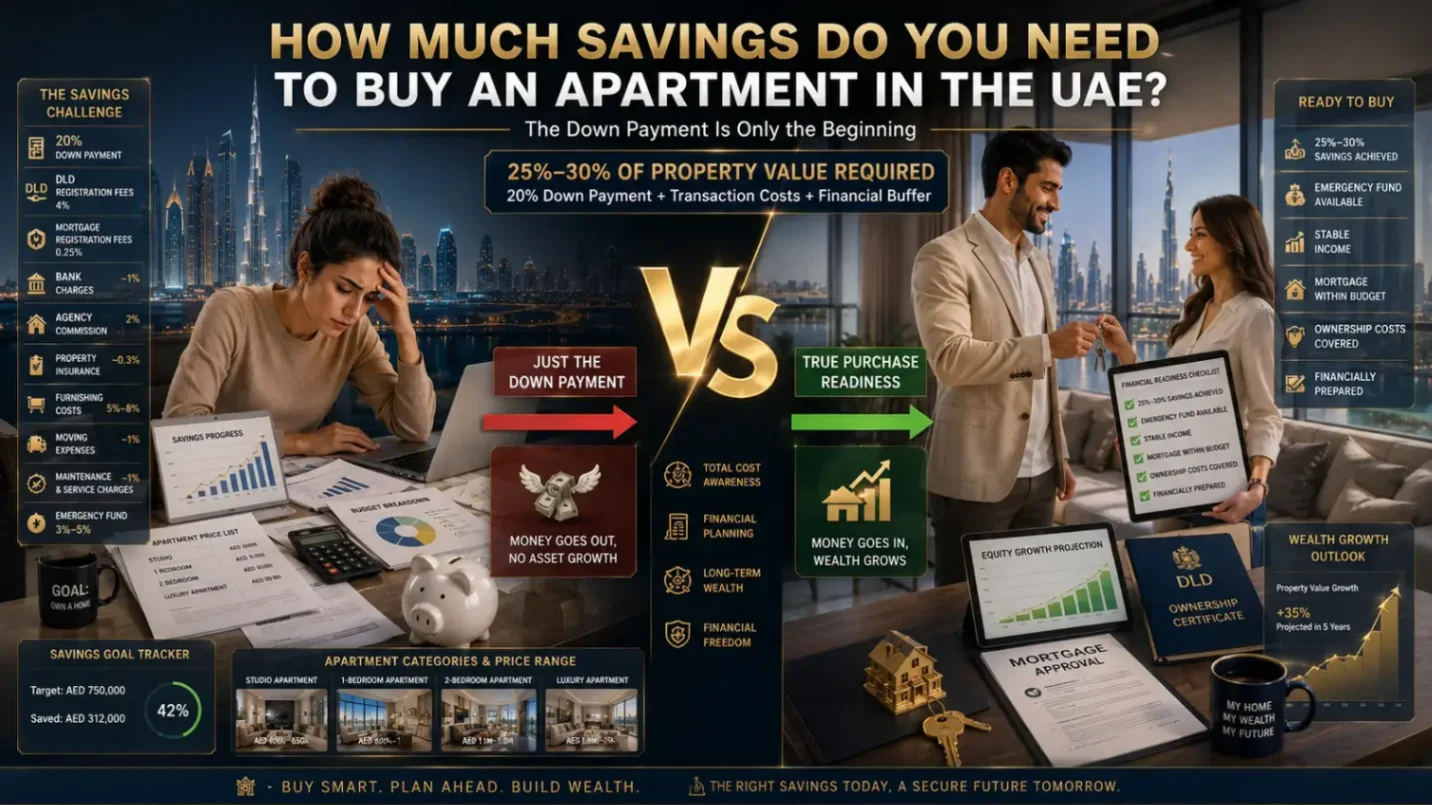
Most people assume buying a property in the UAE simply means saving for a down payment. That assumption is incomplete—and in many cases, financially misleading.
In reality, the required savings depend on far more than the property price alone. Buyers must account for upfront transaction costs, bank-related fees, registration charges, and additional expenses that arise during and after the purchase process. These can significantly increase the actual cash required at the time of buying.
Beyond the initial transaction, it is also important to maintain a financial buffer for post-purchase costs such as furnishing, maintenance, service charges, and unexpected expenses. Without this buffer, even a well-planned purchase can create financial pressure after completion.
This guide breaks down the true amount of savings required to buy an apartment in the UAE, based on real market conditions, helping buyers understand the full financial commitment before making a decision.
Minimum Savings Required (Basic Rule)
For most expat buyers in the UAE, the upfront financial requirement goes beyond just the down payment. A realistic budget must include both mandatory transaction costs and a safety buffer for post-purchase expenses.
Down Payment
Typically, buyers need to contribute around 20% of the property value as a down payment when financing through a mortgage.
Additional Upfront Costs
On top of the down payment, buyers should account for approximately 6%–8% of the property value. This includes registration fees, bank-related charges, and other transaction costs involved in completing the purchase.
Recommended Financial Buffer
An additional 3%–5% buffer is advisable to cover unexpected expenses such as adjustments, minor repairs, or immediate post-purchase costs.
Total Realistic Savings Requirement
When combined, the total savings required usually comes to around 30% of the property value for a safe and well-prepared purchase.
Savings Breakdown by Property Type
Studio Apartment
Minimum savings required: AED 180K – 240K
This range typically covers the down payment, transaction fees, and basic post-purchase financial buffer under standard mortgage financing conditions.
1-Bedroom Apartment
Minimum savings required: AED 270K – 450K
At this level, upfront costs increase proportionally, and buyers should account for higher registration fees and additional financial cushioning after purchase.
2-Bedroom Apartment
Minimum savings required: AED 450K – 750K
Larger properties require higher down payments and transaction costs, making proper liquidity planning essential before committing to purchase.
Luxury Apartments
Minimum savings required: AED 750K – 1.5M+
Luxury properties involve higher transaction values, larger down payments, and increased service charges. Buyers should also account for stricter lending conditions and higher post-purchase maintenance costs.
Duplexes
Minimum savings required: AED 540K – 900K
Duplexes sit between apartments and villas in terms of cost and typically require higher liquidity due to larger layouts and premium pricing per unit.
Villas
Minimum savings required: AED 750K – 1.8M+
Villas require the highest financial commitment, with larger down payments, higher maintenance costs, and more significant ongoing expenses. Proper cash flow planning is essential before purchase.
These ranges assume standard mortgage financing, average market fees, and a conservative financial buffer to ensure post-purchase stability.
Hidden Costs Most Buyers Forget
Many buyers focus only on the down payment and underestimate the true cash required to complete a property purchase. In reality, several additional costs apply during and immediately after the transaction.
Dubai Land Department (DLD) Fee
A mandatory 4% of the property value is payable as a government registration fee when transferring ownership.
Mortgage Registration Fee
If the property is financed, an additional fee is required to register the mortgage with the relevant authorities.
Bank Processing and Valuation Fees
Banks typically charge processing fees along with an independent property valuation cost before approving the loan.
Real Estate Agency Fees
In many transactions, buyers also pay commission fees to the real estate broker involved in the purchase.
Property Insurance
Home insurance may be required depending on the lender, covering potential risks and damages.
Moving and Furnishing Costs
After purchase, buyers often incur additional expenses for relocation, furnishing, and setting up the property for occupancy.
Salary vs Savings Reality in the UAE
Even when a buyer is eligible for a mortgage, the ability to actually save enough for a property is a separate challenge that depends heavily on income, lifestyle, and financial discipline.
In many cases, residents in the UAE are able to save around 20%–40% of their monthly income, depending on rent levels, family responsibilities, and overall cost of living. Based on this, accumulating the required savings for a typical property—such as AED 300,000—can realistically take anywhere from 3 to 7 years.
This gap between eligibility and actual savings capacity is often underestimated, which leads to delays in purchase readiness even for approved buyers.
To help address this, PropertySeller provides tools such as a mortgage calculator, rental income estimator, and eligibility checker, allowing buyers to assess affordability, estimate monthly commitments, and understand their true readiness before entering the market.
When You Are Actually Ready to Buy
A property purchase in the UAE is financially sustainable only when your savings, income stability, and monthly commitments are aligned with long-term affordability.
You are generally in a strong position to buy when you have saved around 25%–30% of the property value, allowing you to comfortably cover the down payment, transaction costs, and initial post-purchase expenses.
Your monthly mortgage payment should also remain within 30%–40% of your income, ensuring that housing costs do not create pressure on other essential expenses or lifestyle needs.
In addition, you should still have a separate emergency fund in place after purchase, along with the ability to cover ongoing costs such as service charges and maintenance without financial strain.
If these conditions are not met, entering the market too early can reduce financial flexibility and increase long-term risk, especially in a market where costs extend beyond just the monthly EMI.
Conclusion
Buying apartments for sale in Dubai is not just about meeting a down payment requirement. It is about ensuring you have enough upfront capital, sufficient post-purchase liquidity, and stable income to support long-term ownership without financial strain.
A purchase decision becomes healthy only when all three factors are aligned. Anything less can turn ownership into a short-term burden instead of a long-term financial advantage.
Property decisions in this market are often distorted by incomplete cost assumptions and marketing-driven pricing. The real challenge is not finding a property—it is understanding whether you are actually ready for it.
Frequently Asked Questions
1. How much money do I really need to buy an apartment in the UAE?
Most buyers think they only need a 20% down payment, but that is incomplete. In reality, you should plan for around 25%–30% of the property value to cover down payment, DLD fees, bank charges, and basic setup costs. PropertySeller always advises budgeting beyond the minimum eligibility to avoid financial pressure after purchase.
2. Is 20% down payment enough to buy property in Dubai?
It is enough to qualify for a mortgage in many cases, but not enough for total affordability. You will still need extra funds for:
DLD fee (4%)
Bank processing and valuation fees
Agency fees
Moving and furnishing
3. Can I buy property in the UAE with a low salary?
Technically yes, if you qualify for a mortgage. But affordability is more important than eligibility. PropertySeller recommends ensuring your EMI does not exceed 30–40% of your monthly income, otherwise long-term financial strain becomes likely.
4. What is the minimum savings for a studio apartment in Dubai?
For a typical studio priced between AED 600K–800K, you should expect to save roughly AED 180K to AED 240K minimum. This includes down payment and essential purchase-related fees. PropertySeller emphasizes that cheaper entry price does not mean low total cost.
5. How long does it take to save enough to buy a property in UAE?
It depends on income and lifestyle, but for most residents – saving AED 250K–400K can take 3 to 7 years. PropertySeller uses this timeline analysis to help buyers understand whether renting longer or buying earlier makes more sense financially.
6. Is it better to buy off-plan or ready property with limited savings?
Off-plan properties often require lower initial payments, making them more accessible. However, ready properties provide immediate rental income potential. PropertySeller evaluates both based on buyer affordability and long-term goals, not just entry price.
7. Can I get 100% financing for property in UAE?
No standard mortgage covers 100% of property value. Even UAE nationals usually need some level of down payment. PropertySeller advises buyers to prepare for at least 15%–25% upfront contribution depending on eligibility.